IA en el Maritime Comercial: Por Qué el Sector Tiene un Problema de Datos, No de IA
The commercial maritime industry is in a hurry to adopt artificial intelligence. Ferry operators, merchant fleets, port agents, terminal operators, and shipyards are all hearing the same pitch: predictive maintenance, autonomous routing, AI co-pilots for compliance, computer vision on the dock. The marketing decks look impressive. The reality, on most operators' bridges and back offices, looks very different.
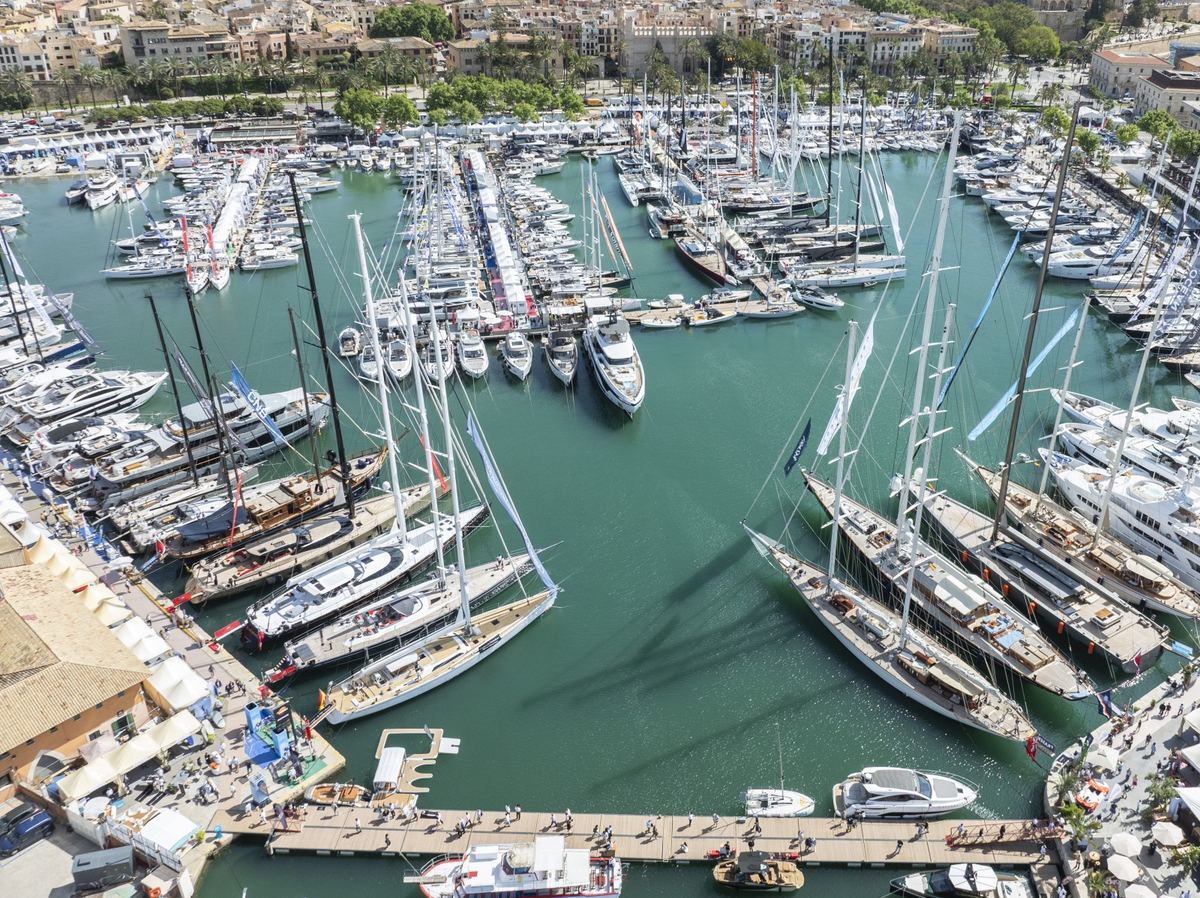
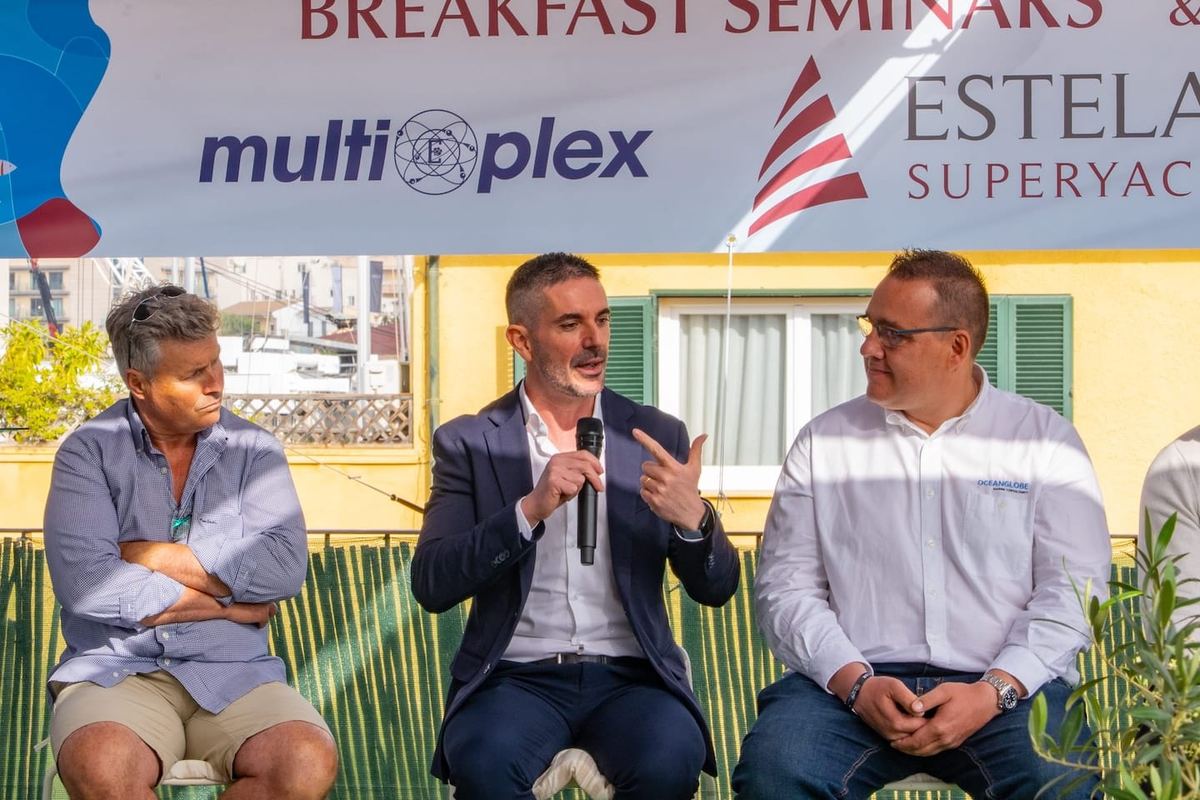
That contrast was the subject of one of the most substantive industry conversations held during Palma Boat Show week 2026. On Thursday 30 April, at Astilleros de Mallorca, Estela Shipping curated a 90-minute panel titled "Beyond the Buzzword: How AI is Actually Changing Superyacht Operations". Although the title focused on yachting, the conclusions apply, with very few amendments, to every commercial maritime sector — ferry, merchant shipping, port agency, and refit.
Luca Longo, Co-Founder of SupaSailing and SupaMaritime, took the panel stage with a single, deliberately uncomfortable claim that the audience of captains, brokers, marina managers and operators heard in silence:
The maritime industry today does not have an AI problem. It has a data problem. Until that is solved, what we currently call AI in this sector will remain a demonstration, not a product.
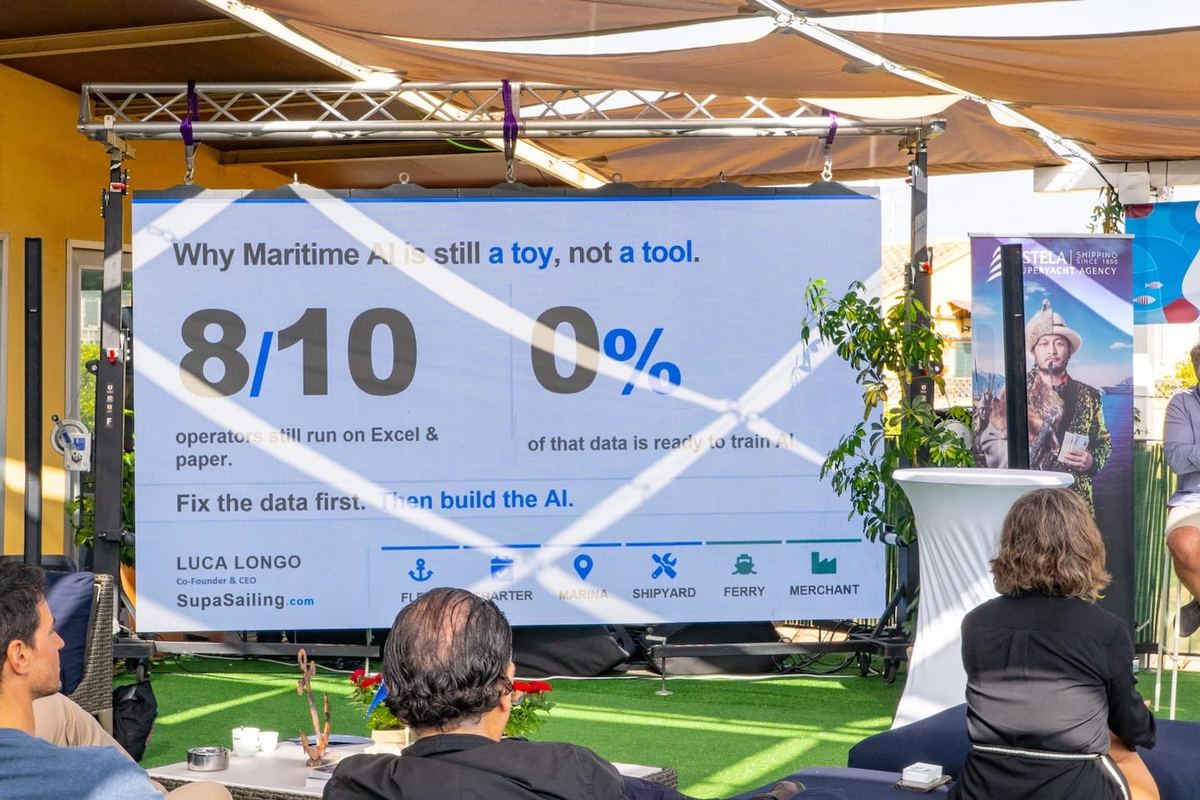
The Inconvenient Truth: 80% of Commercial Operators Still Run on Excel and WhatsApp
The principal competitor of professional maritime software today is not another platform. It is the combination of Excel, WhatsApp, email attachments, paper logbooks, and shared cloud folders managed by an inconsistent set of people. Ferry crews receive operational instructions through messaging apps. Engineers log maintenance on paper or in personal spreadsheets. Equipment manuals are stored as scanned PDFs in cloud drives that nobody owns. Compliance documentation is reconstructed under pressure when the next audit is announced.
Across commercial maritime, somewhere around eight out of ten operators still work this way. None of that information is structured. Almost none of it is searchable. Effectively zero percent of it is ready to train, fine-tune, or even reliably ground a large language model.
This is not a criticism of the industry. The captains, chief engineers and shore-based teams who run these operations are extraordinarily competent. The systems they have inherited, however, are not. And no amount of AI sophistication can fix what is fundamentally an information architecture problem.
From Filing to Operational Data: The Distinction That Matters
Captain Mannie Avenia, speaking from his perspective as the master of MY Inception, made a point during the panel that should be repeated in every conversation about maritime AI: manuals on commercial vessels have been "digitised" for over a decade. They are PDFs. They sit on Dropbox. They are emailed back and forth. None of that, however, qualifies as digitisation in any meaningful operational sense.
True operational digitisation requires that documentation be:
- Linked to the specific equipment installed on a specific vessel, not stored as a generic library
- Connected to the maintenance and incident history of that equipment over its full lifecycle
- Searchable in natural language, including across the working languages of the crew
- Integrated with the operational workflows that surround it — work orders, drydock planning, compliance reporting
- Versioned and audit-logged, so that "who changed what, when and why" is recoverable on demand
Anything less is filing, not digitisation. And filing — however neatly organised — does not become artificial intelligence simply because a model has been pointed at it.
The Fragmentation Tax: Why Five Platforms Equals Zero Intelligence
If the data problem is the first wall, fragmentation is the second — and the two reinforce each other. Walk into any mid-sized commercial maritime operator today and you will find, on average, between four and six different software systems in daily use:
- One ERP for finance and procurement
- A separate CRM for charterers, agents, or commercial bookings
- A maintenance system bolted onto a sensor stack
- A crew management system, often with its own payroll module
- A document management or compliance tool
- And, almost always, a dense web of Excel files and WhatsApp groups holding together what the official systems do not
Each of those systems was reasonable in isolation. Together, they make AI structurally impossible. A predictive maintenance model that can read the sensor data but not the work-order history is blind. A compliance assistant that can read the certificates but not the crew rotation is misleading. A demand forecast that can see ferry bookings but not historical disruptions is a guess dressed up in a chart.
This is what we mean by the fragmentation tax: the cost an operator pays not in software licences, but in everything they cannot do because their data lives in five places with five different schemas, owned by five different vendors with five different roadmaps.
A unified operational platform is not a marketing preference. For AI, it is a precondition. The model only ever performs as well as the joinable surface area of the data it sits on.
The Cybersecurity Bill That Comes With Fragmentation
The conversation that followed Luca Longo's intervention turned, naturally, to security — and this is where the panel's composition paid off. Mario Soave of CleverFi made the case that the AI conversation in maritime cannot be separated from the cybersecurity one. The moment fleet operational data is centralised — and centralisation is, again, a precondition for any meaningful AI — a high-value target is created.

What is rarely said out loud, but should be, is that fragmentation is not a defence — it is a liability. Running operations across five vendors does not protect an operator's data; it multiplies the attack surface. Each vendor is a separate authentication boundary, a separate breach notification process, a separate incident-response timeline, a separate set of GDPR data-processing relationships, and a separate set of subprocessors the operator has never reviewed.
By contrast, a single, well-architected operational platform allows for:
- Tenant isolation by design, so one operator's data is logically separated from another's at the database level — not at the application layer, where mistakes are made
- Row-level access control, so a chief engineer sees the engine room, the captain sees the bridge, the agent sees only their port — without spreadsheets being emailed around
- Encryption in transit and at rest using current standards (TLS 1.3, AES-256), with key management that does not depend on individual employees
- A single audit log, immutable and time-stamped, that satisfies both internal governance and the documentary expectations of MLC 2006, the ISM Code, and increasingly the requirements of port state inspection regimes
- One Data Processing Agreement, one set of subprocessors, and one breach-notification chain — instead of five
This is, again, not an aesthetic preference for unified software. It is the practical answer to a question commercial maritime operators are now being asked, more often than they were three years ago, by their charterers, their flag states, their P&I clubs and their insurance providers: where, exactly, is your operational data, who has access to it, and what happens when one of those five vendors is breached?
What AI Actually Does Today in Commercial Maritime — When the Data Is Right
None of this is an argument against artificial intelligence. It is an argument for honesty about where it adds value today, given how far the underlying data infrastructure has actually been built. On a properly unified operational platform, several use cases are not speculative — they are deployable now:
- Compliance drafting. ISM, MLC and STCW documentation can be assembled from existing operational records in minutes rather than days, with human approval before anything is filed.
- Manual and procedure retrieval. A chief engineer can ask, in natural language, for the correct procedure on the specific equipment installed on the specific vessel, in the working language of the crew, in seconds.
- Cross-fleet pattern detection. With clean maintenance data across multiple vessels, real anomalies — bearings degrading earlier than the manufacturer's curve, pumps failing in correlation with a specific bunker source — become visible. No individual ship sees these patterns. A fleet does.
- Demand and disruption forecasting. For ferry and short-sea operators, route-level forecasting that combines historical bookings, weather, and operational constraints produces measurable improvements in load factor and fuel consumption.
- Back-office acceleration. As Alberto Tablón Vega of OceanGlobe Marine Consultancy emphasised on the panel, the most immediate, measurable returns from AI in maritime today are not on the bridge — they are in the administrative load borne by crews and shore-based teams. Reporting, port paperwork, and documentation are where time savings translate directly into operating margin.
What none of these use cases require is a leap of faith. They require clean, joined, structured data, and they require it to live somewhere a model can actually read it.
Voices from the Panel: Captains, Researchers, and the Reality Check
One of the reasons the Estela seminar stood out was the deliberate heterogeneity of the panel. Beyond Luca Longo and Mario Soave, the conversation included Captain Mannie Avenia, Alberto Tablón Vega (OceanGlobe Marine Consultancy), and Professor Claudio Gallicchio of the University of Pisa, with Jens Oomes, publisher of The Islander Magazine, in the moderator's chair.

Professor Gallicchio's contribution gave the discussion its needed academic discipline. Large language models are, in his framing, exceptionally capable at pattern recognition and language generation; they are not, in any meaningful technical sense, reasoning. When a vendor promises that AI will "predict" engine failures, what is actually being described is a statistical model trained on sufficiently clean data — useful, real, and economically valuable, but neither magical nor a substitute for human expertise. Bridging academic research and industrial application remains a frontier that, in maritime specifically, very few organisations are crossing with rigour.
Captain Avenia, for his part, returned the conversation, repeatedly, to the operational reality of life at sea: the gap between technological promise and daily routine remains significant, and earning a captain's trust requires far more than a product demonstration. That message is one every commercial maritime software company should hear before adding another AI feature to a roadmap.

The Decade Ahead: From Vessel-Level to Fleet-Level Intelligence
Several conclusions emerged from Astilleros de Mallorca that are worth retaining well beyond the Boat Show week.
First, the maritime sector is now ready for an adult conversation about artificial intelligence. The audience of captains, brokers, marina managers, owners and suppliers in Palma was not asking to be sold to. It was asking to understand what works, what does not, and why. That shift in tone is significant — and overdue.
Second, the industry does not need additional vendors of hype. It needs partners who do the unglamorous work: integrating with existing equipment manufacturers, normalising data across fragmented systems, designing for the security architecture that fleet-level data demands, and building tools that fit the workflows of the people who actually operate vessels.
Third — and this is the strategic point — the next decade in commercial maritime technology will not be won by the company with the most sophisticated AI model. It will be won by those who build the cleanest, most standardised operational data infrastructure underneath. Once that infrastructure exists, predictive maintenance across fleets becomes possible. So does anonymised benchmarking, sector-specific model development, and entirely new commercial relationships — with insurers, P&I clubs, regulators, and equipment manufacturers — that today simply cannot be supported.
What This Means for Operators Choosing a Platform Today
If you operate a ferry company, a merchant fleet, a port agency, a marina, or a yard, the practical implication of all this is straightforward. Before you ask a vendor "what AI do you have?", ask three earlier questions:
- Where will my operational data live? One platform, or scattered across five subprocessors? If scattered, who is responsible for joining it? (Hint: it will be you, on Excel.)
- What is the security and compliance posture of that platform? SOC 2 Type II, ISO 27001, GDPR-aligned, EU-hosted, with row-level access control and a single auditable log? Or a patchwork that nobody in the company can describe in one sentence?
- What does the data look like once it is on the platform? Is it structured, joinable, exportable, owned by you and portable on demand? Or is it locked into a vendor format with no clean exit?
If the answers to those three questions are sound, AI follows almost as a consequence. If they are not, no AI on top of that mess will hold up to operational scrutiny — and certainly not to the scrutiny that flag states, port authorities, charterers and insurers are starting, finally, to apply.
That is the work SupaMaritime is engaged in across its commercial modules — ferry, merchant shipping, and port agent — and that its sister brand SupaSailing pursues across yachting, brokerage, charter, refit and marina operations. Not artificial intelligence as a feature on a roadmap, but operational infrastructure as the foundation that makes AI honest in the first place.
Acknowledgements
Our thanks to Estela Shipping for curating one of the most substantive industry conversations of Palma Boat Show week 2026, and for the level of preparation that distinguished the seminar from the surrounding noise. Particular recognition goes to Jens Oomes and Sara Intonti for the editorial care brought to the framing and moderation of the panel, and to the team at The Islander Magazine for their continued role as a thoughtful editorial voice in the sector.
You can read more about SupaMaritime's approach to operational infrastructure on our Security & Trust page, and explore the modules powering ferry, merchant and port-agent operations on the Modules overview.
Lecturas adicionales
Donde encaja SupaMaritime
Los temas tratados arriba — datos fragmentados, presion regulatoria, coste creciente de la ambiguedad operativa — convergen siempre en el mismo destino. Los operadores que consolidan flota, agencia, ferris y merchant detras de una unica capa de datos auditada recuperan el ancho de banda que sus equipos gastan en reconciliacion, y ofrecen a auditores y fletadores una historia coherente en lugar de una pila de exports. Nuestros modulos estan disenados para esa consolidacion, con identidad compartida, logging unificado y una postura de seguridad documentada en la pagina security, para que procurement y la sociedad de clasificacion puedan revisarlos sin una llamada al proveedor.
Si estas evaluando por donde empezar, recomendamos mapear el sprawl de plataformas actual frente a las areas operativas que realmente controlas — fleet, agency, ferry, merchant — y tratar cada sistema duplicado como candidato a sustitucion en la proxima renovacion. La decision rara vez es sobre features aisladas. Es sobre si tus datos, tu audit trail y tus obligaciones viven en el mismo lugar. Es la conversacion que mantenemos cada semana con clientes nuevos, y la que este articulo se escribio para sostener.