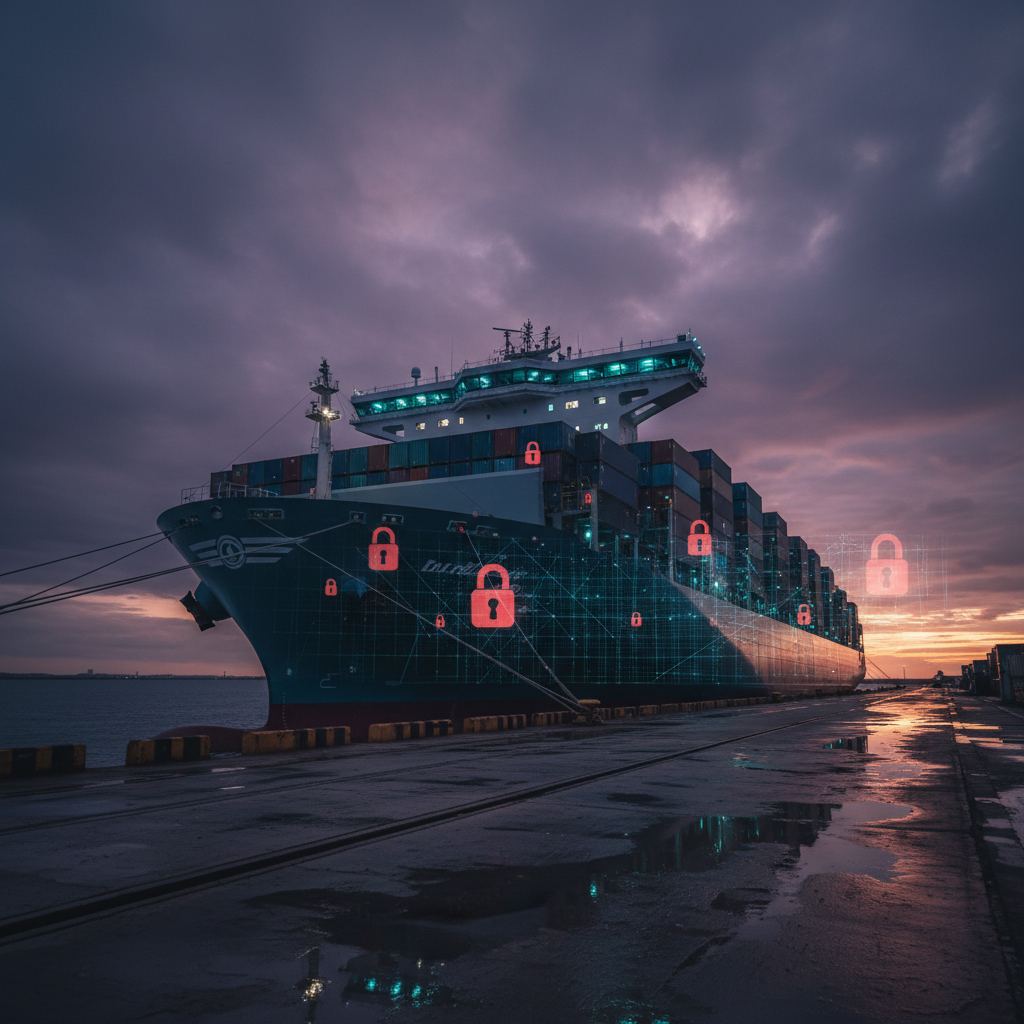
Maritime Cybersecurity: Why Commercial Shipping Has Become a Top Ransomware Target
Commercial shipping moves roughly four-fifths of world trade, runs on thin margins, and increasingly depends on software that connects ship and shore in real time. That combination is exactly what attackers look for: high-value targets, time-sensitive operations, and digital estates that grew faster than the security teams meant to defend them. The result is predictable. Over the past decade, every major container line has been forced to publicly disclose a serious cyber incident, and ransomware crews have moved from opportunistic intrusions to coordinated campaigns that specifically map fleet IT and operational technology.
This is not a story about exotic threats. It is a story about basic hygiene applied unevenly across a fragmented industry, where a single mailbox in a port office can become the first hop into a vessel's planning system. If you operate ferries, run a merchant fleet, or manage agency networks across ports, the work in front of you is not glamorous. It is unfinished.
The Threat Surface Has Quietly Doubled
Ten years ago, the shipboard attack surface was thin: an ECDIS workstation, a few engineering laptops, an aging satellite link. Today the picture is closer to a small enterprise floating at sea. Modern vessels combine integrated bridge systems, networked engine and cargo monitoring, crew Wi-Fi, VSAT and LEO connectivity, biometric access points, vendor remote-maintenance portals, and an expanding list of IoT sensors feeding shore analytics.
Ashore, the picture is similar. Port agents juggle PortNet, customs portals, banking platforms, and dozens of email threads per call. Fleet headquarters connect ERP, crewing, planned maintenance, chartering, voyage analytics, and CRM, often via an accumulated stack of SaaS contracts. Every integration is a doorway. Every doorway has a key. In most operators we speak with, no single person has a current inventory of who holds those keys.
The OT side deserves particular attention. Engine control systems, ballast water management units, cargo handling controllers, refrigeration monitors and even fire and life-safety systems increasingly speak IP. Many were designed in an era when a serial cable was the worst-case attack vector and software updates arrived once a decade. Patching is slow, vendor support windows are long, and a misapplied update can trigger a Port State Control finding. None of that excuses the gap, but it explains why pure-IT security teams who parachute into a vessel often miss the point. Maritime cyber demands engineers who understand both the network and the engine room.
If you cannot list, in one screen, every system that touches your fleet's data and every third party with credentials to it, you do not have a security program. You have hope.
What the Frameworks Actually Require
Regulators are no longer suggesting. IMO Resolution MSC.428(98), in force since 1 January 2021, requires cyber risk to be addressed within each ship's Safety Management System under the ISM Code. Flag and port state inspectors now expect documented evidence: risk assessments, procedures, drills, and corrective actions, not a one-page policy filed at the office.
IACS Unified Requirements UR E26 and E27 raised the bar for new builds. UR E26 covers the cyber resilience of ships at the systems integration level, and UR E27 addresses the cyber resilience of onboard systems and equipment. Both apply to ships contracted for construction on or after 1 July 2024, which means the first vessels delivered under these rules are entering service this year. Inspectors and class surveyors are still calibrating what good looks like, but the direction is unambiguous: cyber resilience is a design property, not a bolt-on.
The European Union has tightened the screws further. The NIS2 Directive treats maritime transport as critical infrastructure, with national transpositions in force across member states. Operators of essential services, including many ferry operators, terminals, and shipowners with EU exposure, face mandatory incident reporting timelines, supply-chain due diligence, and personal liability for management bodies. Add GDPR for crew and passenger data, SOLAS for safety-related systems, and ISO 27001 as the de facto information security baseline expected by charterers and insurers, and the compliance map starts to look like the navigation chart it should be.
How Attacks Actually Unfold
The pattern repeats. According to public disclosures, the 2017 NotPetya event cost A.P. Moller-Maersk roughly three hundred million dollars and forced a near-complete reinstall of the group's IT estate. MSC publicly reported a network outage in 2020 that took its booking systems offline for days. COSCO disclosed a 2018 incident affecting US operations, and CMA CGM acknowledged a ransomware attack in late 2020. None of these companies are negligent. They were targets because they were valuable and connected.
The intrusion paths are not exotic. In our experience, four account for most serious incidents:
- Phishing into ransomware. A finance or chartering inbox receives a credible-looking invoice or BIMCO-style document. One click, credentials harvested, lateral movement, encryption. The vessel side is reached through shared file servers or VPN trust.
- USB-borne malware on the bridge. Chart updates, passage plans, and vendor patches still travel by removable media in too many fleets. An infected USB pushed into an ECDIS workstation in a port lounge is a 2010 problem that keeps shipping in 2026.
- ECDIS and AIS spoofing. Demonstrated in academic and naval research, and now seen in the wild near contested waters. A spoofed position or false target stream is not just a navigation hazard. It is an operational deception that can be combined with other intrusions.
- Supply-chain compromise. A maintenance vendor with remote access to engine monitoring, a chandler portal, a class society file exchange. Trust extended without segmentation becomes the attacker's preferred path.
Two trends sit on top of this list and matter operationally. First, dwell time has shortened. Where attackers used to sit quietly for weeks before triggering encryption, modern affiliates often move from initial access to ransom note in under 48 hours, sometimes under 12 when the target is clearly time-sensitive. Second, double extortion is now the norm: data is exfiltrated before it is encrypted, so even a clean restore from backup leaves the operator facing a public leak threat. For a ferry operator with a passenger booking database or a fleet manager with seafarer documents, that changes both the legal exposure and the conversation with the regulator.
Controls That Move the Needle
The defensive playbook is well known. The reason it does not get implemented is not technical. It is organisational: cyber sits between IT, the DPA, the technical superintendent, and a procurement team that picks the cheapest VSAT contract. Ownership has to be unambiguous, and the controls below have to be funded as line items, not absorbed into existing budgets.
- Network segmentation, ship and shore. The bridge LAN, the engine network, the crew Wi-Fi, and the business LAN must be distinct broadcast domains with enforced policies between them. Flat networks are indefensible.
- OT and IT separation with documented data diodes. Where data must flow from OT to IT, it should flow one way, through audited channels, never through a flat VPN that also carries email.
- Endpoint detection and response on every workstation that can run it. Yes, including bridge and engine PCs where the vendor allows. EDR will not save you alone, but its absence guarantees you will learn about an incident from the encryptor's note.
- Multi-factor authentication on every external service, no exceptions. Crew portals, port community systems, banking, email, vendor admin consoles. MFA prevents the credential-replay attacks that drive most ransomware entry today.
- Vendor isolation and least privilege. Remote maintenance access should be just-in-time, time-bounded, logged, and limited to the equipment under contract. The default of permanent VPN tunnels into engine rooms must end.
- Tested incident response and tabletop exercises. A plan that has never been rehearsed is not a plan. Run scenarios that include a vessel offline mid-voyage, a port agent unable to invoice, and a charterer demanding answers within hours.
- Backups that are immutable and recoverable. Air-gapped or write-once copies of voyage data, planned maintenance records, crew documents, and financial systems. Test the restore. Most operators discover their backups are unusable only after they need them.
Why Platform Choice Is Now a Security Decision
Most fleets we audit run between five and fifteen separate vendors across chartering, voyage management, crewing, planned maintenance, agency, and analytics. Each integration is a credential, a webhook, a service account, and a contract. Each adds attack surface and weakens the operator's bargaining position when an incident happens.
A modern unified maritime platform should reduce this entropy by collapsing core operational functions behind a single identity model, a single audit trail, and a single security posture. The right platform should provide enforced MFA, role-based access control, immutable activity logging, encrypted data at rest and in transit, regional data residency where required, and clear contractual commitments on incident notification and supply-chain diligence. None of this is exotic. What is rare is having it all under one roof rather than reconstructed across five vendor portals.
Consolidation is not a magic wand. A single platform can still be misconfigured, and concentration risk is real. But a smaller, better-managed surface is materially easier to defend than a sprawl no one fully understands.
What Changes in 2026 and Beyond
Three shifts are already reshaping the conversation. First, the IACS UR E26 and E27 deliveries arriving this year set a higher baseline that will, over time, propagate to retrofits and to charterers' vetting questionnaires. Second, NIS2 enforcement is becoming concrete, with national authorities issuing first guidance and, in some jurisdictions, first fines. Expect cyber due diligence to become a standard clause in charter parties and management agreements. Third, insurers are pricing differently. War-risk and cyber exclusions are tightening. Operators that cannot demonstrate basic controls are seeing premiums rise and coverage narrow.
A fourth shift, less discussed, is the human one. The pool of seafarers and shoreside staff comfortable with both the maritime and the digital sides of the job is small, and recruiting against tech firms is brutal. Operators that win this decade will be the ones who train technical superintendents and DPAs to read a network diagram, who treat the master's role as including basic OT awareness, and who give cadets a serious cyber module before their first watch. Procurement teams matter too. The lowest-bid VSAT or ECDIS vendor is rarely the most secure one, and the procurement spreadsheet must start carrying security weighting alongside price and bandwidth.
The honest summary is that cybersecurity has moved from an IT topic to a commercial topic. It now affects vetting, insurance, port acceptance, and bank financing. The operators who treat it that way will outcompete those who keep it parked in a spreadsheet.
A Realistic Starting Point
If you are reading this with a knot in your stomach, the path forward is not heroic. Start with three things this quarter. Build a complete inventory of systems, third parties, and credentials. Enforce MFA everywhere and rotate dormant accounts. Run a tabletop exercise with your DPA, IT lead, and one master, with a scenario realistic to your trade. The point is not perfection. The point is to remove the easiest paths an attacker would take this week.
SupaMaritime is built around the assumption that fleet, agency, and ferry operations should share one secure backbone rather than a federation of point tools. Our Ferry, Merchant and Agent modules sit on a common identity and audit layer, and our dedicated Security page documents the controls, certifications, and shared-responsibility model in plain language. If you are mapping your platform decisions against your obligations under MSC.428(98), UR E26/E27, and NIS2, our modules overview is a useful place to compare scope side by side. The decisions will still be yours. The surface should be smaller.