Dry Docking Commercial Ships: Planning, Surveys and Cost Control
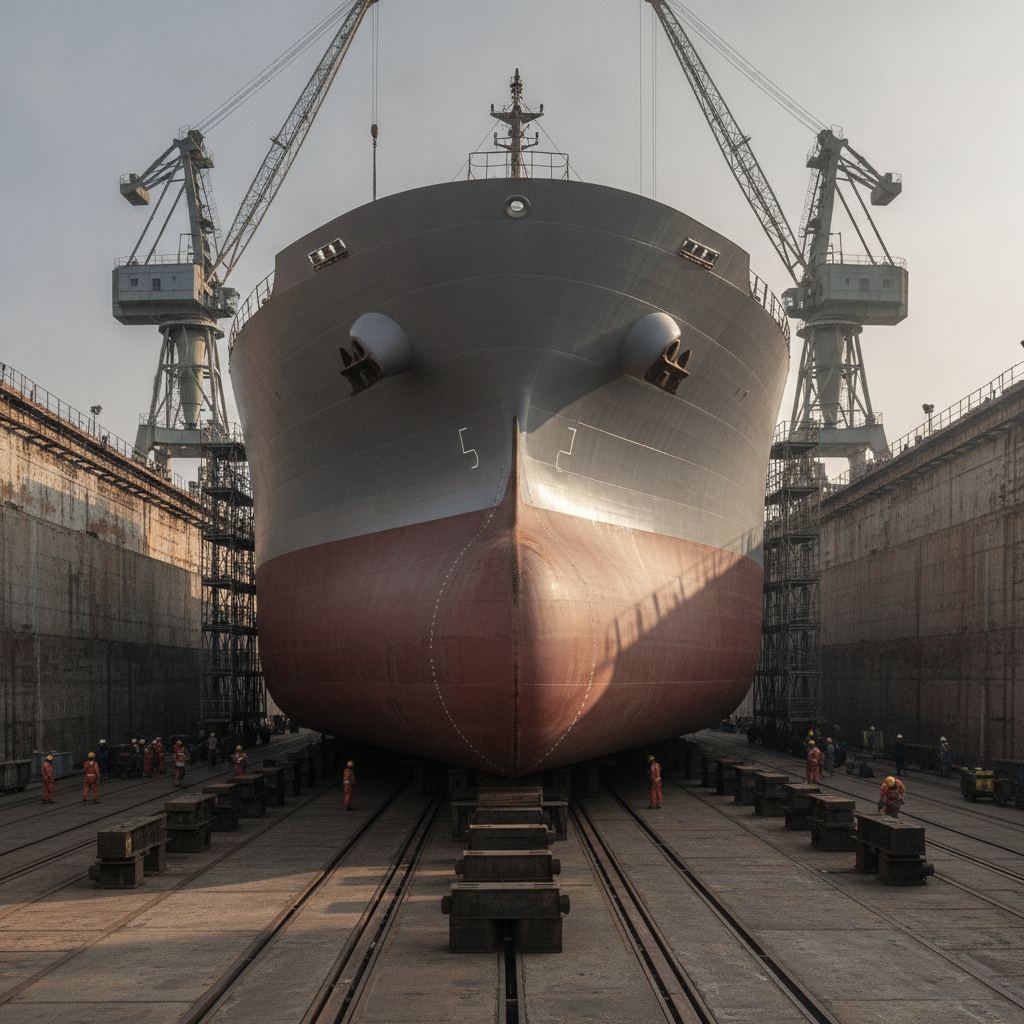
Every commercial ship has to come out of the water on a regular schedule. For a few weeks the vessel sits on keel blocks, the hull is exposed, and hundreds of jobs that cannot be done afloat are carried out against a fixed deadline.
Dry docking is one of the largest single expenses in a ship's operating life. It combines yard invoices, spare parts, class surveys and, above all, off-hire time, when the ship earns nothing.
This guide explains when a ship must dry dock, what happens in the dock, how technical managers plan a docking twelve to eighteen months ahead, and where budgets usually go wrong. It is written for superintendents, technical managers and owners of bulk carriers, tankers, container ships and offshore vessels.
A dry docking is won or lost before the ship arrives at the yard. The specification, the spares and the data from the last docking decide the final bill far more than the negotiation on the daily dock rate.
What Dry Docking Is and Why Ships Need It
Dry docking means bringing a ship out of the water so that the underwater hull, propeller, rudder and sea connections can be inspected and repaired. Some of this work is impossible afloat, and some of it is simply far cheaper to do in the dry.
Three types of facility are common in commercial shipping:
- Graving dock. A basin dug into the shore. The ship enters, the gate closes and the water is pumped out until the hull settles on prepared blocks.
- Floating dock. A large U-shaped pontoon that is ballasted down, receives the ship, and then deballasts to lift it clear of the water.
- Shiplift or slipway. Used mainly for smaller vessels such as offshore supply ships, tugs and short-sea tonnage.
Whatever the facility, the principle is the same. The ship is out of service, the clock is running, and every day in dock carries both a yard cost and a commercial cost.
When a Ship Must Dry Dock: The Regulatory Clock
Owners do not choose freely when to dock. The interval is driven by SOLAS, by the ship's classification society and by the flag state, which together define a survey cycle that repeats every five years.
For cargo ships, SOLAS requires a minimum of two inspections of the outside of the ship's bottom in any five-year period, with no more than 36 months between any two of them. One of these inspections coincides with the renewal survey.
Within the five-year class cycle, the main survey milestones are:
- Annual surveys, carried out within a window around each anniversary of the certificate.
- Intermediate survey, held around the second or third anniversary, which usually includes a bottom inspection.
- Special survey, also called the renewal survey, at the end of the five-year cycle. It is the most extensive and always involves a docking.
Bulk carriers, oil tankers and chemical tankers are also subject to the Enhanced Survey Programme. As ships age, it requires more extensive thickness measurements and close-up surveys of structure, which increases both the work scope and the time needed in dock.
Can an in-water survey replace a docking?
In many cases the intermediate bottom inspection can be carried out as an in-water survey, using divers or remotely operated vehicles, instead of a full docking. Class societies allow it subject to conditions, typically related to ship age, hull coating and survey notation.
An in-water survey saves a docking, but it does not remove the need for one. It moves the next docking to the renewal survey, which then carries the full accumulated work scope.
What Actually Happens in the Dock
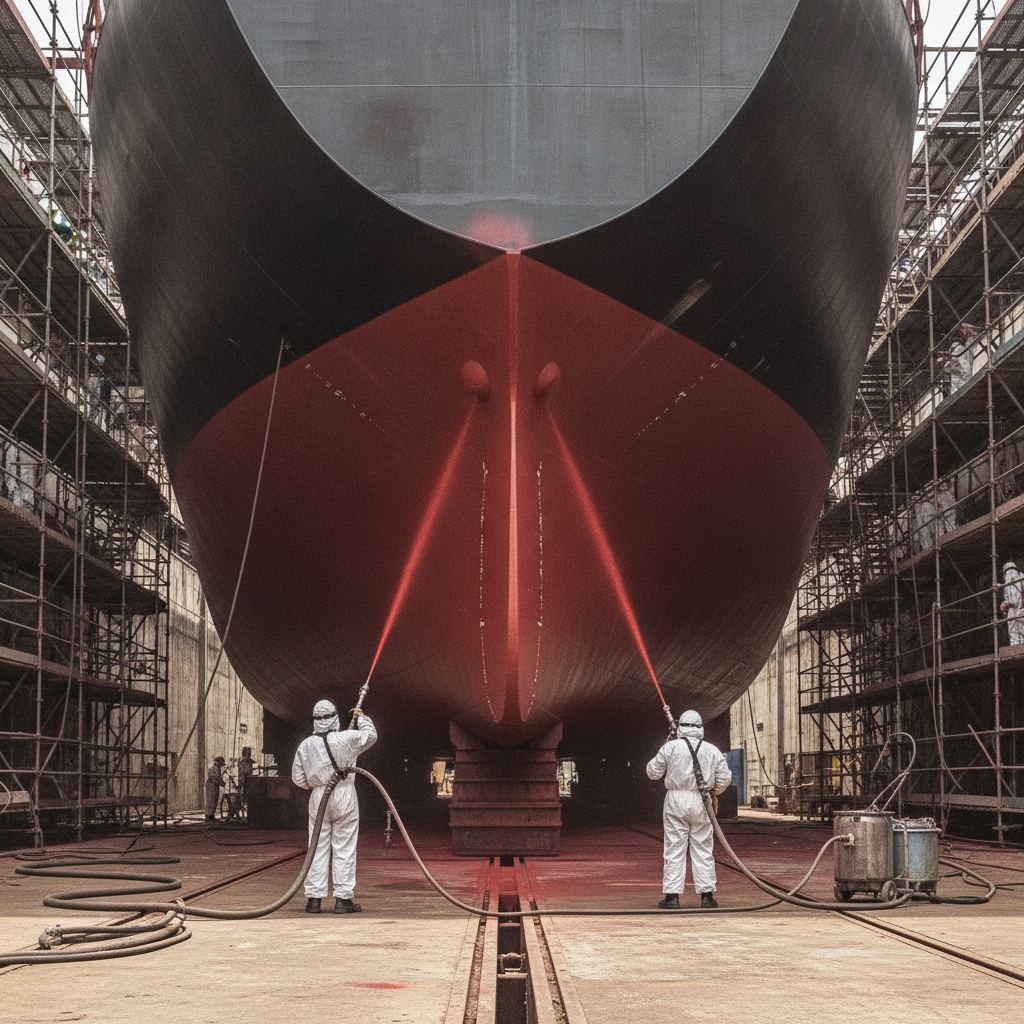
A routine commercial docking combines statutory survey items with maintenance that has been deferred until the ship is out of the water. The core scope is remarkably consistent across ship types.
- Hull cleaning, blasting and coating. Removal of fouling, surface preparation and application of anticorrosive and antifouling systems.
- Sea chests and sea valves. Opening, cleaning and overhaul of the valves that connect the hull to the sea.
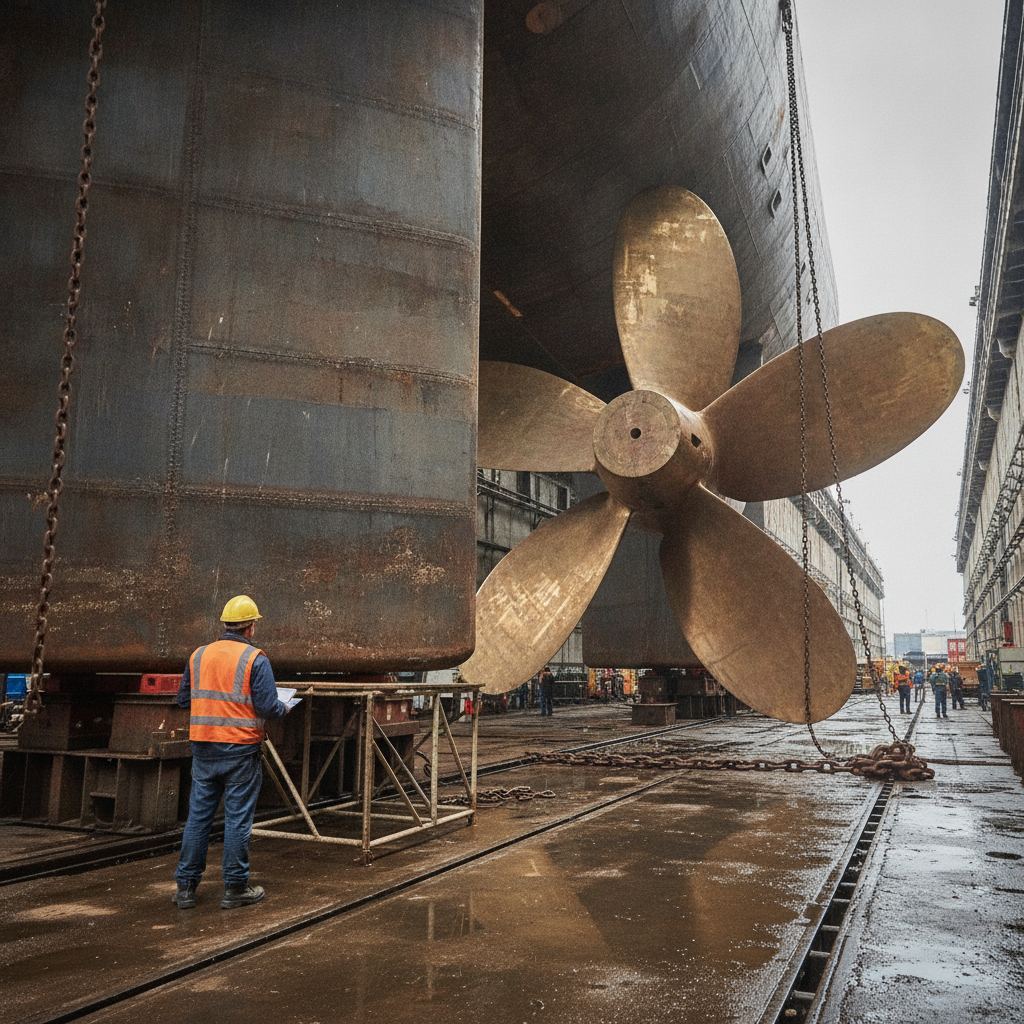
- Propeller and rudder. Propeller polishing, rudder bearing clearances and pintle checks.
- Tailshaft and stern tube. Clearance measurements, seal inspection and, when due, tailshaft withdrawal.
- Anchors and chain cables. Ranging the chain, measuring wear and inspecting the chain locker.
- Cathodic protection. Renewal of sacrificial anodes and checks of impressed current systems.
- Tanks and structure. Inspection of ballast and cargo tanks, thickness gauging and steel renewal where required.
On top of this baseline, many dockings now include retrofits: ballast water treatment systems, energy-saving devices, hull air lubrication or new coatings chosen for their effect on fuel consumption.
Retrofits change the planning completely. They bring engineering drawings, class approval, long-lead equipment and specialist contractors into a schedule that was designed around routine work.
Planning a Dry Docking: The 18-Month Timeline
Technical managers who dock ships well treat the docking as a project, not an event. The work starts long before the ship sails for the yard.
12 to 18 months before
The superintendent confirms the survey window, decides whether an in-water survey is possible, and sets a first budget. The commercial department is told when the ship will be off-hire, so that the docking can be matched with the trading pattern.
6 to 12 months before
The repair specification is written and sent to shortlisted yards. Deferred maintenance jobs, class recommendations and condition findings from the crew are collected into a single work list.
3 to 6 months before
The yard is selected, long-lead spares are ordered, and class and flag attendance is arranged. Coating makers, service engineers and specialist contractors are booked for exact dates.
During the docking
The owner's superintendent is on site. Daily progress meetings with the yard track the schedule, and every additional job is agreed in writing before it starts.
After the docking
A close-out report records what was done, what was found, what it cost and what was deferred. This report becomes the starting point for the next docking.
Writing the Repair Specification: The Document That Decides the Bill
The specification is the contract basis for the whole docking. A vague specification produces vague quotes, and vague quotes produce variation orders once the ship is in dock and the owner has no leverage left.
A good specification item is precise enough for a yard to price it without guessing. It usually contains:
- Location and scope, referenced to drawings and frame numbers.
- Quantities, such as square metres of coating, kilograms of steel or number of valves.
- Condition evidence, including photos, thickness measurements and findings from the last docking.
- Who supplies what: owner-supplied spares, yard-supplied materials and third-party services.
- Acceptance criteria, meaning the standard the work must meet and who signs it off.
The quality of the specification depends almost entirely on the quality of the ship's maintenance records. If the planned maintenance history is incomplete, the specification is built on assumptions, and assumptions are expensive in a shipyard.
Choosing the Yard and Comparing Quotes
Yard quotes are rarely comparable at first sight. Each yard structures its tariff differently, and the lowest total on the first page is often not the lowest final cost.
To compare quotes on a like-for-like basis, technical managers normally look at:
- Dock days and berth days, and the daily rate for each.
- Unit prices for steel renewal, blasting and coating per square metre, and pipe work.
- Deviation cost: the fuel, time and port costs of reaching a yard that is off the ship's normal route.
- Yard capacity and track record with the same ship type and size.
- Terms for extra work, delays caused by the yard, and warranty on coatings and repairs.
A yard that is slightly more expensive but delivers on schedule frequently beats a cheaper yard that adds five days of off-hire. For a ship on a profitable charter, those extra days can cost more than the entire price difference.
Where Dry Docking Budgets Go Wrong
Few dockings finish exactly on budget. The overruns, however, tend to come from the same small set of causes.
- Growth work. Steel, piping or valves found in worse condition than expected once opened up.
- Unpriced extras. Jobs added on site without an agreed price, often under time pressure.
- Missing spares. Parts that were not ordered in time, forcing extra days in dock or costly air freight.
- Schedule slippage. Weather, yard congestion or late contractors extending the stay.
- Off-hire overrun. The commercial cost of every extra day, which is often larger than the yard bill itself.
A realistic budget includes an explicit contingency for growth work, sized from the ship's age and the findings of previous dockings rather than a flat percentage.
Coating decisions deserve particular attention. The choice of hull coating affects fuel consumption for the next five years, and with it the ship's emissions reporting. Our guide to CII, EEXI, FuelEU and EU ETS in operational practice explains why hull condition now shows up in regulatory ratings, not only in the bunker bill.
The Data That Makes the Next Dry Docking Cheaper
The best preparation for a docking is not a spreadsheet assembled in the last three months. It is the data the ship and the office have been recording since the previous one.
- Planned maintenance history. Which jobs were completed, which were deferred to the docking, and why.
- Class status. Open conditions of class, recommendations and survey due dates in one view.
- Condition findings. Crew reports, photos and measurements collected during the cycle.
- Hull and propeller performance. Trends that show how fast fouling is building up.
- Spares and procurement. Stock levels and lead times for parts that the docking will consume.
When this information lives in separate spreadsheets and email threads, every docking starts from scratch. When it lives in one system, the specification almost writes itself.
Performance data is particularly valuable here. A clear trend in speed loss is often the strongest argument for or against a full hull treatment, as described in our article on vessel performance monitoring. Condition-based methods can also refine what really needs opening up, a topic we cover in predictive maintenance ROI in merchant shipping.
Dry docking is also where maintenance and safety management meet. Maintenance of the ship and its equipment is a formal requirement of the safety management system, as explained in our guide to the ISM Code in practice.
Frequently Asked Questions
How often does a commercial ship go into dry dock?
Most cargo ships dock twice in every five-year survey cycle. SOLAS requires at least two inspections of the outside of the bottom in five years, with no more than 36 months between them. One of them can often be replaced by an in-water survey, subject to class conditions.
What is the difference between an intermediate survey and a special survey?
The intermediate survey takes place around the second or third anniversary of the class certificate and is less extensive. The special survey, or renewal survey, closes the five-year cycle, covers the full structure and machinery scope, and always requires the ship to be docked.
How long does a dry docking take?
A routine commercial docking typically lasts one to three weeks in the yard. Special surveys on older ships, heavy steel renewal and major retrofits can extend the stay considerably, which is why the off-hire estimate must be built from the work scope.
What drives the cost of a dry docking?
The main cost drivers are hull preparation and coating, steel renewal, dock days, spares and service engineers, and the off-hire period. Growth work discovered on site and extra jobs agreed without a price are the most common causes of overruns.
How can owners reduce dry docking costs?
By writing a precise specification from reliable maintenance records, ordering long-lead spares early, comparing yard quotes on a like-for-like basis including deviation and off-hire, and agreeing every extra job in writing before work starts.
SupaMaritime's Merchant module brings planned maintenance, dry-dock scheduling and class requirements tracking into the same system that runs voyages, crew and compliance. To see how it supports technical management, explore the Merchant module, its full feature list, and our pages for bulk carrier operators and tanker operators.