Ship Agent: Role, Duties and Types of Shipping Agents
No ship calls at a port on its own. Behind every arrival there is a ship agent on the ground who books the pilot, clears the vessel with the authorities, pays the local suppliers and keeps the principal informed until the ship has sailed again.
The job looks simple from the outside. Yet a single port call can involve customs, immigration, port health, the harbour master, the terminal, towage companies, chandlers and the crew. A good shipping agent turns that crowd of parties into one reliable line of communication for the owner or charterer.
This guide explains what a ship agent does, who appoints one, the different kinds of ship agency, how a port call runs from appointment to final accounts, and how principals judge whether their agents perform. It is written for operators, chartering and claims teams, masters and anyone new to port agency work.
A ship agent is the principal's eyes, hands and wallet in a port. The quality of a port call depends less on the port itself than on how early, how accurately and how transparently the agent communicates.
What Is a Ship Agent and Who Appoints One?
A ship agent is a person or company that represents a ship and its principal during a port call. The agent acts in the name and on behalf of the principal, arranging services, dealing with authorities and handling port costs that would otherwise have to be managed from a distant office.
The principal is not always the same party. The shipowner, the ship manager, the commercial operator and the charterer can all appoint agents, and sometimes more than one of them appoints an agent for the same call.
Under a time charter, the charterer usually appoints and pays the agent for cargo and port matters, because the charterer bears the port costs. The owner remains responsible for the ship itself, its crew and its technical condition.
Under a voyage charter, the owner normally pays the port costs, but the charter party often gives the charterer the right to nominate the agent at the loading or discharging port. Charterers want an agent who knows their cargo, their terminal and their receivers.
Nominated agent versus protecting agent
When the agent is chosen by the charterer, it is called a nominated agent. It still acts for the owner in many respects, but the owner may worry that its interests on laytime, damage or cargo claims are not fully looked after.
For that reason the owner may appoint a second agent in the same port, the protecting agent. The protecting agent does not run the port call. It monitors it, checks documents such as the statement of facts, and reports independently to the owner.
Types of Ship Agency: Port, Liner, Husbandry, Protecting and Hub Agents
The term "ship agent" covers several distinct roles. One agency company may offer all of them, but the scope of work, the principal and the fee change from one role to the next.
- Port agent. The classic role in tramp shipping: attending a specific call, arranging arrival and departure, clearance, cargo operations and the disbursement account.
- Liner agent. Represents a liner shipping company in a port or country on a continuous basis, often handling bookings, bills of lading, container equipment and local customer service as well as the vessel calls.
- Husbandry agent. Looks after the owner's matters that are not related to cargo, such as crew changes, spare parts, cash to master, medical cases, surveys and repairs.
- Protecting agent. Appointed by the owner to supervise a call handled by the charterer's nominated agent and to safeguard the owner's position.
- Hub agent. A single point of contact that coordinates agency services across a region or a group of ports, appointing and supervising local sub-agents and consolidating costs and reporting.
- Cargo agent. Acts for cargo interests such as shippers or receivers, attending loading or discharge, monitoring quantities and liaising with terminals and surveyors.
Hub agency has grown because large operators prefer one relationship and one set of standards instead of dozens of separate local contacts. A hub agent is only as good as its network, however, so the principal still needs visibility of what happens in each port.
Protecting and husbandry roles often overlap in practice. On a time-chartered ship, the owner's husbandry agent frequently acts as protecting agent too, because it is already in the port to handle crew and spares.
The Port Call Lifecycle, Step by Step
Every port has its own rules, but the sequence of a well-run port call is remarkably consistent. The agent's work begins days or weeks before the ship arrives and ends only when the final accounts are settled.
1. Appointment and pre-arrival
The call starts with the appointment, when the principal instructs the agent and confirms who pays for what. The agent replies with a proforma disbursement account, local restrictions, draft and berth information, and the list of documents the authorities will require.
The agent then collects the pre-arrival information from the ship and from the principal. Typical items are:
- ETA and ETA updates. Usually sent at fixed intervals, such as 72, 48 and 24 hours before arrival, and whenever the estimate changes.
- Crew and passenger lists. With passport, visa and seafarer identity document details for everyone on board.
- Cargo documents. Manifests, dangerous goods declarations and stowage information for the terminal and customs.
- Health and security declarations. For example the Maritime Declaration of Health and the ISPS pre-arrival security information.
- Certificates and port-specific data. Ship's certificates and any details on stores, waste or ballast water the port asks for.
Many of these declarations follow the standard forms of the IMO Facilitation Convention, and more and more ports accept them only electronically. Our article on maritime single window and port clearance explains how that submission works in practice.
2. Arrival: pilot, tugs, berth and linesmen
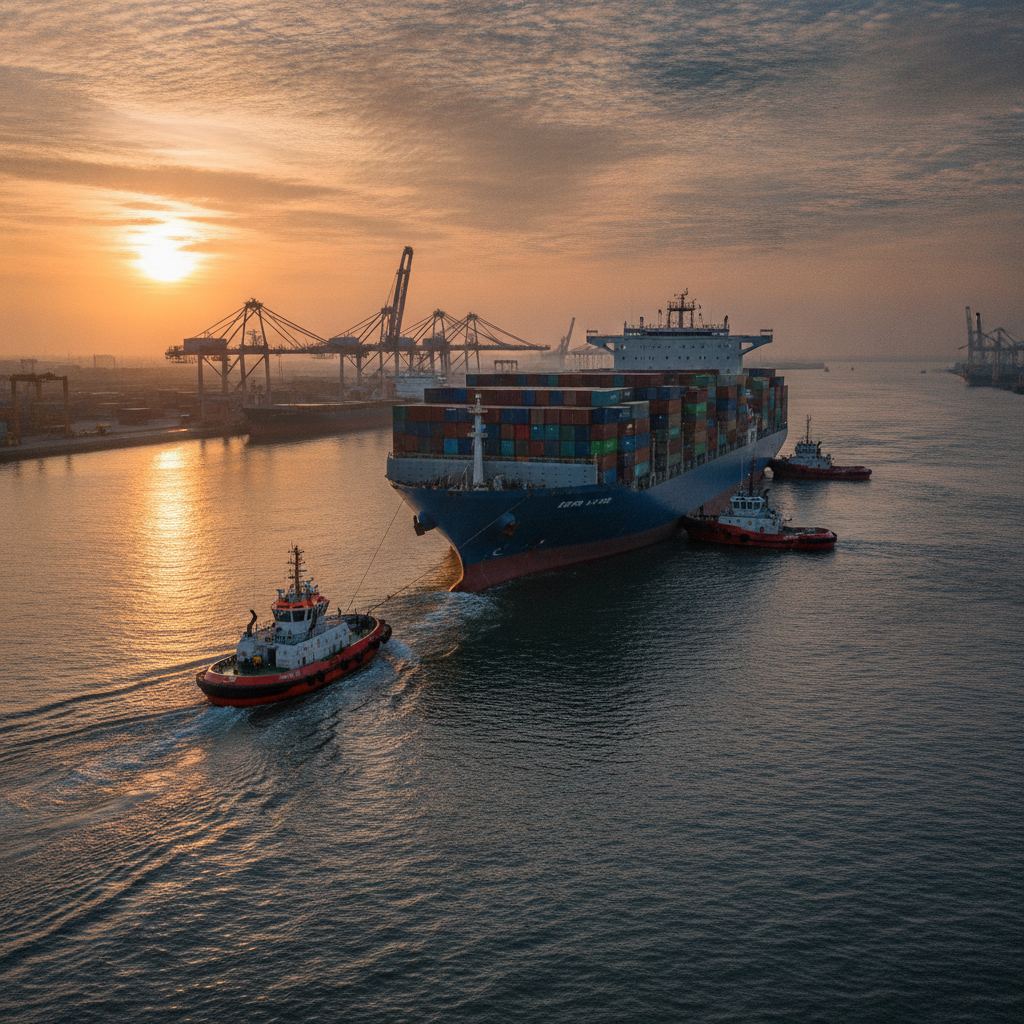
As the ship approaches, the agent confirms the berth with the terminal and the harbour master, and orders pilots, tugs and mooring gangs for the right time. If the berth is not free, the agent arranges an anchorage and keeps the principal updated on berthing prospects.
The master tenders the notice of readiness when the ship has arrived and is ready to load or discharge. The agent passes it to charterers, shippers or receivers as instructed, because the time it was tendered and accepted can decide laytime and demurrage later.
3. Clearance with the authorities
Inward clearance means obtaining permission from each authority for the ship to operate in port. Depending on the country, this involves customs, immigration or border police, port health for free pratique, the harbour master and sometimes agricultural or environmental inspectors.
The agent submits the declarations, answers questions, arranges boarding if officials attend the ship, and resolves discrepancies. A missing visa, an undeclared item in the bonded store or a mismatch in the crew list can hold up a whole ship, so precision matters more than speed.
4. Cargo operations and the statement of facts
During cargo operations the agent follows the terminal's progress, reports daily to the principal and coordinates surveyors, stevedores and cargo interests. When delays occur because of weather, equipment or cargo availability, the agent records them as they happen.
That record becomes the statement of facts, a chronological log of the call: arrival, notice of readiness, berthing, start and end of operations, stoppages and departure. Laytime and demurrage are calculated from it, so owners and charterers both read it closely.
5. Departure and post-departure
Before sailing, the agent obtains outward clearance, makes sure cargo documents and bills of lading are signed or released as instructed, and books pilot and tugs for departure. It then sends a sailing report to the principal and to the agent at the next port.
The port call is not over when the ship leaves. The agent still has to collect supplier invoices, check them against the services actually provided and prepare the final account for the principal.
Money in the Port Call: PDA, Funding and FDA
Port authorities, pilots, tug operators and terminals expect to be paid, often in advance or on the day. The agent pays them locally, which is why port call finance is a core part of the job and the source of most friction between agents and principals.
- Proforma disbursement account (PDA). An estimate of all port costs, prepared before arrival from local tariffs, the ship's particulars and the expected length of stay.
- Funding. The principal remits all or part of the PDA in advance, so that the agent is not financing the call with its own money.
- Final disbursement account (FDA). The actual costs after departure, supported by invoices and receipts, with the balance paid by the principal or refunded by the agent.
- Agency fee. The agent's own remuneration, agreed in advance and shown separately from third-party costs.
- Disputes. Queries on items that differ from the PDA, costs without receipts, or charges the principal believes belong to another party.
A gap between PDA and FDA is not automatically a sign of a bad agent. Shifting berths, extra waiting days or overtime can change the bill legitimately. What principals expect is that every variance is explained and documented before they have to ask.
Disbursement accounts are also where time gets lost. Chasing invoices, converting currencies and answering queries can keep a call open for weeks after the ship has gone. We describe that workflow in our guide to disbursement account management.
Husbandry Services: Looking After Ship and Crew
Husbandry covers the owner's needs that have nothing to do with the cargo. For many agencies it is a large share of the daily workload, because each request involves different suppliers, authorities and deadlines.
- Crew changes. Visas, sign-on and sign-off formalities, flights, hotels, local transport and immigration escort for joining and leaving seafarers.
- Spare parts and stores. Receiving shipments, clearing them through customs, often as ship's spares in transit, and delivering them on board or by launch.
- Cash to master. Arranging local or foreign currency on board for crew wages and ship's expenses.
- Medical assistance. Doctor and dentist appointments, hospital admission and, in serious cases, the repatriation of a sick or injured seafarer.
- Provisions, bunkers and fresh water. Coordinating deliveries by chandlers and suppliers so they fit the ship's schedule.
- Surveys and inspections. Arranging attendance of class and flag surveyors, P&I surveyors, service engineers and vetting inspectors.
Crew changes are the most time-critical of these tasks. A delayed flight or a visa refused on the day can leave a seafarer stranded and the ship short of a required officer. Our page for crew change coordinators shows how agencies organise that work.

Husbandry work also connects to the ship's safety management. Medical cases, crew handovers and the delivery of critical spares all have a place in the company's procedures, as explained in our guide to the ISM Code in practice.
Legal Position and Liability of a Ship Agent
In general, a ship agent acts as an agent: it contracts in the name and on behalf of its principal. When the agent orders a tug or pays port dues, the obligation normally belongs to the owner or charterer who appointed it, not to the agent personally.
That protection depends on the agent making clear that it acts for a disclosed principal. This is why agents usually sign orders and documents "as agents only" and name the party they represent. Where this is not clear, an agent can find itself exposed to a supplier's claim.
The agent still carries its own duties. It must follow instructions, act with reasonable care, account for the funds it receives and avoid conflicts of interest. Errors in declarations or missed deadlines can lead to fines or delays, and principals may hold the agent accountable for them.
The legal framework varies by country. In Italy the raccomandatario marittimo is a registered professional under Law no. 135 of 4 April 1977. In Spain the consignatario de buques is regulated by Law 14/2014 on Maritime Navigation, and in France the consignataire de navire is defined in the Code des transports. Elsewhere, general agency and commercial law usually applies.
Internationally, the national associations of ship agents and ship brokers are brought together in FONASBA, their international federation. Membership of a national association is one signal a principal can check, alongside references and track record in the port concerned.
What a Good Port Agent Looks Like: The KPIs That Matter
Principals rarely change a port agent because of a single bad call. They change when small problems repeat: slow replies, surprising invoices, missing documents. Measuring a few indicators consistently makes those patterns visible early.
- Response time. How quickly the agent acknowledges appointments, answers queries and confirms bookings, including outside office hours.
- PDA accuracy. The difference between the proforma and the final disbursement account, and whether each variance was flagged in advance.
- FDA turnaround. The number of days between departure and a complete, documented final account.
- Clearance time. The time from arrival to free pratique and customs clearance, compared with what is normal for that port.
- Reporting quality. Timely arrival, daily and sailing reports, and a statement of facts that holds up in a laytime calculation.
These numbers only mean something when they are compared across calls and ports. A principal that keeps them scattered in emails and spreadsheets ends up relying on memory, and memory favours the most recent incident over the long-term picture.
For the agency itself, the same indicators are a commercial argument. An agent that can show its average FDA turnaround or its PDA variance per port makes a stronger case than one that simply promises good service.
How Digital Tools Are Changing the Ship Agent's Job
Much of the traditional work of a port agency was re-keying: copying crew lists into forms, retyping ETAs into emails and assembling invoices into spreadsheets. That work is shrinking, and the job is shifting toward coordination and handling exceptions.
Three developments drive the change. First, single window systems let the agent submit arrival and departure formalities once, electronically, instead of separately to each authority. Second, real-time port call data, from AIS positions to terminal schedules, lets the agent update principals without calling around.
Third, shared platforms put appointments, documents, disbursements and messages in one place. Principals see the status of a call without asking, and agents spend less time answering the same question for different people. Our article on port call optimization covers how better data reduces waiting time at berth and at anchor.
The transition is gradual. Many agencies still work with email, shared drives and paper files, especially in smaller ports. A realistic path from that starting point is described in port agent digitization, from paper to platform.
None of this removes the need for local knowledge. Software cannot persuade a harbour master at midnight or find a doctor for an injured seafarer on a public holiday. What it can do is free the agent to spend more time on exactly that kind of work.
Frequently Asked Questions
What is the difference between a ship agent and a ship broker?
A ship broker negotiates the employment or sale of a ship, bringing owners and charterers or buyers together. A ship agent looks after the ship when it calls at a port: arrival, clearance, services, cargo operations and port costs. Some companies do both, but they are different functions.
Who pays the ship agent?
The party that appoints the agent pays the agency fee and funds the port costs. Under a time charter this is usually the charterer. Under a voyage charter the owner normally pays, even when the charterer nominates the agent. Protecting and husbandry agents are paid by the owner.
What are a PDA and an FDA in shipping?
A PDA, or proforma disbursement account, is the agent's estimate of all costs of a port call, sent before arrival so the principal can fund it. An FDA, or final disbursement account, lists the actual costs after departure with supporting invoices and settles the difference between the advance and the real expenses.
What does a husbandry agent do?
A husbandry agent looks after the owner's needs that are not related to cargo. Typical tasks are crew changes, delivery of spare parts and stores, cash to master, medical assistance for seafarers and arranging surveyors or service engineers during the port stay.
What is a hub agent?
A hub agent coordinates port agency services for a principal across several ports or a whole region. It acts as a single point of contact, appoints and supervises local agents, applies common standards and consolidates reporting and disbursement accounts, so the principal does not have to manage each port separately.
SupaMaritime's Agent module gives ship agencies one place to manage appointments, port call documents, PDAs and FDAs, and communication with principals. To see how it supports daily agency work, explore the Agent module and its features, or our pages for port agents and hub port agencies.