
Maritime ERP Systems: How to Choose the Right Platform in 2026
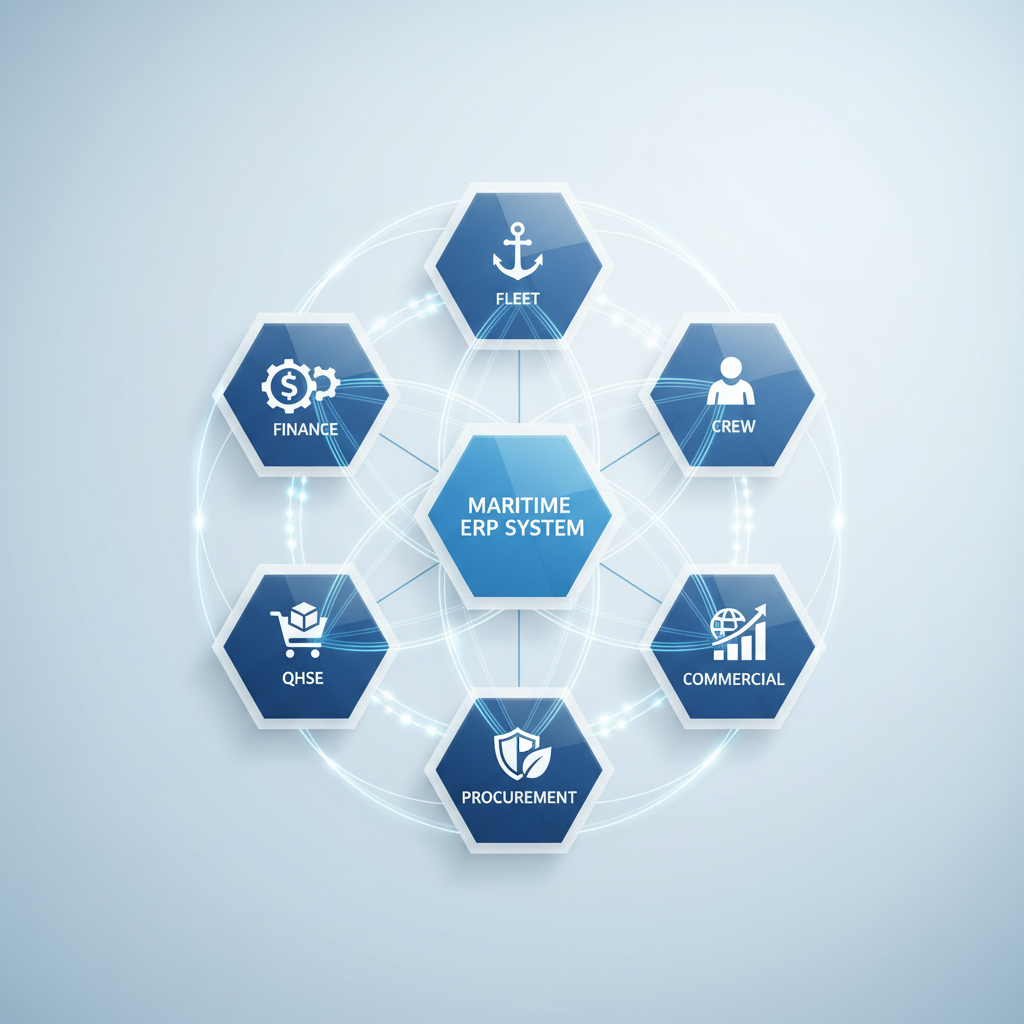
Maritime ERP systems have become the cornerstone of modern shipping operations, transforming how companies manage vessels, crews, finances, and compliance from a single integrated platform. A maritime ERP system is an integrated enterprise resource planning platform specifically designed for the shipping and marine industry. Unlike generic ERP solutions, maritime ERP software combines vessel-centric financial management, technical operations, crew administration, and regulatory compliance into a single platform — eliminating the data silos that plague most shipping organizations.
The maritime ERP market is undergoing rapid transformation. According to Allied Market Research (2024), 67% of shipping companies plan to replace or upgrade their ERP systems by 2027, driven by the need for real-time fleet visibility, tighter ESG reporting requirements, and the operational advantages of cloud-native architectures. The global maritime ERP software market is projected to reach $3.2 billion by 2028, growing at a CAGR of 8.4% as operators seek end-to-end digital integration across their fleets.
In this guide, we walk through the critical differences between maritime ERP software and generic alternatives, how to evaluate the core modules, what implementation really costs, and a vendor comparison to help you shortlist the right platform for your fleet. Ready to see it in action? Book a demo of SupaMaritime to explore all six modules with your own data.
What Makes a Maritime ERP Different from Generic ERP?
Shipping companies that try to force-fit SAP, Oracle, or Microsoft Dynamics into maritime operations face significant challenges. Here's why:
| Requirement | Generic ERP | Maritime ERP |
|---|---|---|
| Vessel-level P&L | Requires custom development | Built-in per-vessel cost centers with SPV support |
| Voyage accounting | Not supported | Native voyage costing, TCE calculations, demurrage tracking |
| Crew certification | Basic HR module | STCW tracking, flag-state requirements, automatic expiry alerts |
| Planned Maintenance | Generic asset management | Class survey integration, running-hours tracking, maker-specific job trees |
| Regulatory compliance | Manual configuration | Pre-built IMO, SOLAS, MARPOL, MLC frameworks with auto-updates |
| Multi-currency | Supported | Supported + maritime-specific (charter hire in USD, bunker in local, crew wages multi-currency) |
| Vessel connectivity | Assumes always-online | Offline mode + intelligent data sync over satellite |
The operational and financial implications of these gaps are significant. When a generic ERP lacks native voyage accounting, your finance team builds shadow spreadsheets. When crew certification tracking is manual, a single oversight can trigger a port state control detention costing $10,000–$50,000 per day in delays. Purpose-built maritime enterprise resource planning software eliminates these risks from day one.
Key Modules of a Maritime ERP
1. Technical Management
The operational backbone: Planned Maintenance System (PMS), dry-dock planning, spare parts inventory, procurement workflows, and class/survey management. A good maritime ERP integrates directly with classification societies (Lloyd's Register, DNV, Bureau Veritas) for real-time survey status.
2. Commercial Operations
Handles chartering (voyage and time charter), voyage estimation, laytime/demurrage calculations, and freight invoicing. This module is what most clearly separates maritime ERP from generic alternatives.
3. Crew Management
Manages crew rotations, payroll across multiple currencies, STCW/MLC compliance, travel arrangements, and document validity tracking. According to ICS (2024), crew-related compliance failures account for 23% of port state control detentions — making this module critical.
4. Financial Management
Maritime-specific accounting: vessel-level chart of accounts, voyage P&L, bunker cost allocation, charter hire reconciliation, and consolidated group reporting across multiple management entities.
5. QHSE & Compliance
Quality, Health, Safety, and Environment management including ISM documentation, non-conformity tracking, risk assessments, environmental reporting (CII, EEXI, EU ETS), and audit management.
Implementation Challenges and How to Overcome Them
Implementing a maritime ERP is a significant undertaking. Industry surveys show that 40% of maritime software implementations run over budget or over schedule, primarily due to data migration complexity, change management resistance, and insufficient vendor support during go-live.
The most common implementation challenge is data migration from legacy systems — historical maintenance records, voyage data, and crew certificates are often spread across multiple disconnected systems. Consolidating this data into a single ERP requires careful mapping, validation, and often manual cleansing work that teams consistently underestimate. Budget at least 20–30% of the total project cost for data preparation alone.
Change management is equally critical. Crew managers, superintendents, and port captains who have relied on spreadsheets for years will resist new workflows unless they receive structured training and see clear personal benefits. Best-in-class implementations assign internal champions at each operational layer before go-live, creating peer advocates rather than top-down mandates.
Connectivity on board remains a practical constraint. Even with modern VSAT and 4G LTE connectivity at sea, vessels still experience periods of limited bandwidth. Your maritime ERP must support full offline functionality with intelligent synchronization when connectivity is restored — not just a degraded read-only mode. Verify this capability with a live demonstration before signing any contract.
To mitigate implementation risk, request a detailed methodology from every vendor, ask specifically how they handle data migration, what their go-live support SLA looks like, and whether they offer phased module rollout rather than a single big-bang deployment. Visit our solutions page to see how SupaMaritime structures phased implementations.
Integration Considerations for Shipping ERP Platforms
Modern shipping operations depend on a web of third-party systems that must connect seamlessly with your ERP. Key integration points include:
- Port community systems — for customs and cargo documentation
- Electronic chart display systems (ECDIS) — for voyage data ingestion
- Voyage optimization platforms — for bunker and routing decisions
- Payroll processors — for multi-currency crew wages
- Classification society portals — for survey and certificate management
- Bunker suppliers — for real-time price feeds and delivery confirmation
When evaluating shipping ERP platforms, assess the quality and breadth of native integrations before relying on vendor promises. REST APIs and standardized data formats such as EDIFACT and XML are table stakes. Proprietary connectors that require the vendor to build each integration on your behalf create long-term lock-in and escalating costs.
SupaMaritime provides open REST APIs and pre-built connectors to the most widely used maritime third-party systems, reducing integration project scope by up to 60% compared to bespoke implementations. Explore our solutions page to see the full integration ecosystem.
Vendor Selection Criteria
Choosing between maritime ERP systems requires more than a features checklist. Consider these criteria when shortlisting platforms:
Domain expertise matters enormously. A vendor that has been building for the maritime industry for ten or more years will have solved edge cases that newer entrants have not yet encountered. Ask about their R&D roadmap and how many development team members hold maritime industry certifications or backgrounds.
Customer support coverage is critical for a globally operating fleet. Your vessels operate around the clock across all time zones. Your ERP vendor must offer 24/7 support — not just business-hours helpdesk access — with clear SLAs for critical incidents that distinguish between a reporting outage and a full system unavailability.
Regulatory update cadence separates good vendors from great ones. IMO regulations, CII thresholds, MLC requirements, and port state control databases change frequently. Your vendor should release regulatory updates proactively, not reactively after you flag a compliance gap.
Finally, evaluate vendor financial stability and customer retention rate. An ERP migration is expensive and disruptive — you want a vendor that will still be actively developing the platform in ten years. Request audited financials or publicly available data on customer churn before committing to a multi-year contract.
Top Maritime ERP Solutions Compared (2026)
| Platform | Strengths | Deployment | Fleet Size | Starting Price |
|---|---|---|---|---|
| SupaMaritime | Unified platform across 6 modules (Fleet, Charter, Marina, Ferry, Broker, Port). Modern cloud architecture, rapid deployment. | Cloud | 1 - 500+ vessels | Contact for quote |
| DNV ShipManager | Strong class integration, established track record. Heavy focus on PMS and QHSE. | Cloud / Hybrid | 10 - 1000+ vessels | ~$800/vessel/mo |
| AMOS (ABB) | Industry standard for maintenance. Deep PMS functionality, large supplier network. | On-Premise / Hybrid | 20 - 500+ vessels | License + maintenance |
| Danaos ONE | Comprehensive ship management. Strong crew and commercial modules. | Hybrid | 10 - 300+ vessels | Custom pricing |
| Veson IMOS | Best-in-class commercial operations. Voyage management, chartering, freight analytics. | Cloud | Any size | ~$1,200/user/mo |
5-Step Selection Framework
- Map your operations — Document every process from voyage planning to financial closing. Identify pain points and data silos.
- Define must-have vs nice-to-have — Regulatory compliance and financial management are typically non-negotiable. Advanced analytics may be phase 2.
- Evaluate total cost of ownership (TCO) — Include implementation, training, data migration, and 5-year licensing. Cloud solutions may have higher monthly costs but lower TCO over time.
- Request live demos with YOUR data — Don't accept generic demos. Provide vendors with sample voyage data and ask them to demonstrate real workflows.
- Check maritime-specific references — Ask for references from companies with similar fleet types and sizes. A platform that works for a container line may not suit a tanker operator.
ROI Analysis: What to Expect from Maritime Enterprise Resource Planning
The financial case for investing in a modern maritime enterprise resource planning platform is compelling. Based on deployment data from maritime technology consultants, operators consistently report measurable returns across four dimensions:
- Payback period: 12–24 months for cloud deployments, 24–36 months for on-premise — reflecting the lower upfront capital requirements of SaaS models
- Operational cost reduction: 15–25% through process automation, reduced manual data entry, better procurement visibility, and elimination of duplicate data entry across disconnected systems
- Compliance cost reduction: 30–50% through automated regulatory tracking, pre-built compliance frameworks, and proactive certificate expiry alerts that prevent costly port state control detentions
- Decision speed: 60% faster access to operational KPIs and financial data as real-time dashboards replace weekly reporting cycles
Beyond these headline figures, consider the softer ROI: reduced staff turnover from lower administrative burden, improved audit outcomes, and the ability to scale fleet size without proportionally scaling back-office headcount. A fleet that grows from 20 to 40 vessels on a modern maritime ERP can often absorb the additional operational complexity with minimal additional hiring.
Frequently Asked Questions
What is a maritime ERP system?
A maritime ERP (Enterprise Resource Planning) system is an integrated software platform designed specifically for the shipping and marine industry. It combines vessel management, commercial operations, crew administration, financial management, and regulatory compliance into a unified system, replacing disconnected tools and spreadsheets.
How is a maritime ERP different from SAP or Oracle?
Maritime ERPs include industry-specific features that generic platforms lack: vessel-level accounting, voyage costing, crew certification tracking (STCW/MLC), planned maintenance with class society integration, charter party management, and offline vessel operations. Building these features on top of SAP or Oracle typically costs 3–5x more than adopting a purpose-built maritime ERP software solution.
What does a maritime ERP cost?
Cloud-based maritime ERPs typically cost $500–$2,000 per vessel per month depending on modules selected. On-premise solutions require $100K–$500K in upfront licensing plus 15–20% annual maintenance. Total cost of ownership over 5 years for a 20-vessel fleet ranges from $600K (cloud) to $1.2M (on-premise with customization).
Can a maritime ERP handle both ship management and commercial operations?
Yes — modern maritime ERP systems like SupaMaritime integrate both technical/operational management and commercial operations (chartering, voyage estimation, freight invoicing) into a single platform. This eliminates the need for separate ship management and commercial systems, reducing integration overhead and providing a single source of truth for operational and financial data.
How long does a maritime ERP implementation take?
Implementation timelines vary by fleet size and complexity. Cloud deployments for fleets under 20 vessels typically take 3–6 months. Larger fleets with complex integrations and extensive data migration may require 9–18 months. Phased rollouts — starting with financial management and compliance before adding commercial modules — reduce risk and deliver faster initial value. Talk to our team to get an estimate for your specific fleet profile.
Take the Next Step Toward a Modern Maritime ERP
Choosing the right maritime ERP system is one of the most consequential technology decisions a shipping company will make. The difference between a well-suited platform and a forced-fit generic solution can translate to millions of dollars in operational savings, avoided compliance penalties, and faster decision-making across your entire fleet.
SupaMaritime is purpose-built for the maritime industry, with six integrated modules covering every operational domain from fleet maintenance and crew management to chartering, port operations, marina management, and brokerage. Whether you operate 2 vessels or 200, our cloud-native architecture scales with your fleet without expensive customization projects.
Ready to see how SupaMaritime can transform your operations? Book a personalized demo today — our maritime specialists will walk you through the platform using workflows relevant to your specific fleet type. Or explore our solutions page to learn more about each module before you reach out.
Last updated: March 2026