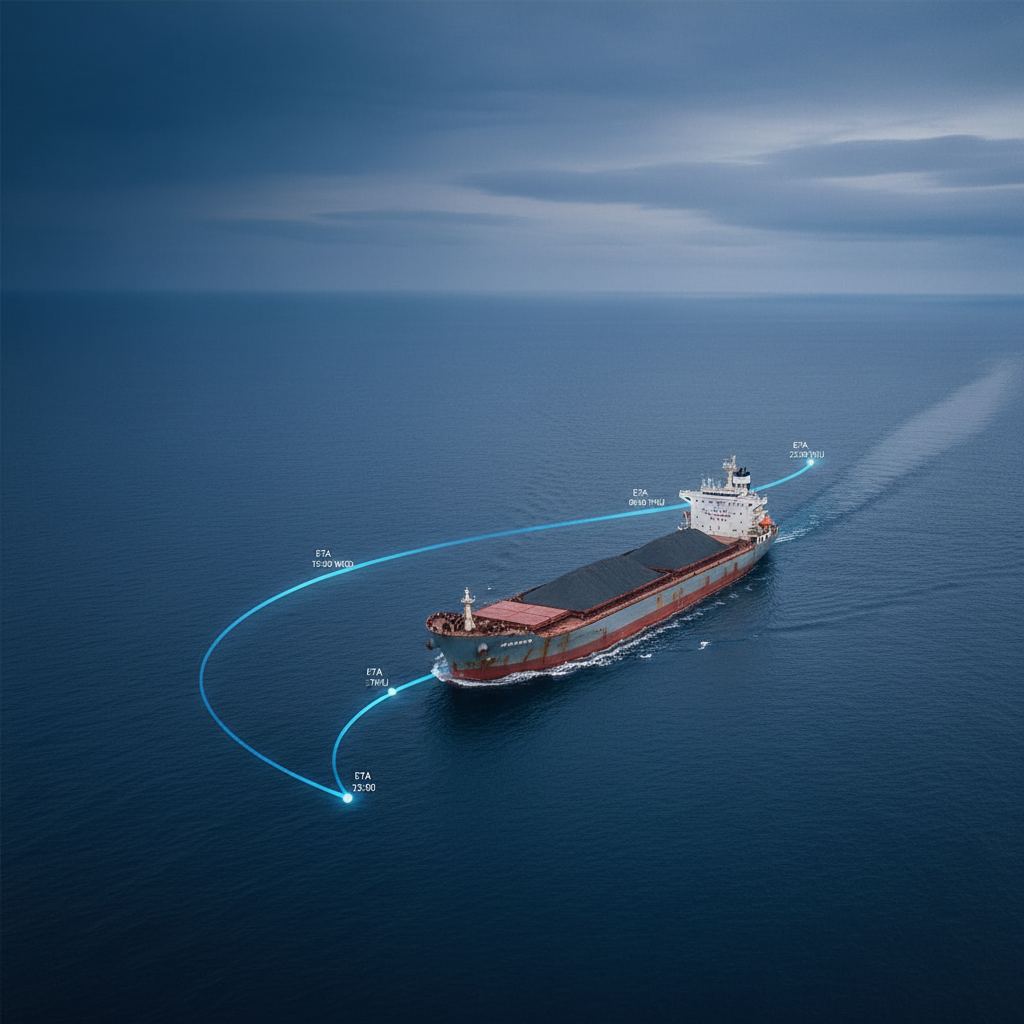
From ETA to ATA: How Voyage Forecasting Is Reshaping Charterer Relationships
For most of shipping's modern history, the Estimated Time of Arrival was a polite fiction. The master gave a number, the charterer adjusted expectations, the port reconciled. Slack between ETA and ATA was absorbed by waiting anchorages, demurrage clocks and a shared assumption that the sea, ultimately, decides. That tolerance is now collapsing. Charterers, terminals, port authorities and traders increasingly expect arrival accuracy at the level of hours, not days, and the delta between Estimated and Actual Time of Arrival has become an analysed performance metric in its own right.
This is not a software fashion. It is a structural shift driven by IMO's Just-In-Time Arrival initiative, by container terminal productivity economics, by demurrage and despatch sensitivity in the dry and tanker markets, and by the simple commercial fact that a charterer who can plan shore logistics around a tight ETA window will, all else being equal, prefer the operator who provides one. Voyage forecasting software has moved from optimisation tool to commercial instrument.
The implications run through every layer of the operating model. Chartering desks fix differently when arrival precision is part of the offer. Voyage managers stop chasing master ETAs and start managing forecast confidence. Commercial operations teams begin to surface forecast deviation as a recurring KPI alongside speed and consumption. None of this is theoretical: it is happening, often unevenly, across every operator we speak with that handles either container slots or dry bulk laytime calculations under modern charter parties.
Why ETA Accuracy Became a Commercial Requirement
Several forces converged. The IMO's Just-In-Time Arrival initiative, advanced through MEPC working papers and the GIA-LAC programme since 2020, formalised the idea that vessels should slow down when port reception is not ready, rather than steam at full speed and wait at anchorage. The fuel and emissions case is uncontroversial. The operational case requires accurate, shareable ETA: a port cannot allocate a berth slot to a vessel whose arrival window is plus or minus 18 hours.
Container terminals built productivity models that depend on confirmed berth windows; missed slots cascade into yard congestion, gang reassignment and vessel queueing. Dry bulk and tanker charterers, exposed daily to demurrage and despatch differentials of tens of thousands of dollars, have long had the financial incentive to monitor ETA closely. What is new is the ability to do so against a forecast they trust. Charterer trust, in chartering manager surveys conducted across European pools in 2024 and 2025, has emerged as a stated competitive variable in fixture decisions, alongside hire rate and vessel specification.
- JIT arrival reduces fuel burn, CII exposure and anchorage congestion when the forecast is shared upstream.
- Container terminal slot windows are tightening from 12-hour to 6-hour and, in some hubs, 4-hour bands.
- Demurrage and despatch swing on hours, not days, in volatile freight markets.
- BIMCO has published JIT clauses that give the language to bind vessel and charterer to a shared arrival expectation.
What a Voyage Forecast Actually Combines
A useful ETA forecast is not a single equation. It is a stack of models that produce, ideally, a probabilistic arrival distribution rather than a single timestamp. The components are well known to naval architects and voyage managers, but rarely integrated in one system.
The vessel hydrodynamic model translates engine power, hull condition and trim into speed-through-water under a given draft. The environmental model overlays wave height, wind direction, swell period and ocean currents from numerical weather prediction sources, typically blended from at least two providers to dampen forecast bias. Commercial constraints enter as boundary conditions: charter-party warranted speed, fuel consumption envelopes, CII trajectory targets, sulphur cap zone routing, ECAs and emerging EU ETS exposure. Port reception is a variable in its own right, modelled from terminal slot calendars, tide windows, pilot availability and canal or lock schedules at choke points like the Bosphorus, the Kiel Canal, Panama or the Suez transit booking system.
A voyage forecast that ignores any one of these layers will be wrong in characteristic ways. Ignore currents and you will be optimistic east of the Cape; ignore canal slot availability and your transatlantic ETA will be invalidated by a missed booking window; ignore CII trajectory and your forecast may be operationally feasible but commercially unacceptable.
Where AI and ML Help, and Where They Don't
Machine learning has a real but bounded role. The strongest contribution is pattern learning from completed voyages of similar vessels: a model trained on thousands of arrivals at a given terminal can capture systematic biases that hydrodynamic models miss, including pilot waiting time distributions, weather-conditional channel speed restrictions, and the subtle effect of cargo type on terminal handling that propagates back to berth release. This is empirical residual modelling, and it works.
Where ML alone underperforms is in low-data regimes: a new vessel class, a recently dredged channel, a port that has just changed its slot allocation rules. Domain modelling, rooted in physics and operational knowledge, remains the spine. The honest architecture is hybrid: hydrodynamic and weather models produce the prior, and ML adjusts the residual against historical reality. Operators who replace one with the other tend to discover the limits of their choice the first time conditions move outside the training distribution.
The Data Infrastructure Problem
Most fleets cannot produce defensible ETA forecasts because their voyage data is fragmented. Navigation data sits in the ECDIS and GPS feed; engine and consumption data sits in the engine logger or noon report; commercial data sits in the chartering system; weather routing comes from a third-party advisory; port estimates come from agents over email. Each is correct in isolation. None reconciles automatically.
The result is an organisation that knows the vessel's position, its current speed and its destination, but cannot answer, with quantified uncertainty, when it will arrive. Building a forecast capability is, more than anything, a data integration project. EU MRV reporting has, somewhat incidentally, accelerated this work by forcing operators to assemble auditable per-voyage fuel and distance records. ISO 28005, the maritime port single window data standard, is doing similar work at the port-side data layer. Operators who treat voyage forecasting as a software purchase rather than a data discipline find that the software cannot perform without the discipline.
Charter Party Clauses Are Adapting
The contract layer has begun to follow. The traditional speed warranty, framed as average performance over good weather days, was always an awkward fit for modern voyage analytics. BIMCO's revised speed and consumption clauses, alongside its JIT clause framework, give charterer and owner a shared vocabulary to address the realities of voyage forecasting and JIT arrival.
- Speed warranty clauses increasingly reference defined weather window methodology rather than informal good weather days.
- Consumption warranty clauses are being aligned with CII reporting boundaries to avoid contradictory incentives.
- JIT clauses give the charterer the right to instruct slow steaming when port reception is delayed, without abrogating warranted speed obligations.
- Performance underperformance penalties, where included, are being negotiated against documented forecast deviations rather than master-reported ETAs.
None of this works without forecast data that both parties accept. The charter party is a contract of expectations; voyage forecasting is increasingly the instrument that defines them.
The Port and Terminal Side
The other end of the line is equally exposed. Container terminals operate on the Berth Allocation Problem, a well-studied operations research challenge of assigning vessels to berths and quay cranes under uncertainty. The classical formulation assumes ETA as a noisy input. As ETA quality improves, the BAP becomes a tractable optimisation rather than a recurring crisis. Labour planning, gang assignment, yard equipment positioning and downstream rail and truck appointments all key off ATA, and every hour of forecast variance translates into productivity loss.
Dry bulk and tanker terminals face the same dynamic with different vocabulary. Pilot scheduling, tug allocation, tide-restricted berth approaches and shore tank readiness depend on shared, current ETA. Several major hub ports now publish vessel call performance metrics that compare promised against actual arrivals, and operators who consistently underperform pay for it in slot priority and, eventually, in fixture preference from the trading houses behind the cargo.
What Good Voyage Forecasting Software Produces
The output of a serious voyage forecasting system is not a number. It is a distribution, a confidence interval and a live, updating view that propagates new information as conditions change.
- Confidence intervals, not single-point ETAs. A forecast that says 14 May 0600 is wrong. A forecast that says 14 May 0400 to 14 May 1000 with 80 percent confidence, narrowing as the vessel approaches, is honest and operationally useful.
- Live updates against measured progress. Each noon report, weather refresh and AIS position should narrow the distribution and trigger an update if the central estimate shifts beyond a configurable threshold.
- Charterer-shareable views with appropriate granularity. The charterer needs ETA window, current confidence band, fuel and CII trajectory and any flagged risks. They do not need engine RPM. The granularity is a commercial choice and a contractual one.
- Auditability. Every forecast should be reproducible from the input data at the time of forecast. Disputes about why an ETA was missed are resolved by replaying the inputs, not by argument.
- Integration with the noon report and engine data. Forecast quality decays without ground-truth feedback; closing the loop is the only way to keep models honest.
The Cultural Shift
The harder change is cultural. For a generation, the master's ETA was the ETA. The number on the noon report carried the weight of seamanship, judgement and personal accountability. Voyage forecasting does not replace that judgement. It frames it. The mature operating model is that the system produces a forecast, the master validates or adjusts it with captured rationale, and the charterer receives a reconciled view that carries both the statistical confidence of the model and the operational confidence of the master.
This works only when the master is genuinely on the inside of the system, not adversarial to it. Forecasts that override masters without dialogue are rejected, often correctly, by the people closest to the conditions. Forecasts that are opaque become political. Forecasts that show their working, accept master input as a first-class data source and improve visibly over time are the ones that earn trust on the bridge and in the chartering desk.
What This Means for Operators in 2026
Voyage forecasting is now a competitive capability rather than a back-office optimisation. Operators that can produce a defensible ETA distribution, share it with charterers and ports under an appropriate confidence band, and feed it back into berth allocation and CII planning, will fix at better terms with charterers who measure these things. Operators who cannot will find themselves quietly deprioritised in slot allocation and re-fixture conversations, often without ever being told why.
The work is part data engineering, part naval architecture, part contract design and part operational change management. None of it is exotic. All of it has to be done deliberately. The shift from ETA as a planning artefact to ATA as a contract benchmark is not coming; it is here, and the gap between operators who have absorbed this and those who have not is widening every quarter. The operators who pull ahead in the next twenty-four months will be the ones who treat voyage forecasting as a discipline that crosses functions, not as a feature in a single dashboard.
SupaMaritime's voyage and commercial modules are built around this thesis: arrival is a forecast, the forecast is data, and the data should travel cleanly from the bridge to the chartering desk to the terminal. To explore how this fits the merchant fleet, ferry operator and port agent contexts we work in, see SupaMaritime for merchant fleets, the port agent module and the full module overview.