Bunker Management Software: Control Your Largest Operating Cost
For most commercial fleet operators, fuel is not just a line item — it is the dominant operating cost, frequently accounting for half or more of a voyage's variable expense. When bunker prices move, margins move with them. Yet despite this exposure, a surprising number of operators still manage fuel with spreadsheets, scanned Bunker Delivery Notes, and end-of-month reconciliation that arrives too late to change any decision. Modern bunker management software exists to close that gap: to turn fuel from an after-the-fact accounting entry into a controllable, auditable, and continuously optimised part of fleet operations.
This guide explains how the bunkering process actually works, where money and trust leak out of it, and how purpose-built marine fuel management software ties procurement, delivery verification, consumption monitoring, and emissions compliance into one defensible data trail. It is written for fleet operators, technical and bunker managers, and procurement teams who need accurate fuel data not only to save money, but increasingly to satisfy regulators.
Why Fuel Deserves Its Own System
Fuel is unusual among shipping costs because it is simultaneously the largest, the most volatile, and the most disputed. Bunker prices can swing significantly within a single quarter, the quantity delivered is notoriously hard to verify, and the quality of what arrives in the tanks directly affects engine reliability and compliance. A small percentage error on a large stem — repeated across a fleet and a year — quietly erodes profitability in a way that is almost invisible in monthly accounts.
Treating fuel as a managed asset rather than a recurring invoice changes the conversation. Instead of asking "what did we spend on bunkers last month," operators using dedicated marine fuel management software can ask "did we pay the right price, receive the right quantity and quality, and burn it as efficiently as the voyage allowed." Those are operational questions, and they require operational data captured in real time.
The Bunkering Process, Step by Step
To understand where software adds value, it helps to walk through a typical bunkering operation. Each stage produces data that, if captured cleanly, becomes the basis for verification and analytics.
- Enquiry and price discovery. The operator identifies a bunkering port along the voyage and requests indicative prices for the required grades — typically VLSFO, LSMGO, or HSFO where scrubbers are fitted.
- Stem and nomination. Once a supplier and price are agreed, the operator places the stem (the order for a specified quantity and grade) and nominates the vessel, delivery window, and port.
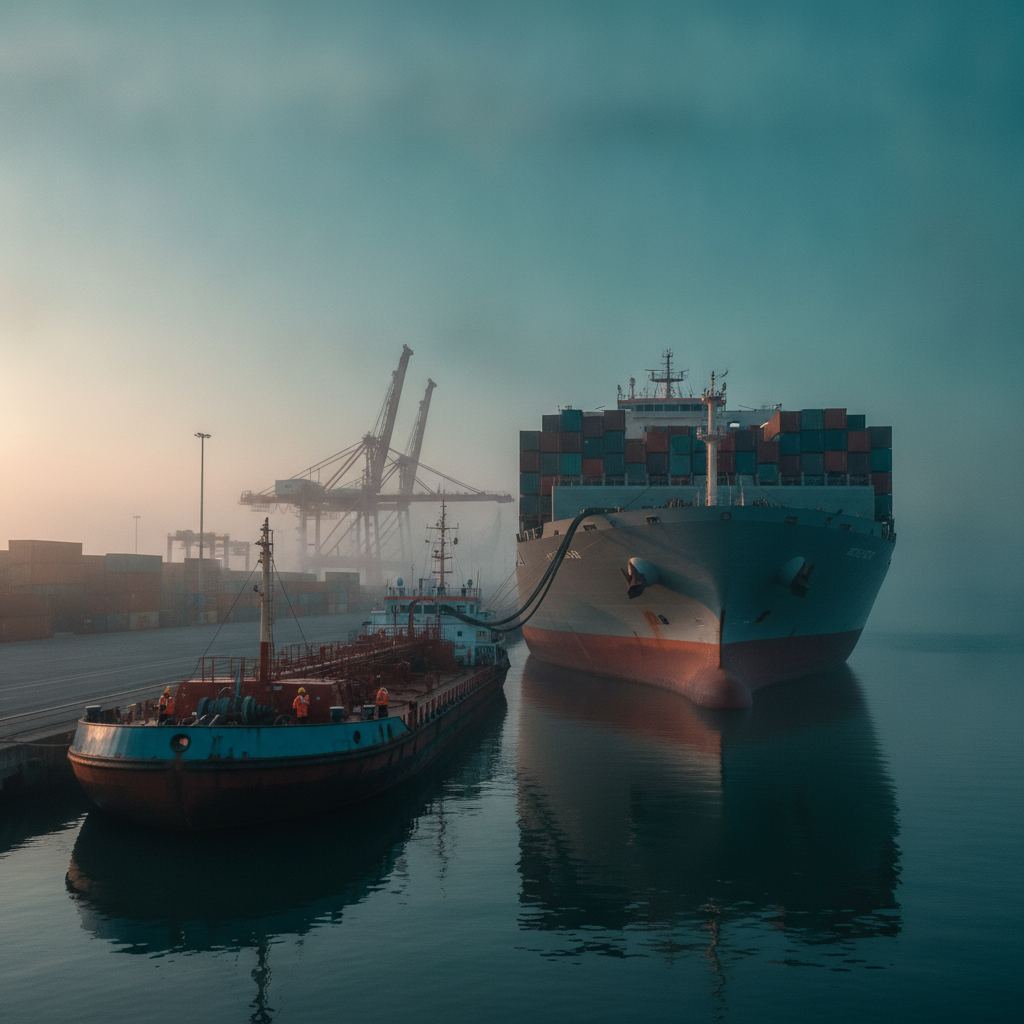
- Delivery. A bunker barge or shore facility delivers fuel to the vessel. Crew measure tank soundings before and after, ideally witnessed by the supplier.
- Bunker Delivery Note (BDN). The supplier issues the BDN documenting grade, quantity, density, sulphur content, and delivery details. The BDN is a regulated document and must be retained on board, typically for three years under MARPOL Annex VI.
- Sampling. Representative samples are drawn, sealed, and signed by both parties. One sample is retained for the MARPOL requirement; others may be sent for independent laboratory analysis to confirm the fuel meets the agreed specification.
Every one of these steps is an opportunity to either build a clean record or lose control of the data. Bunkering software exists to make the clean record the path of least resistance.

Where Money and Trust Leak Out
Bunkering is one of the few areas of shipping where disputes are routine and the sums are material. The recurring pain points are well known to anyone who has managed a fleet:
- Quantity disputes and short delivery. The quantity stated on the BDN does not always match what actually reaches the tanks. Differences in temperature, measurement method, and — in the worst cases — deliberate manipulation can produce significant short deliveries that go unchallenged without rigorous on-board verification.
- Quality off-spec. Fuel that does not meet the agreed grade can damage engines, cause filter blocking, or breach sulphur limits. Without prompt sampling and analysis, off-spec fuel may already be in use before the problem is identified.
- Fraud. The "cappuccino effect" (aerating fuel to inflate volume) and tampered meters are persistent risks. Detecting them requires disciplined comparison of expected versus delivered quantities.
- Manual reconciliation. When BDNs, noon reports, and invoices live in separate systems, reconciling them is slow and error-prone — and discrepancies are often found too late to recover anything.
- Price volatility. Buying without comparing live port prices, or without any awareness of hedging, means leaving money on the table whenever the market moves.
The most expensive fuel is not the most expensive grade — it is the fuel you paid for but never received, or the fuel that damaged an engine because nobody checked the certificate of quality in time.
Fuel Procurement Done Properly
Good procurement is not simply finding the lowest headline price. It is a disciplined process of comparison, negotiation, and risk awareness. Best practice typically includes maintaining a panel of multiple, vetted suppliers rather than relying on a single source; comparing prices across candidate bunkering ports along the planned route, since the cheapest port is not always the most convenient and vice versa; and understanding the role of hedging and fixed-price contracts in smoothing exposure to a volatile market, even when the operator does not hedge directly.
Software supports procurement by centralising supplier records, capturing every enquiry and stem, and making port price comparison a structured activity rather than an email scramble. The goal is a repeatable, auditable purchasing process where each decision can be justified after the fact — which matters as much for internal governance as for cost.
Consumption Monitoring: From Noon Reports to Flow Meters
Procurement controls what you pay; consumption monitoring controls what you burn. Historically, fuel consumption has been tracked through the daily noon report, in which the crew records distance, fuel remaining on board (ROB), and consumption since the previous report. Noon reports are universal and cheap, but they are coarse: a single daily snapshot cannot reveal what happened hour to hour, and manual figures are prone to error and rounding.
Increasingly, operators supplement or replace noon-report estimates with mass flow meters that measure consumption continuously and accurately at the engine. Flow meter data enables much finer analysis — per leg, per engine, and even per operating condition — and provides an independent check on both noon reports and BDN quantities. The most useful approach is usually to combine both sources: flow meters for accuracy where fitted, noon reports for fleet-wide coverage, with software reconciling the two and flagging where they disagree.
Whatever the data source, the analytical questions are the same. How much did this voyage actually consume against plan? Which vessels in the fleet are least efficient at a given speed and load? Is consumption drifting over time in a way that suggests hull fouling or machinery degradation? Reliable fuel consumption monitoring turns these from guesses into measurements.
The Regulatory Layer That Makes Accurate Fuel Data Mandatory
Even operators who are relaxed about cost control no longer have the option of being relaxed about fuel data, because regulation now depends on it. Several overlapping regimes require trustworthy, auditable fuel and emissions figures:
- IMO DCS (Data Collection System) requires ships above a tonnage threshold to report annual fuel oil consumption to their flag administration.
- EU MRV (Monitoring, Reporting and Verification) requires monitoring and third-party verification of CO2 emissions for voyages to, from, and within the EU.
- CII (Carbon Intensity Indicator) rates ships A to E on operational carbon intensity, derived directly from fuel consumed and distance sailed — a rating that can affect commercial acceptability.
- EU ETS (Emissions Trading System) now brings maritime shipping into Europe's carbon market, meaning operators must surrender allowances for a share of their emissions — in effect, paying for the carbon they emit.
- FuelEU Maritime sets progressively tightening limits on the greenhouse gas intensity of the energy used on board, in force from 2025, pushing operators toward lower-carbon fuels and accurate accounting of what is burned.
The common thread is that all of these regimes are only as reliable as the underlying fuel data. A short delivery you never detected, a noon report that was rounded, or a BDN that was misfiled does not just cost money — it corrupts the figures you are legally obliged to report and, under ETS, may even be financially penalised. Accurate bunker and consumption data is now the foundation of compliance, not merely of cost control. For a deeper treatment of the decarbonisation rulebook, see our overview of maritime decarbonisation software for CII, EEXI and FuelEU.
What Bunker and Fuel Management Software Actually Does
A capable fuel management platform brings the entire lifecycle into one place. In practice, that means:
- Procurement. Supplier panels, enquiry and stem tracking, and port price comparison to support disciplined buying.
- ROB tracking. A continuous, fleet-wide picture of remaining fuel on board by grade and tank, so planning is never blind.
- BDN capture. Structured digital capture of every Bunker Delivery Note, with the documents retained and searchable rather than buried in a folder on the bridge.
- Consumption analytics. Reconciliation of noon reports and flow-meter data into per-leg, per-engine, and per-vessel performance views.
- Emissions and compliance reporting. Automated generation of the figures required for IMO DCS, EU MRV, CII, ETS, and FuelEU from the same verified fuel record.
- Fraud and discrepancy detection. Automatic comparison of stemmed, delivered, and consumed quantities to flag short deliveries and anomalies while there is still time to act.
The decisive advantage is that all of this draws on one record. When procurement, delivery, consumption, and emissions are computed from the same source of truth, discrepancies surface immediately and every regulatory figure is traceable back to a document.
Integration With Voyage and Performance Data
Fuel data is most valuable when it is not isolated. Consumption only makes sense in the context of the voyage that produced it — the route, the weather, the speed profile, the cargo. That is why effective bunkering software integrates with voyage planning and performance analytics rather than standing alone. Connected to voyage data, fuel figures reveal whether a slow-steaming decision actually paid off, whether a weather routing choice saved the tonnes it promised, and how each vessel's real-world performance compares with its baseline. Within an integrated platform, fuel management, voyage planning, and performance analysis reinforce one another instead of living in separate silos.
How to Choose Fuel Management Software
When evaluating marine fuel procurement and management systems, operators should look beyond the feature checklist and assess the following:
- Data integrity. Does the system create a single, auditable record from enquiry through emissions reporting, or does it merely store documents?
- Verification. Can it automatically reconcile stemmed, delivered, and consumed quantities and flag discrepancies?
- Compliance coverage. Does it generate IMO DCS, EU MRV, CII, ETS, and FuelEU figures from the underlying data, and keep pace as rules tighten?
- Integration. Does it connect to voyage planning and performance analytics, and to existing reporting workflows on board?
- Usability for crew. Will the people entering noon reports and BDNs actually use it, or will they revert to spreadsheets?
Frequently Asked Questions
What is bunker management software?
Bunker management software is a system that manages the full marine fuel lifecycle — procurement and price comparison, stem and delivery tracking, Bunker Delivery Note capture, remaining-on-board monitoring, consumption analytics, and emissions compliance reporting — from a single, auditable data record across the fleet.
How does fuel software help detect short deliveries and fraud?
By recording the stemmed quantity, the delivered quantity from the BDN and tank soundings, and the consumed quantity from noon reports or flow meters in one place, the software can automatically compare them. Discrepancies that suggest short delivery, the cappuccino effect, or meter tampering are flagged while there is still time to raise a claim.
Are flow meters better than noon reports for consumption monitoring?
Flow meters typically give more accurate, continuous, per-engine data than the daily noon report, and provide an independent check on it. However, noon reports remain valuable for fleet-wide coverage. The strongest approach usually combines both, with software reconciling the two and highlighting where they disagree.
Why does regulation make accurate fuel data so important now?
Regimes such as IMO DCS, EU MRV, CII, EU ETS, and FuelEU Maritime all derive directly from fuel consumed. Inaccurate fuel data corrupts mandatory reports, can worsen a CII rating, and under the EU ETS can carry a real financial cost because operators effectively pay for the emissions they report.
Can fuel management integrate with voyage planning?
Yes, and it should. Fuel consumption is only meaningful in the context of the voyage that produced it. Integrated platforms connect fuel data with voyage planning and performance analytics so operators can see whether routing and speed decisions actually delivered the savings they were meant to.
SupaMaritime Merchant brings procurement, ROB tracking, BDN capture, consumption analytics, and emissions compliance into one fuel management module that integrates with voyage planning and performance data across bulk, tanker, container, ro-ro, and OSV fleets. Explore the Merchant module, see how it serves tanker operators and bulk carrier operators, or browse the full range of SupaMaritime modules to take control of your single largest operating cost.