Ferry Operations Software: Dynamic Scheduling, Yield, and Disruption Recovery
Of all the segments grouped under commercial maritime, ferry operations sit furthest from the textbook. A container vessel sails for weeks; its commercial cycle is measured in quarterly contracts and FFA hedges. A tanker spends days in load and discharge ports; its operational rhythm is dominated by laytime clauses. A passenger ferry, by contrast, can complete a full commercial cycle four to twelve times a day, with thirty-minute turnarounds, retail-level passenger expectations, perishable inventory in the form of empty seats and unsold lane metres, and weather risk concentrated in narrow seasonal windows. The operational physics are different, and the software that supports them must be different too.
This article looks at what ferry operations software actually has to do — across scheduling, yield, regulatory load planning, and disruption recovery — and why generic platforms ported from container or tanker contexts tend to fail when they meet a real ferry day.
The Anatomy of a Ferry Day
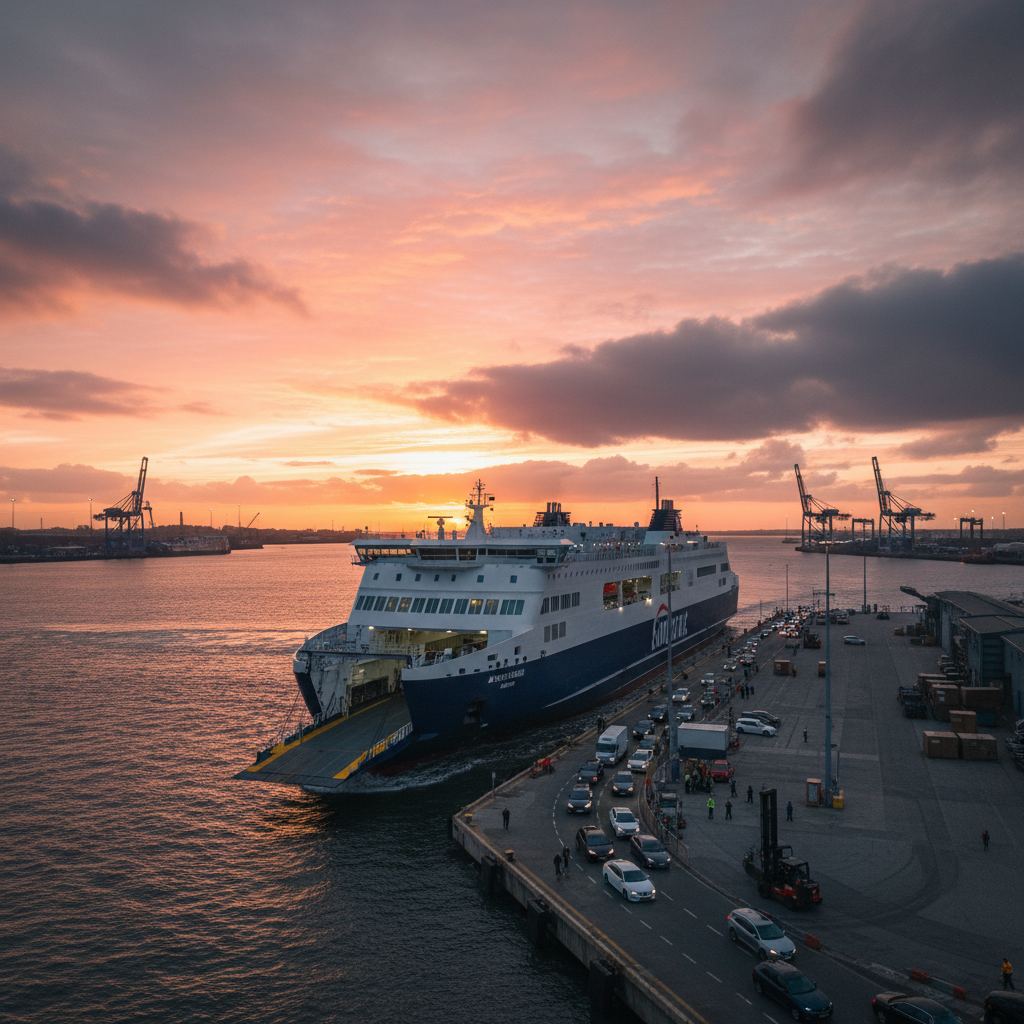
A representative coastal or short-sea ferry day might begin at 04:30 with crew sign-on, fuel uplift coordination with the port bunker barge, vehicle deck preparation, and a final check on the previous night's noise and emissions records. By 06:15 the first foot passengers are queueing; by 06:45 the vehicle deck is loading according to a stowage plan that already accounts for trailer weights, dangerous goods segregation, and the operator's own commercial priorities — frequent travellers, contract hauliers, last-minute drive-ups. The vessel sails at 07:00. It returns at 09:30. It must reload and sail at 10:00. That is a thirty-minute turnaround, repeated five to ten times across the day.
Inside that window, the operations team must reconcile:
- Disembarkation flow and vehicle deck clearance against linkspan availability;
- Boarding flow for foot passengers, accessibility passengers, and vehicle traffic, often through different gates;
- Crew rotations governed by MLC 2006 rest-hour rules;
- Fuel uplift and waste reception scheduling under MARPOL Annex I, IV, V and VI;
- Port slot reconciliation, since most short-sea ports allocate berth windows that cannot slip without cascading effects;
- Real-time passenger communications: gate changes, delayed arrivals, missed connections to onward rail or coach.
- Safety briefings, manifest closure, and final SOLAS damage stability checks before departure clearance.
None of these activities is exotic on its own. The challenge is that they are all interlocked, all on a thirty-minute clock, and all happening at every port of every rotation, every day. A spreadsheet that is accurate at 06:00 is irrelevant by 09:30, and a software stack that requires manual reconciliation at every port call simply cannot keep pace.
Capacity and Yield: Two Inventories on One Hull
A passenger ferry sells two fundamentally different products from the same sailing. The passenger deck is a retail product: seats, cabins, lounges, sometimes restaurants and shops. The vehicle deck is a logistics product: lane metres for cars, motorcycles, vans, coaches, and increasingly important freight trailers. The two have different revenue per cubic metre, different price elasticities, different booking curves, and different cancellation behaviour. Vehicle bookings firm up earlier and rarely no-show; passenger bookings, especially leisure ones, can move dramatically in the final 72 hours.
Yield management built for airlines or hotels treats inventory as a single homogeneous pool. Ferry yield management cannot. A modern ferry yield engine has to model passenger and vehicle deck inventories separately, then jointly, because they interact: a heavy freight load may reduce remaining lane metres for cars, which constrains the price you can charge for the next car booking, which feeds back into the offer surface shown to leisure browsers. Some operators add cabin inventory as a third axis on overnight crossings — and cabins, unlike seats, behave more like hotel rooms than airline seats, with a strong same-day floor.
Operators referenced as industry context — DFDS, Stena Line, Brittany Ferries, Grimaldi, GNV, Moby, Trasmediterránea, Baleària — have all spent years tuning yield logic to their own route mixes. The common pattern is a layered model: a strategic price ladder per route and season, a tactical overlay that responds to booking pace, and a real-time floor that prevents cannibalisation of contracted freight.
Dynamic Scheduling and Schedule Recovery
The published timetable is, in practice, an aspiration. A ferry COO knows that on any given day a fraction of sailings will be touched by something — a force-eight forecast, a steering gear alarm, a port closure for a cruise call, a medical disembarkation. The question is not whether disruption happens; it is how quickly the operation can be re-stabilised.
Dynamic scheduling software has to support three distinct horizons:
- Strategic schedule design, where annual or seasonal timetables are built against demand forecasts, port slot availability, crew rosters, and vessel maintenance windows;
- Tactical re-planning, in the 24 to 72-hour window before sailing, when forecast wind data, mechanical defects, or commercial bookings can justify cancelling, merging, or upgrading sailings;
- Real-time recovery, where a sailing has been disrupted and the operator must rebook passengers, reroute freight, reposition crews, and recover the timetable within the same day or the next.
The hardest of these is real-time recovery. It requires the platform to hold a live picture of the entire fleet's state — bunker, ballast, crew hours, port permissions, passenger and vehicle manifests — and to generate feasible recovery plans within minutes rather than hours. Software ported from container shipping, where a delayed vessel can simply be rebuffered against the next port window, has no native concept of this; container schedule recovery is measured in days, not minutes.
Load Factor Optimization Without Breaking Stability
Every commercial operator wants to fill empty deadweight. On a ferry, the constraint that gives way last is not commercial; it is regulatory. SOLAS Chapter II-1 governs damage stability for passenger ships, and its post-2009 probabilistic framework — together with the Stockholm Agreement for North-West European RoRo passenger ferries — places hard limits on how vehicle decks can be loaded relative to passenger compartments and watertight subdivision. A trim that looks commercially attractive may be operationally illegal.
Good ferry load planning software does not just optimise stowage for centre of gravity and trim. It encodes the vessel's actual damage stability documentation, treats the loading computer as the source of truth, and refuses to release stowage plans that breach the approved envelope. It then layers commercial logic on top: dangerous goods segregation under the IMDG Code, hazardous cargo on weather decks, livestock on ventilated decks, refrigerated trailer power outlet planning, and lane assignment that minimises shunting time on disembarkation.
For LNG-fuelled ferries, the IGF Code adds another layer: bunker compatibility checks, gas detection zones around the bunker manifold, and operational limits on simultaneous bunkering and passenger embarkation. None of this is captured in software designed for box stowage on a 12,000-TEU container vessel.
MARPOL, EEXI and CII Pressures Specific to Ferries
Ferries are environmentally exposed in a way deep-sea fleets are not. Their port-to-port intensity means a high share of total fuel burn happens during manoeuvring, berthing, and shore-power transitions. Their frequent berthing produces disproportionate exposure to local air quality regulation in port cities — Genoa, Barcelona, Marseille, Dover, Helsinki — where municipal pressure on emissions is sharper than open-sea regulation.
EEXI applies one-time. CII applies annually, and the rating bands are unforgiving for short-sea operators whose distance-based denominator is small. Operators are responding with cold ironing, battery hybridisation, slow steaming on flexible legs, and operational efficiency gains that depend on detailed voyage data: sea state, drift, ETA accuracy, port wait times. The software needs to capture this data per leg, attribute it correctly, and feed it into both regulatory reporting (EU MRV, IMO DCS) and the commercial scheduling logic — because a CII band downgrade can change the commercial case for an entire route.
Disruption Recovery and Passenger Communications
Ferry passengers in 2026 expect what they get from rail and short-haul air: real-time disruption information, automated rebooking offers, refunds processed without phone calls, and accessibility-aware re-accommodation. The ATOC-equivalent rail standards in the UK, and EU Passenger Rights Regulation 1177/2010 for sea travel, set the legal floor; commercial reputation sets a higher one.
The challenge is that ferry disruption is rarely clean. A cancelled rail service simply doesn't run; a cancelled ferry sailing leaves freight trailers stranded at port, foot passengers without onward connections, and vehicles whose drivers have already paid for hotels at destination. Recovery requires the platform to:
- Rebook passengers across affected sailings while respecting cabin allocation and accessibility needs;
- Reposition vehicles and freight trailers, with explicit handling of dangerous goods and refrigerated units;
- Coordinate with port authorities, linkspan operators, and onward transport providers;
- Generate Regulation 1177 compensation files automatically, not as a manual back-office task three weeks later;
- Communicate proactively, in the passenger's language and channel of choice, with substantive content — not generic apology templates.
Done well, this turns a force majeure event into a defensible commercial story. Done badly, it produces the social media incidents that ferry operators now genuinely fear more than the regulator.
What Good Ferry Software Does That Container-Adapted Software Cannot
The pattern is now visible. Software built originally for container or tanker fleets, then sold to ferry operators with a passenger module bolted on, fails on five recurring fronts:
- Time horizon: it assumes commercial cycles measured in days or weeks, not in thirty-minute turnarounds;
- Inventory model: it treats capacity as homogeneous, not as a joint passenger plus vehicle plus cabin yield surface;
- Stability and safety: it has no native model of SOLAS damage stability, IGF gas zones, or RoRo lane assignment under IMDG segregation;
- Disruption: it lacks the real-time, fleet-wide schedule recovery primitives a ferry COO needs at 06:00 on a force-eight morning;
- Passenger experience: it has no native concept of accessibility, EU Regulation 1177 compensation, or multilingual passenger communication.
Purpose-built ferry operations software starts from the opposite assumption: that the ferry day is the atomic unit, that the passenger and the trailer share a hull but not a commercial logic, and that disruption recovery is not an exception path but a core capability.
From Tooling to Operating System
The strongest ferry operators we observe in Europe and the Mediterranean are moving past the era of separate scheduling, yield, and disruption tools stitched together by spreadsheets and shared calendars. They are consolidating onto a single operational system of record that the COO, route managers, port operations managers, revenue team, and customer service all work from. The benefit is not a single dashboard. It is that the same data — manifest, stowage, crew hours, bunker, weather, port slots — drives every decision, so that a tactical rerouting at 11:00 and a yield adjustment at 14:00 are not contradicting each other by 17:00.
Reaching that point is a multi-year programme, not a software purchase. The work tends to begin with the reconciliation of master data — vessels, ports, routes, tariffs, fare classes, vehicle categories — and only then move into operational integration. Crew rostering, bunker management, and port agency interfaces are typically last because they touch the most external counterparties. But the payoff is measurable: higher load factors at lower yield risk, faster schedule recovery, lower regulatory exposure, and a passenger experience that holds up under stress.
SupaMaritime's Ferry module is built specifically for this segment — passenger and RoRo operators on coastal, short-sea, and Mediterranean routes — and integrates with the wider SupaMaritime modules for agency and merchant fleet operations. Localised entry points are available at /it/ferry, /es/ferry, /fr/ferry, and /de/ferry. For operators evaluating where to start, the practical first step is rarely a full platform replacement; it is a focused review of where the current toolchain fails on a real disrupted day, and a roadmap that fixes the highest-cost failure modes first.