Ballast Water Management: BWM Convention, D-1 and D-2 Standards and Treatment Systems
Every time a ship discharges cargo and fills her ballast tanks, she takes in water along with everything it contains. When she discharges it thousands of miles away, she carries with it organisms that should not be in the receiving ecosystem. Ballast water management exists to stop this transfer.
For shipowners and technical managers the subject is not theoretical. The BWM Convention requires an approved plan, an up-to-date record book, a valid certificate and, for almost all ships, a working treatment system. A system that fails to start or a badly completed record book can become a deficiency in an inspection and slow down a port call.
This guide explains why ballast water is regulated, what the D-1 and D-2 standards require, which documents are needed, how treatment technologies compare and how to plan a retrofit. It closes with the most common operational problems, Port State Control checks and cost factors.
The BWM Convention does not end with installing a system: it requires a system that is approved, used correctly, maintained, recorded and demonstrable in an inspection. The real operational risk lies on the day the system does not work and the ship has to discharge anyway.
Why ballast water is regulated
Ballast is used to keep trim, stability and structural stresses within safe limits when the ship sails empty or partly loaded. The water is taken in at the loading port or during the voyage and released where the ship loads or discharges. The problem is what travels along with the water.
The tanks take in plankton, larvae, bacteria, algae and small organisms of every kind, together with the sediments that settle on the bottom. Some of them survive the voyage. If the discharge environment is similar enough, the species can establish itself, reproduce and become an invasive aquatic species.
The effects are ecological, economic and health-related: competition with local species, damage to fisheries and aquaculture, blocked water intakes, toxic algal blooms. Among the cases most often cited in the literature are the zebra mussel in the North American Great Lakes and the comb jelly Mnemiopsis in the Black Sea, both attributed largely to ballast water.
The International Convention for the Control and Management of Ships' Ballast Water and Sediments, known as the BWM Convention, is the IMO's response to this problem. It sets uniform rules, because a local solution in a single port would not be enough.
What the BWM Convention is and which ships it applies to
The Convention was adopted in 2004 and entered into force on 8 September 2017. It applies, in general terms, to ships entitled to fly the flag of a party State, and to those operating under the authority of a party State, that make international voyages and have ballast tanks.
There are exclusions: the main ones include ships not designed to carry ballast water, those with permanent ballast in sealed tanks, warships, and ships that operate only in the waters of a single party State, unless otherwise decided. The details and exceptions must be checked in the text and with your flag.
As regards surveys and certification, the requirement for an international certificate generally concerns ships of 400 gross tonnage and above, with exclusions for certain offshore units. Smaller ships must still comply with the operational rules, as laid down by the flag administration.
The compliance timetable
Ships built after entry into force must meet the D-2 standard from delivery. For existing ships, compliance was tied to the renewal survey of the IOPP (oil pollution prevention) certificate, with a final deadline in 2024. Today almost all ships subject to the Convention must have a system installed.
Detailed rules and exemptions change with amendments: check flag and class for each ship. The United States is a case apart, as it is not a party to the Convention and applies its own regime, with separate type approvals: anyone operating in those waters must therefore consider both regimes.
D-1 and D-2 standards: ballast exchange and the performance standard
The Convention defines two standards: the first concerns ballast water exchange, the second treatment.
D-1: ballast water exchange in the open sea
The D-1 standard provides for ballast water exchange: the ship replaces, in the open sea, the water taken in port with oceanic water, where coastal organisms are less likely to survive. The required efficiency is at least 95% of the volume.
The exchange must be carried out, where possible, at least 200 nautical miles from the nearest land and in water at least 200 metres deep. If that is not possible, the minimum distance is 50 miles with the same depth, in areas designated by the port State. The method has limits: it depends on the weather, affects stability and hull stresses and does not eliminate the organisms entirely.
D-2: the performance standard
The D-2 standard does not prescribe how to treat the water but what it must contain at the time of discharge. It sets maximum limits for viable organisms by size and for certain indicator bacteria:
- Organisms with a minimum dimension of 50 micrometres or more. Fewer than 10 viable organisms per cubic metre.
- Organisms between 10 and 50 micrometres. Fewer than 10 viable organisms per millilitre.
- Indicator microbes. Limits for toxicogenic Vibrio cholerae, Escherichia coli and intestinal enterococci, expressed in colony-forming units per hundred millilitres.
To meet these limits an approved ballast water management system (BWMS) is needed. The D-2 standard is the one now required of ships subject to the Convention, while D-1 exchange remains relevant as a contingency measure and in some particular situations.
Plan, record book and certificate: the Convention's documents
Compliance is demonstrated with three documents, in addition to the system manufacturer's manuals. They are the ones the inspector asks for first.
- Ballast Water Management Plan (BWM Plan). Specific to the ship and approved by the flag administration or by the class society on its behalf. It describes procedures, safety, sediment management, responsibilities and the role of the designated officer.
- Ballast Water Record Book. It records every operation: intake, discharge, treatment, exchange, accidental releases and exceptions. The entries must be kept on board for two years after the last entry and then, for at least a further three years, under the company's control.
- International Ballast Water Management Certificate. Issued after an initial survey, with subsequent verification surveys during its validity, which is five years at most.
Each operation is signed by the responsible officer and each completed page by the master. The record book is the mirror of real operation: if it does not match the system's alarms and logs, an inspector notices immediately.
How ballast water treatment systems work
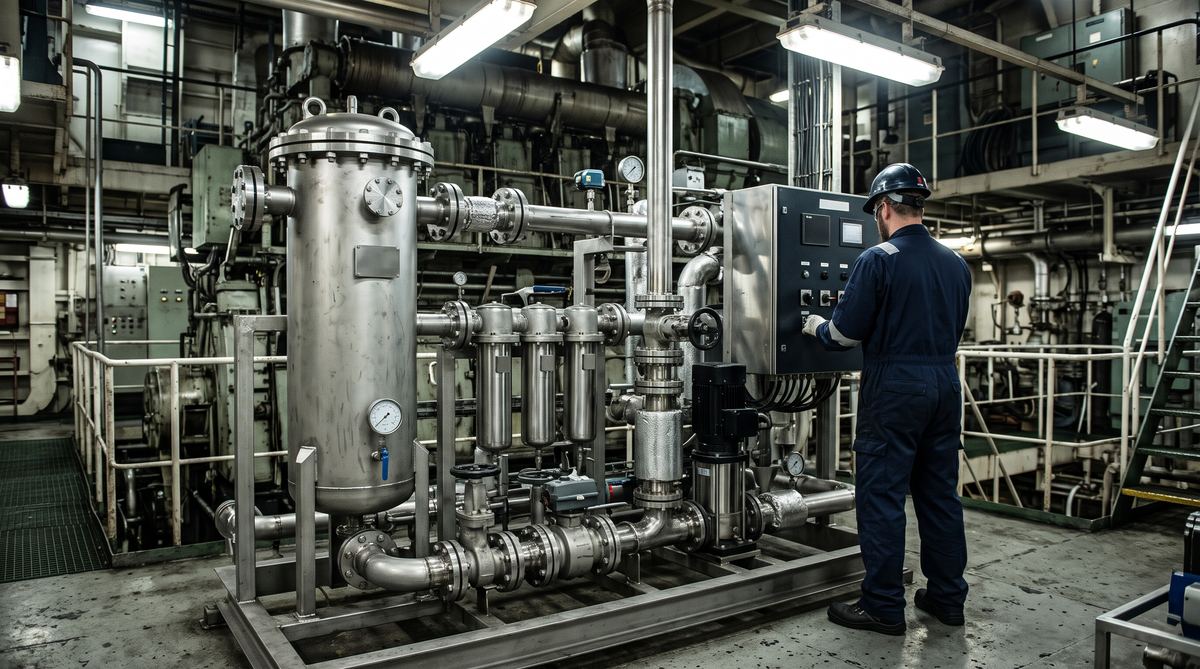
BWMS generally combine a physical separation stage with a disinfection stage. Separation, for example with filters, removes the larger organisms and particles. Disinfection acts on the smaller ones and on microorganisms, or on the water itself.
| Technology | How it works | Strengths | Points to watch |
|---|---|---|---|
| Filtration and UV | Inlet filter and ultraviolet lamps that damage the organisms | No chemicals added, relatively simple structure | Effectiveness tied to water clarity and lamp condition; electrical consumption |
| Electrochlorination | Electrolysis of the water to produce a chlorine-based disinfectant | Disinfectant produced on board, with no chemical storage | Depends on salinity and temperature; requires neutralisation and management of the hydrogen produced |
| Chemical dosing | Injection of a biocide that is then neutralised before discharge | Compact installation in some solutions | Storage and handling of chemicals, supply of the products |
| Deoxygenation | Reduction of dissolved oxygen to suffocate the organisms | Less dependent on water quality and salinity | Longer holding times in the tank, less widespread solutions |
The choice depends on the ship and her trades: pump capacity, available electrical power, free space, the type of water she operates in (fresh, brackish, turbid, cold) and safety constraints, such as hazardous areas on tankers.
Each system must hold type approval, issued under the IMO guidelines, updated over time up to the current BWMS Code. Before ordering a system, always check that the model version is approved for your flag and, if necessary, for US waters.
How to plan a retrofit and which factors determine the cost
Fitting a BWMS to an existing ship is an engineering project, not the purchase of a component. It requires a survey of the ship, a study of the spaces, hydraulic and electrical calculations, approval of the drawings by class and flag, and a period in the yard.
Many retrofits are concentrated in dry dock, when the ship is out of service anyway and work is done on the ship's pipework and valves. For the yard period, see the guide to dry-docking for commercial ships.
A typical checklist includes:
- Analysis of the ship and her trades. Maximum pump capacity, quality of the waters where she operates, ballasting and discharge patterns.
- Choice of technology and supplier. Checking the approval, service support in the ports served and spare parts availability.
- Engineering and approval of drawings. Pipework, switchboard, ventilation, hazardous areas, interface with the alarm system.
- Installation and commissioning. Including the functional test after installation, which the most recent regulations require in the form of a commissioning test.
- Updating the plan, record book and training. The BWM Plan and shipboard procedures must be adapted before the first operation.
The overall cost depends on factors that vary greatly from ship to ship: the treatment capacity required in cubic metres per hour, the technology, the complexity of the pipework and electrical installation, the days in the yard, the engineering and approval costs and the off-hire time. There is no single price: always ask for a quotation that includes installation, commissioning and training, not just the equipment.
Daily operation and maintenance: the problems you encounter
The troubles of a BWMS rarely appear at commissioning and more often in service, when the ship ballasts in a port with turbid or cold water.
- Turbid water and sediments. They clog the filters and reduce UV transmission, with a drop in effectiveness or a shutdown of the system. As far as possible, avoid ballasting in water heavily laden with sediments.
- Salinity and temperature. In electrolysis systems, fresh or cold water can reduce disinfectant production, with risks to the usable flow rate.
- Sensors and instrumentation. Flow meters, probes and analysers require calibration according to the manual. An out-of-calibration sensor can block the system or distort the logs.
- Lamps, filters and electrodes. They are wear components, with replacement intervals tied to running hours or the calendar.
- Energy consumption. The system's electrical load enters the generators' balance, an aspect to consider also in efficiency calculations and in the framework described in decarbonisation, CII, EEXI and FuelEU.
These points are managed with planned maintenance by running hours or calendar, critical spares on board and consistent records. For the value of data-driven maintenance, you will find ideas in ROI of predictive maintenance in shipping.
Sampling and Port State Control checks
Port States may verify compliance during inspections. In general the check starts with the documents: certificate, BWM Plan and record book, then the match between the entries and the actual state of the system. An inspector may ask to see the system running and to consult its logs.
Ballast water sampling follows IMO guidelines and proceeds in two stages: an indicative analysis, quick and less costly, which can give a first signal, and a detailed analysis, more accurate, if exceedance of the limits is suspected. If the indicative analysis raises doubts about compliance, the ship may have to demonstrate that the system works correctly.
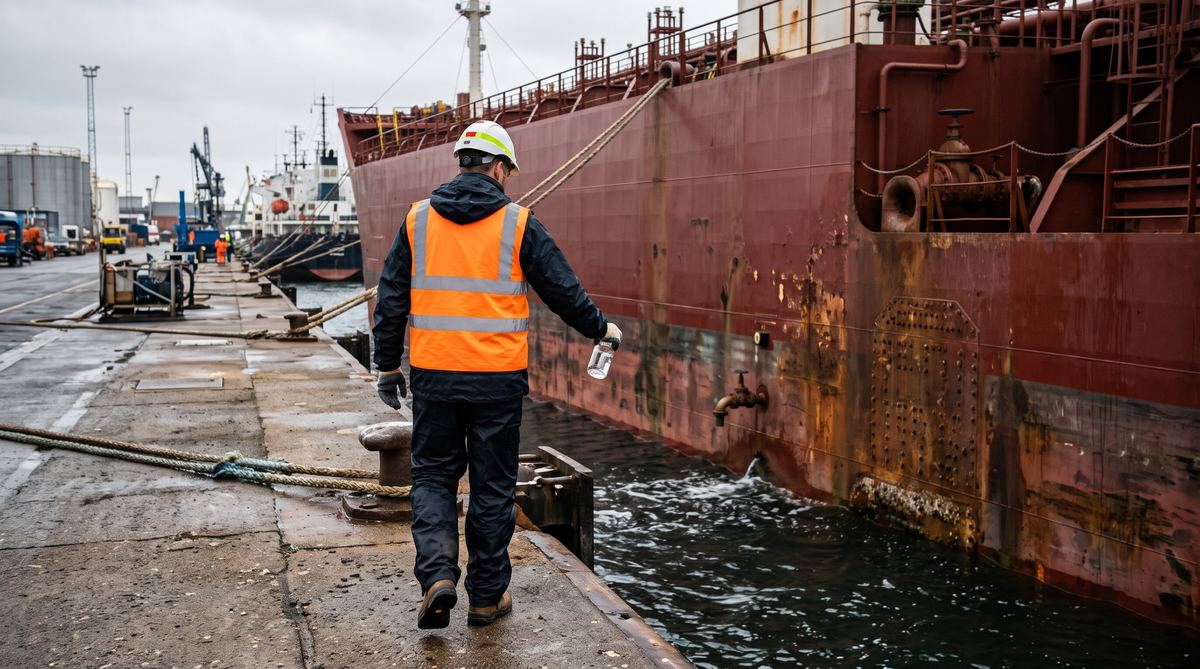
The weak points to avoid are incomplete records, inconsistencies between the record book and the system's logs, officers who do not know the procedures and systems out of service without notice to the administration. To understand how an inspection works and what consequences it can have, read the Port State Control guide.
What to do if the system does not work: contingency measures
It happens that a BWMS stops or does not reach the required limits. The Convention does not simply authorise discharging anyway: the IMO has published guidance on the contingency measures that the crew and the company may adopt in agreement with the flag and the port State.
The typical options, to be assessed case by case, are:
- Repair on board. If possible before discharge, with documentation of the failure and the intervention.
- D-1 ballast exchange. When safety and route conditions allow, as a temporary measure.
- Retention on board. Postponing discharge, if safety and commercial operations allow.
- Delivery to a reception or discharge facility in an agreed area. Only with the consent of the State concerned, and with facilities often limited in availability.
In all cases: inform the flag immediately and, if necessary, the port State, document everything in the record book and keep alarms and logs. A well-handled and documented stoppage is distinguishable from non-compliance.
How Software Simplifies Ballast Water Compliance Management
Ballast water management generates deadlines, records and repetitive maintenance: certificate surveys, replacement of lamps and filters, sensor calibration, officer training. With spreadsheets and scattered records it is easy to miss a deadline or end up with inconsistent data.
The SupaMaritime Merchant module brings together for each ship planned maintenance by calendar or running hours, work orders, certificates with expiry alerts and compliance records, including MARPOL and ballast water, in a single hub. You can enter the tasks of a BWMS in the maintenance plan and keep the record entries alongside the ship's other documents.
The module also covers crew, rest hours and ISM and ISPS items, but does not manage cargo, voyages and charters: see the features and the pages for bulk carrier operators and tanker operators.
Frequently Asked Questions
What is the BWM Convention?
It is the IMO's international Convention for the Control and Management of Ships' Ballast Water and Sediments, adopted in 2004 and in force since 8 September 2017. Its aim is to prevent the transfer of harmful aquatic organisms and pathogens from one region to another through ballast tanks.
What is the difference between the D-1 standard and the D-2 standard?
D-1 concerns the exchange of ballast water in the open sea, with a volumetric efficiency of at least 95%. D-2 is a performance standard: it sets how many viable organisms and indicator microbes may remain in the discharged water and is met with an approved treatment system.
Must all ships have a treatment system?
Almost all those that fall within the Convention and make international voyages with ballast water, after the end of the transitional period. There are exclusions, for example for ships without ballast tanks or that operate only in national waters. Check the specific case with your flag and classification society.
Which documents are needed on board?
The approved ballast water management plan, the record book of operations and the international certificate, for ships subject to them. The system manuals and the type approval documentation must also be kept on board.
What happens if the treatment system breaks down?
Contingency measures apply: repair, ballast exchange, retention on board or delivery to a facility, depending on the case. The flag must be informed, and if necessary the port State, and the failure and the actions must be documented in the record book.
Does the United States follow the same Convention?
No. The United States has its own regime, with system approval requirements distinct from the IMO ones. A ship operating in those waters must check which approvals are needed, in addition to those required by the Convention.
Can the ballast water record book be kept in electronic form?
The most recent amendments to the Convention allow it under certain conditions. Before moving to the electronic format, make sure that flag and class accept it and that the system guarantees the integrity, traceability and availability of the data for inspections.
In Conclusion
Ballast water management is an obligation in which both hardware and discipline count: an approved system, an up-to-date plan, a record book consistent with the logs, trained crews and timely maintenance. Those who treat it as a requirement to install and forget usually find out in a port, with a system that will not start.
Good organisation starts from a single place where the ship's deadlines, maintenance and records are visible together. To build it, discover the SupaMaritime Merchant module and its features for onboard compliance.