IMDG Code: Guide to Dangerous Goods by Sea, Classes, Declaration and Stowage
Every day, millions of packages of chemicals, batteries, aerosols, paints and gases travel in containers on merchant ships. The rules that make this possible without accidents are collected in the IMDG Code, the International Maritime Dangerous Goods Code, which anyone working with packaged cargo will sooner or later encounter.
For freight forwarders, shippers, terminal operators, liner companies and ship agencies the code is a common language: UN number, class, packing group, segregation. An error in the declaration does not remain a paperwork problem. It can stop a container at the gate, hold up a ship or, in the worst cases, start a fire on board.
This guide explains what the IMDG Code is and the legal basis from which it derives, the nine classes, how a dangerous good is identified, what marking and documents must show, how segregation and stowage work, and who is responsible for what along the transport chain.
The key point: the IMDG Code regulates packaged dangerous goods, and responsibility for classifying and declaring them correctly lies with the person who ships them. Downstream, every link in the chain must check that the documentation is consistent with what it sees.
What the IMDG Code Is and Why It Is Mandatory
The IMDG Code (International Maritime Dangerous Goods Code) was developed by the International Maritime Organization (IMO) to lay down how packaged dangerous goods are to be packed, marked, documented, stowed and segregated on board. Its aim is to prevent accidents and to protect crew, ship, cargo and the marine environment.
The code is mandatory by virtue of two international conventions. Chapter VII of the SOLAS Convention makes it binding for the carriage of dangerous goods in packaged form, and Annex III of the MARPOL Convention refers to it for harmful substances carried in packaged form. Contracting States incorporate it into national law.
The code is updated at regular intervals, generally every two years, with amendments that enter into force according to a timetable set by the IMO and that can often be applied voluntarily before the mandatory date. To know which edition applies to a specific shipment, check the amendment in force with your maritime authority or the shipping line.
What it covers and what it does not
The IMDG Code concerns dangerous goods carried in packages: boxes, drums, jerricans, big bags, intermediate bulk containers (IBCs), portable tanks and containers. The carriage of solid bulk cargoes, liquid chemicals in bulk and liquefied gases in the ship's fixed tanks follows other international codes, such as the IMSBC Code, the IBC Code and the IGC Code.
The Nine Hazard Classes of the IMDG Code
Dangerous goods are divided into nine classes according to their primary hazard. Some classes are in turn divided into divisions. The table summarises the structure, with generic examples of products.
| Class | Hazard | Typical examples |
|---|---|---|
| 1 | Explosives (divisions 1.1 to 1.6) | Ammunition, fireworks, detonators |
| 2 | Gases: flammable (2.1), non-flammable non-toxic (2.2), toxic (2.3) | Propane cylinders, nitrogen, aerosols, refrigerants |
| 3 | Flammable liquids | Solvents, paints, fuels, alcohols |
| 4 | Flammable solids (4.1), substances liable to spontaneous combustion (4.2), substances which in contact with water emit flammable gases (4.3) | Sulphur, phosphorus, calcium carbide |
| 5 | Oxidising substances (5.1) and organic peroxides (5.2) | Nitrates, bleaches, polymerisation initiators |
| 6 | Toxic substances (6.1) and infectious substances (6.2) | Pesticides, biological samples |
| 7 | Radioactive material | Radioisotopes for medical and industrial use |
| 8 | Corrosive substances | Acids, caustic soda, lead-acid batteries |
| 9 | Miscellaneous dangerous substances and articles | Lithium batteries, environmentally hazardous substances |
A good can present more than one hazard. The code assigns a primary class and, where necessary, one or more subsidiary hazards, which affect labels and segregation. A liquid that is flammable and also corrosive, for example, carries both indications.
How a Dangerous Good Is Identified: UN Number, Name and Packing Group
Every regulated substance or article has an entry in the code's dangerous goods list. The entry is identified by elements that appear in all documents and on the markings of the package.
- UN number. A four-digit number, preceded by the letters "UN", that identifies the substance or group of substances. For example, UN 1090 corresponds to acetone.
- Proper shipping name. The official name of the entry, to be used as it stands; the commercial name of the product is not enough. For acetone it is "ACETONE".
- Class and subsidiary hazards. The primary class and any additional risks. Acetone is class 3, a flammable liquid.
- Packing group. Indicates the degree of danger for the classes where it applies: I for high danger, II for medium, III for low. The group determines which packagings are permitted. Acetone is in group II.
- Marine pollutant. If the substance is harmful to the marine environment, the entry says so and the package requires a specific mark.
A frequent error is confusing the commercial name with the official name, or giving a generic UN number when a more specific entry exists. Classifying correctly requires the manufacturer's safety data sheet and, for new products or mixtures, often also tests or the advice of an expert.
Marking, Labels and Placards: How a Dangerous Cargo Is Recognised
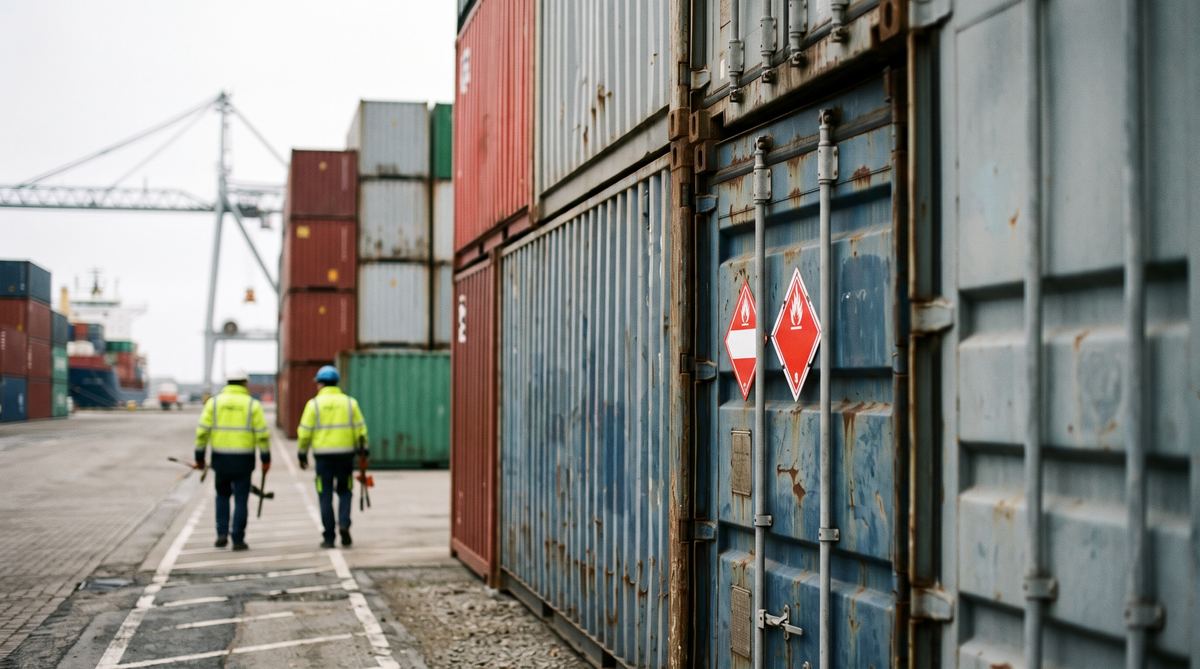
The IMDG Code requires the hazard to be shown visibly, at every level of packaging. Anyone working at the gate, in the yard or on board must be able to recognise the risk without opening anything.
- Marking of the package. The package shows the proper shipping name and the UN number and, for marine pollutants, the dedicated mark.
- Hazard labels. Coloured diamonds with the symbol of the primary hazard and, if present, of the subsidiary ones.
- Placards on the container or vehicle. Larger diamonds, applied on the sides and ends of the cargo transport unit, which show the class of the contents.
- UN number on the unit. In certain cases, the number is also displayed on the container or vehicle, on a panel or on the placard itself.
Dimensions, colours and position are detailed in the code. If the container holds several dangerous goods, the placards reflect all the classes present; once the unit has been emptied (and cleaned) they must be removed or covered.
Dangerous Goods Declaration and Packing Certificate
The central document is the Dangerous Goods Declaration (DGD), signed by the forwarder or shipper who hands the goods to the carrier. It is the declaration of responsibility by which the shipper certifies that the cargo is correctly described, classified, packed, marked and in a fit condition for carriage.
The information required includes the UN number, the proper shipping name, the class, any subsidiary hazards, the packing group, the total quantity and type of packages, any marine pollutant marking and an emergency contact. For some substances the flashpoint and other properties are also stated.
The container packing certificate
When dangerous goods are loaded into a container or vehicle, the person carrying out the loading also signs the container/vehicle packing certificate. It declares that the unit was clean, that the packages are intact and properly stowed and secured, that the markings and placards have been applied and that the segregation rules have been observed.
The declaration and the certificate may be combined into a single multimodal document. They are often completed by different parties, for example the forwarder and the company that loads the container, and must agree on the essential details. For the overall picture of transport documents, see the guide to the bill of lading: the DGD accompanies it but does not replace it.
Segregation and Stowage: Where a Dangerous Cargo Goes
Some goods must not be kept close together, because on contact or in the event of a leak they would react dangerously. The code therefore lays down segregation rules between classes and between specific substances, and indicates for each entry a stowage category, from A to E, with any additional conditions.
The segregation levels range from a simple distance to separation by entire compartments. In brief, the terms used are:
- Away from. A minimum horizontal distance between units.
- Separated from. Different holds or compartments, or a greater distance if on the same deck.
- Separated by a complete compartment or hold. An entire intervening compartment or hold.
- Separated longitudinally by an intervening complete compartment. The strictest level, with an intervening compartment in the longitudinal direction.
Stowage conditions also consider whether the package must be carried on deck only, away from heat sources, from accommodation or from spaces with an ignition risk. On container ships, stowage planning combines these constraints with stability, weights and the port rotation: this is why carriers require dangerous cargo data in advance and approve it before acceptance.
The ship must also have a list, a manifest or a stowage plan showing the dangerous goods on board and their position, and carry a document of compliance for the carriage of dangerous goods. These documents serve the master and, in an emergency, the rescuers.
Limited quantities and excepted quantities: reduced requirements, not absent ones
The code provides simplified regimes for small quantities. Limited quantities (LQ) allow small volumes to be packed in inner packagings of limited capacity, with reduced requirements compared with the ordinary regime. Excepted quantities (EQ) apply to even smaller quantities and have the lightest regime.
Both regimes have their own marking and conditions on packagings and quantities. They do not mean that the goods are not dangerous: outside the limits you return to the full regime, and the conditions must be checked against the edition in force.
Who Is Responsible for What in the Transport Chain
The IMDG Code assigns obligations to each party. The principle is simple: everyone answers for what they do and must check what they receive.
- Shipper. Classifies the goods, chooses approved packagings, applies markings and labels, completes and signs the declaration. The greatest responsibility is theirs.
- Freight forwarder. Collects and passes on the information, books with the carrier and checks that the data is complete. May also be the declarant, if signing in their own name.
- Packer or container loader. Loads, secures and segregates the packages, applies the placards and signs the packing certificate.
- Carrier. Accepts the cargo, checks that the documents are present and formally correct, and plans stowage and segregation.
- Terminal. Receives, stores and handles the units in suitable areas, in compliance with the segregation rules ashore, and checks markings and documents at the gate.
- Master. Answers for the safety of the ship: checks that the goods on board comply with the plan and has the authority to refuse a doubtful cargo.
- Ship agent. Passes on to the authorities and the terminal the notifications required and coordinates information between ship, carrier and port. For the general role, see the guide to the ship agent.
Port Notifications and Formalities for Dangerous Goods
In addition to the transport documents, port authorities want to know in advance which dangerous goods are coming in or going out. At international level the FAL Convention provides a standard form for the declaration of dangerous goods, Form 7, which many administrations now accept only in electronic format.
In the European Union, Directive 2002/59/EC on vessel traffic monitoring provides for notification of dangerous or polluting goods carried by ships bound for ports of the Member States or departing from them. The practical arrangements go through national systems and the maritime single window. Our article on the maritime single window explains how submission works in practice.
Each State adds its own rules on notification deadlines and waiting areas; for quayside procedures, see the guide to port terminal operations software. Before shipping to a new port it is best to ask the local agency for confirmation.
Common Mistakes and the Risks of a Wrong Declaration
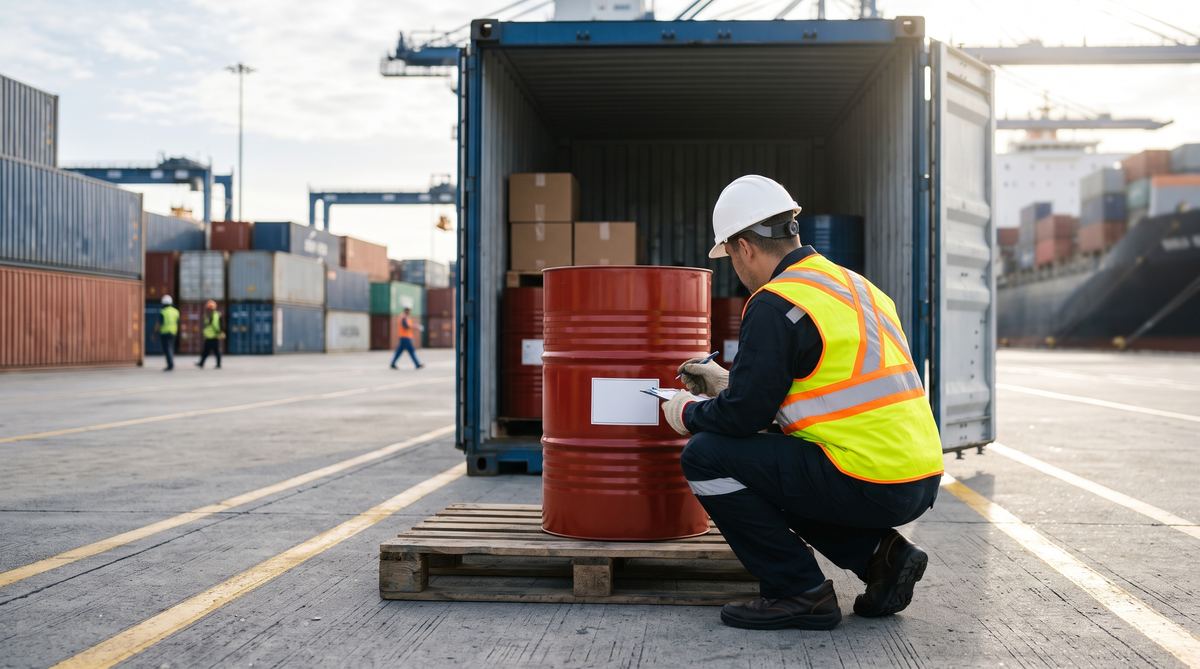
Wrong or missing declarations are one of the known causes of serious incidents on container ships, and maritime authorities and industry associations have long flagged them as a priority. The error is rarely malicious: more often it is an oversight that nobody caught.
- Goods not declared or declared as non-dangerous. The gravest case, because the ship does not know what she is carrying or where to stow it.
- Wrong classification. Class, packing group or UN number do not match the real substance.
- Packagings not approved or damaged. Leaks and breakage of packages during handling.
- Segregation ignored inside the container. Incompatible goods loaded in the same unit.
- Placards missing, wrong or forgotten. The empty container still carrying them, or the full one that has none.
- Inconsistent documents. The weight or packages in the declaration do not match what was loaded, or the emergency contact does not answer.
Consequences can include penalties, refusal of the cargo, delays, clean-up operations and damage to third parties; penalties depend on national legislation and, for specific cases, a legal adviser or the insurer is needed.
Training for those who work with dangerous goods
The IMDG Code requires all persons involved in the carriage of dangerous goods to be trained in a manner proportionate to their responsibilities. Training includes a general awareness of the rules, function-specific training for the role performed and a safety component, and it must be documented.
It applies to those who classify, pack, accept bookings, plan stowage and work at the gate or on board, and must be refreshed with each new edition of the code.
How Software Simplifies the Management of Dangerous Goods Information
Classification and declaration of dangerous goods remain the responsibility of those who ship and those who carry, and take place in the systems of carriers and terminals. What the software of an agency or a shipowner can do is keep in order the information and documents that surround the port call.
The SupaMaritime Agent module gathers services, activities, documents and emails for each port call in a single record, from draft to closing. An agency can thus keep documents and communications with the carrier, terminal and authorities together with its other files, and find them again when needed.
The SupaMaritime Merchant module brings together for each ship certificates, ISM, ISPS and MARPOL records, crew and maintenance, useful to anyone running a fleet carrying regulated cargo. It does not replace the systems for the declaration or the stowage plan, which remain the carrier's. For agencies handling daily port calls, a starting point is the solution for port agents, and for those running container lines, the one for container line operators.
Frequently Asked Questions
What is the IMDG Code in simple terms?
It is the international regulation that lays down how to carry packaged dangerous goods by sea: how they are classified, how they are packed and marked, what documents are needed and how they are stowed on board.
It is issued by the IMO and made mandatory by the SOLAS Convention. It applies to anyone who ships, carries or handles these goods.
How many classes of dangerous goods are there in the IMDG Code?
Nine, numbered 1 to 9: explosives, gases, flammable liquids, flammable solids, oxidisers and peroxides, toxic and infectious substances, radioactive material, corrosives, and miscellaneous dangerous substances and articles.
What is a UN number?
It is a four-digit number, preceded by "UN", that identifies a dangerous substance or group of substances. It appears on the package, in the declaration and in the code's dangerous goods list.
Together with the proper shipping name it allows anyone, in any port, to know what is involved and which rules to apply.
Who completes the dangerous goods declaration?
It is completed and signed by whoever hands the goods over for carriage, generally the shipper or the forwarder acting on their behalf. If the goods are loaded into a container, whoever carries out the loading also signs the packing certificate.
The carrier does not classify the cargo on behalf of others, but is required to check that the documents are present and formally correct before accepting it.
How often is the IMDG Code updated?
Generally every two years, with a series of amendments adopted by the IMO. There is normally a period in which the new edition can be applied voluntarily before it becomes mandatory.
The exact dates depend on IMO acts and national transposition: check them every time.
Final Thoughts
The IMDG Code works if every link in the chain does its own part well and checks that of the link before. A correct classification, a consistent declaration and a container marked as declared cost little; problems arise when one of these three elements is missing.
For agencies and shipowners, the daily work consists of keeping the documents and communications of each port call in order and flagging inconsistencies before the ship is in port. To see how the work of an agency is organised, you can start with the SupaMaritime Agent module.