Ship Chandler and Ship Supplier: What They Supply and How to Work with Suppliers to Vessels
A ship in port has only a few hours to do everything: load or discharge, take on spares, and replenish food and consumables. Behind much of this supply there is a ship chandler, also called a ship supplier, who brings what is needed to the quay or to the anchorage within the time of the port call.
When supply works, nobody notices. When it does not, the consequences show immediately: meat thawed and refrozen, the wrong paints, a spare part delivered an hour after departure, an invoice that does not match the order. The relationship with the ship supplier is therefore a concrete part of the cost and risk of every port call.
This guide explains what a ship chandler sells, how an order flows from request to invoice, what bonded ship stores are, how quotations are compared using IMPA codes and what role the ship agent plays. It is aimed at purchasing departments, superintendents, masters and agencies.
The key point: a good ship chandler is judged on punctuality, order accuracy and clean paperwork, not on price alone. An agent who coordinates the order, port access and delivery avoids most problems before the ship has sailed.
What a Ship Chandler Is and How It Differs from a Ship Supplier
A ship chandler is a supplier that provides ships with consumables and equipment during a port call. In Italy the current term is provveditore navale, or simply "fornitore di bordo"; in English the terms ship chandler, ship supplier and ship's provedore are all used, and in port practice people often say just "chandler".
The chandler is not a shipowner, not an agent and not a generic wholesaler. It buys from manufacturers and distributors, assembles the order, delivers it to the ship and invoices. In many cases it works for several principals in the same port and relies on warehouses, cold rooms and transport of its own or of third parties.
Operators differ greatly. A large international supplier present in several ports and a small local business serving ships at anchor with its own boat may sell the same items, but they offer different guarantees, coverage and prices.
Chandler, supplier and agent: three distinct roles
The chandler supplies the goods. The ship agent coordinates the port call, obtains port access for the supplier and advances or pays local expenses. The principal, that is the shipowner, ship manager or charterer, decides what to order and approves the quotation. For the general role of the agent, see the guide to ship agency and the ship agent.
What Ship Chandlers Supply: The Main Categories
The range is very wide. To find your way around, it helps to think by category, because each one has its own rules, delivery times and checks.
- Fresh and dry provisions. Meat, fish, fruit, vegetables, dairy products, flour, tinned goods, soft drinks and everything the galley needs.
- Bonded stores. Alcohol, tobacco and other items that, under certain conditions, are taken on board free of duty and indirect taxes. They are discussed below.
- Deck stores. Ropes and wires, paints, brushes, solvents, spare anchors and chains, mooring fittings, and tools for hull maintenance.
- Engine stores. Gaskets, filters, bearings, tools, rags, bilge and engine room cleaning products, nuts and bolts. Engine-specific spares often come from the manufacturer or an authorised distributor.
- Cabin and housekeeping items. Linen, soaps, cleaning products, items for cabins and common areas.
- Safety equipment. Fire extinguishers and refills, lamps, lifejackets, overalls, personal protective equipment, drill materials.
- Related services. Delivery of fresh water, collection of waste and waste oil, equipment rental and logistics for spares in transit.
Propulsion fuels (bunkers) have a separate channel and are not part of a ship chandler's ordinary business.
Ship Stores, Provisions and Bonded Stores: The Customs Side
Anyone working with ships soon encounters the subject of bonded stores. These are goods intended for consumption on board which, for ships engaged in international trade, may be supplied under an exemption or suspension of duties and taxes. Typical examples are cigarettes, alcohol and, in some cases, ship's fuel.
The principle is simple. The item is bought free of tax because it will be consumed at sea, not in national territory. For this reason customs control the deliveries and, if necessary, seal the spaces in which the goods are kept while the ship is in territorial waters.
The detailed rules depend on the country and the customs union. In the European Union there is a common customs regime, but delivery procedures, declarations and limits per person or per voyage may vary. The chandler must know them; the owner, through the agent, must check with the supplier and the local authority that the supply is permitted for the type of voyage.
What must not be forgotten
- The ship's destination. The exempt regime generally applies to ships in international trade; for calls and coastal trade the conditions may differ.
- Documents and records. The list of ship stores, delivery notes and the records kept by the master must be filed in an orderly way.
For the rules applicable in a specific port, always ask the chandler and the local agency for confirmation and, if in doubt, the competent customs office.
How an Order Works: From Request to Invoice
The flow is the same in most cases, and understanding it helps to see where delays and errors arise. The timing changes, not the sequence.
- Requisition. The ship, or the technical office, fills in the request with items, quantities, units of measure and priority. In the galley and on deck the list often comes from the consumption inventory.
- Request for quotation. The purchasing office sends it to one or more suppliers, stating the port, ETA, delivery date and commercial terms.
- Quotation and comparison. Suppliers reply with prices, lead times, proposed substitutes for items that are not available and delivery costs.
- Purchase order. The principal approves and issues a purchase order with references to the ship, port and cost centre.
- Preparation. The chandler picks, checks and packs. For fresh goods, preparation takes place as close as possible to delivery.
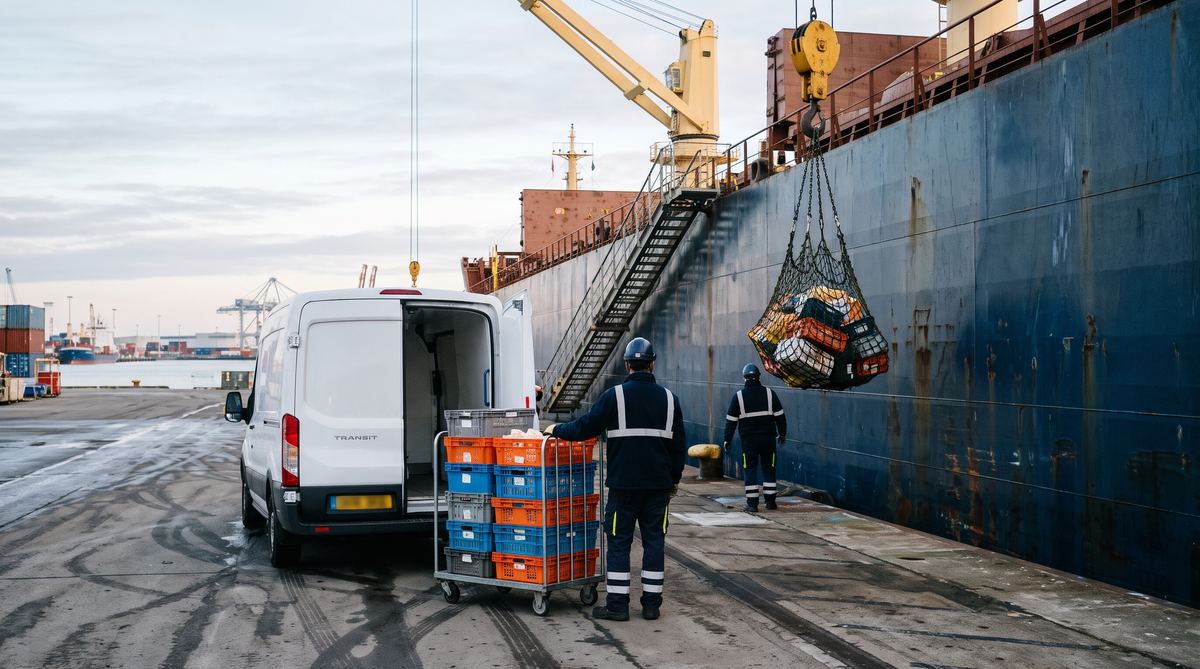
- Delivery. The goods arrive at the quay or the anchorage, pass the security checks and are taken on board.
- Receipt and inspection. The person responsible on board, usually the chief officer or the head cook for provisions and the chief engineer for engine stores, checks quantity and quality and signs the delivery note.
- Invoice and closing. The supplier issues the invoice on the basis of the order and the signed delivery note; the purchasing office reconciles it before payment.
The point where the process most often breaks down is the step between the order and the signed delivery note: if the note does not record substitutions and part deliveries, the invoice does not match.
The IMPA Code and How to Compare Quotations
To make offers comparable, the industry has for decades used a common language. IMPA (the International Marine Purchasing Association) publishes a catalogue of marine items, each with a six-digit numerical code. The code states precisely what is being requested, regardless of the trade name.
An order line that shows the IMPA code, the unit of measure and the quantity leaves little room for misunderstanding. It helps the supplier to prepare and the owner to compare different offers for the same item. Not all goods have a code, for example many fresh products and specific items, but for deck, engine and safety stores it is the reference tool.
What to look for in a quotation
- Unit price and unit of measure. A pack of ten or of twelve, litres or kilograms: a difference in unit can change the comparison.
- Brand and specification. "Or equivalent" needs clarifying: which brand, what quality, who approves the substitution.
- Additional costs. Transport, packing, use of a boat for anchorage delivery, out-of-hours overtime, port dues and coordination fees.
- Timing and schedules. The delivery deadline must be compatible with the updated ETA and with the terminal's operating window.
The lowest price is not always the best: an offer with many substitutions or extra charges may turn out dearer than a complete one. On the organisational side, the guide to ship provisioning and procurement software looks at the process in more depth.
Delivery at the Quay, at Anchorage and on Short Calls
Getting the goods to the ship is often the most complicated part. There are many variables and almost all of them are outside the supplier's control: berthing, weather, terminal hours, port access, availability of the crew to receive.
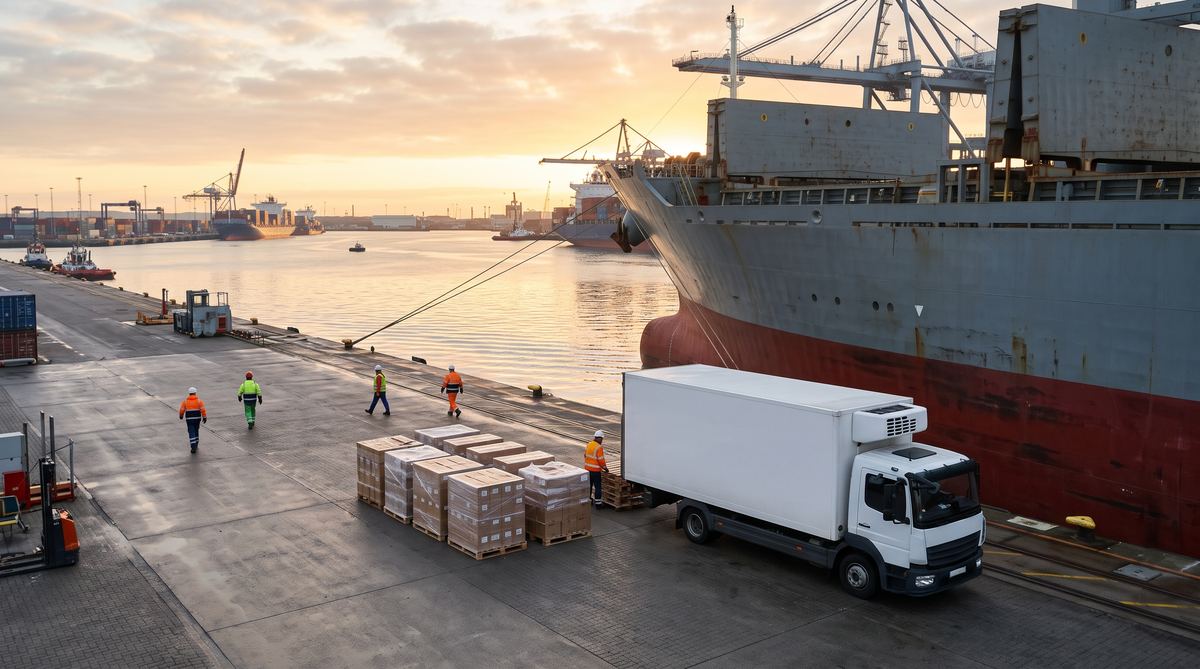
At the quay, delivery is relatively simple, but the supplier must be able to enter the terminal with vehicles and personnel, and the ship must have a crane, derrick or gangway to take the goods on board. Port access and security rules, linked to the ISPS Code, generally provide for checks on visitors and on the materials going on board.
At anchorage the service requires a craft, usually a launch or a barge, and the master's cooperation to embark the goods safely. Rough seas can cancel or postpone the delivery, and the hours of navigation cost money. For this reason many orders for ships at anchor are planned with wide margins and with alternatives.
On short calls it is best to fix the delivery window with the agent as soon as the ETA is known and to have a plan B for whatever does not arrive: an order delivered early almost always costs less than a ship waiting.
Quality, Freshness and Food Safety
Food provisions deserve particular attention. On board, a load of rotten vegetables cannot be sent back once the ship has sailed, and the quality of the food affects the health and morale of the crew. The Maritime Labour Convention (MLC 2006) requires food and drinking water of appropriate quality, quantity and nutritional value.
On receipt, the person responsible checks a few essential points:
- Cold chain. Temperature of the vehicle and of the chilled and frozen products, with no signs of thawing and refreezing.
- Expiry dates and batches. Dates consistent with the length of the voyage, intact packaging, legible labels.
- Freshness. Appearance, smell and ripeness of fruit and vegetables, matched to the time expected until the next replenishment.
- Match with the order. Quantities, cuts, sizes and agreed substitutions.
If something is wrong, the complaint must be made immediately, with photographs, a note on the delivery note and notification to the supplier and the agent. After departure, any remedy becomes slower and more expensive. To go deeper into running the galley, see our article on catering and galley management software.
The Role of the Ship Agent and Cash to Master
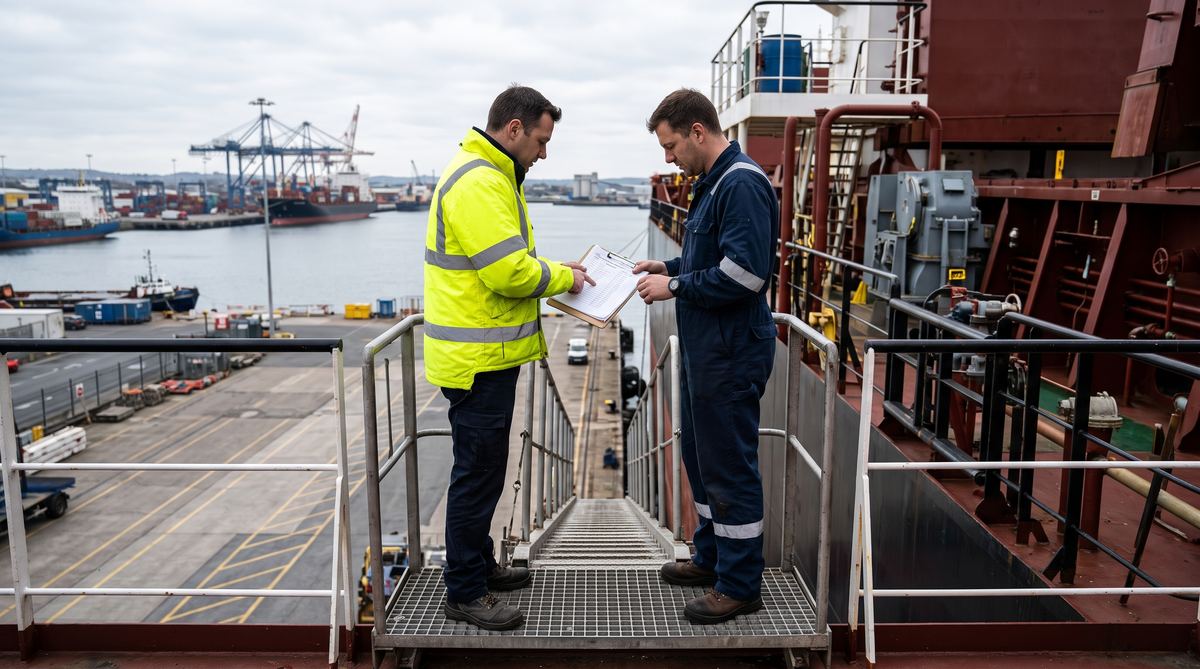
The agent is the link between the ship, the principal and the supplier. The agent receives the list, passes the request to the chandler, checks that the terminal access permit is ready and tells everyone the delivery time. On the quay, it is often the agent who obtains the passes for vehicles and personnel.
If the supplier works on behalf of the agent, the expense is included in the items of the port call account, first the proforma disbursement account and then the final disbursement account. Anyone wanting to understand how these items are built up and reconciled can read the guide to disbursement account, PDA and FDA software.
What cash to master is
Cash to master (CTM) is an advance of cash that the agent hands to the master during the port call, on the principal's instruction. It is used for small onboard expenses, for cash wages where applicable or for urgent needs.
Because it is cash, it calls for precautions: a written instruction from the principal, an agreed limit, a receipt signed by the master and an entry in the port call account. Many companies and many flag States set limits on the amount of cash on board; the permissible amount must therefore be checked against your own internal policy and local rules.
How to Assess a Ship Supplier and Which Mistakes to Avoid
A supplier is assessed over time, with data and not with impressions. A simple checklist helps both in the initial choice and in periodic reviews.
- Coverage and capacity. The ports, hours and types of ship served, at the quay and at anchorage, and the ability to handle demand peaks.
- Punctuality. How many deliveries arrive within the agreed window and how delays are handled.
- Order accuracy. How many lines arrive complete, with the right item and without unauthorised substitutions.
- Quality and traceability. Origin of foodstuffs, certifications, storage conditions and cold chain.
- Documents. Delivery notes, invoices and customs documents that are correct, legible and consistent with the order.
- Commercial soundness. Clear payment terms, insurance and financial reliability, checked with your office's usual sources.
The most common mistakes recur regularly, and almost all of them are avoidable:
- Late orders. They reach the supplier when the ETA is already close, with no margin for fresh goods and special items.
- Ambiguous lines. Generic descriptions instead of code, size and specification.
- Substitutions not agreed. The "equivalent" item changes in quality or price without authorisation.
- Delivery notes signed without checking. Then the invoice does not match and there is no way to prove it.
How Software Simplifies Working with Ship Suppliers
In agencies the relationship with suppliers is scattered across emails, messages and spreadsheets. The SupaMaritime Agent module gathers services, activities, documents, emails and deliveries in a single record for each port call, from draft to closing. Whoever coordinates a supply therefore has the time, documents and communications with the ship at hand.
Port call expenses flow into the disbursement accounts: the module handles PDAs and FDAs with line items, allocation between several owners and PDF export, as well as invoices, payments and the net balance per port call. This makes it simpler to reconcile a supply with the corresponding account line, and also the cash to master, which remains tracked within the same port call.
To find out more about what the module covers, see the page on Agent features. Agencies handling everyday port calls will find a starting point in the solution for port agents, while those coordinating a network of ports can look at the one for hub agencies.
Frequently Asked Questions
Who pays for ship supplies: the owner or the charterer?
It depends on the charter party. Under a time charter, provisions, water and ship supplies for the crew are generally for the owner's account, while the charterer bears bunkers and port expenses. Under a voyage charter the owner normally bears the ship's running costs.
Specific clauses can change this allocation, so the charter party must be read. If in doubt, ask your chartering department for confirmation.
What are bonded stores?
They are goods intended for consumption on board, such as alcohol and tobacco, supplied to ships in international trade under an exemption or suspension of duties and taxes. They remain under customs control and cannot be sold ashore.
The conditions and procedures vary from country to country. For the port of call, ask the chandler, the agency and, if necessary, customs.
What is an IMPA code?
It is the six-digit numerical code by which the IMPA catalogue identifies marine items. It serves to describe a product unambiguously, regardless of brand and language, and to compare several quotations on the same order line.
It does not cover every item: for many fresh goods and for very specific items, traditional descriptions are used.
How far in advance should supplies be ordered?
It depends on the port, the type of goods and the length of the call. As a rule of thumb, the more unusual the goods or the shorter the stay, the earlier you need to act. For fresh provisions and customs items you think in days, not hours.
The right moment is when the ETA is stable enough to fix a delivery window: at that point the agent can confirm it to the supplier and check port access.
Can goods be received at anchorage?
Yes, with a suitable craft and sea conditions that allow safe embarkation. The master's consent and coordination with the agency are needed. The cost is generally higher than at the quay and the risk of postponement greater: it is best to allow for time margins.
Final Thoughts
The ship chandler is one of the suppliers most present in a ship's life, yet is often handled with last-minute haste. Those who structure the process, from requisition to signed delivery note, reduce errors, disputes and delays without changing supplier.
For agencies, keeping the port call, documents, expenses and communications in one place makes the supply an item under control rather than an unknown. To see how the work of a port call is organised, you can start with the SupaMaritime Agent module.