Ro-Ro and Ro-Pax Ferries: How They Work, from Vehicle Loading to Safety
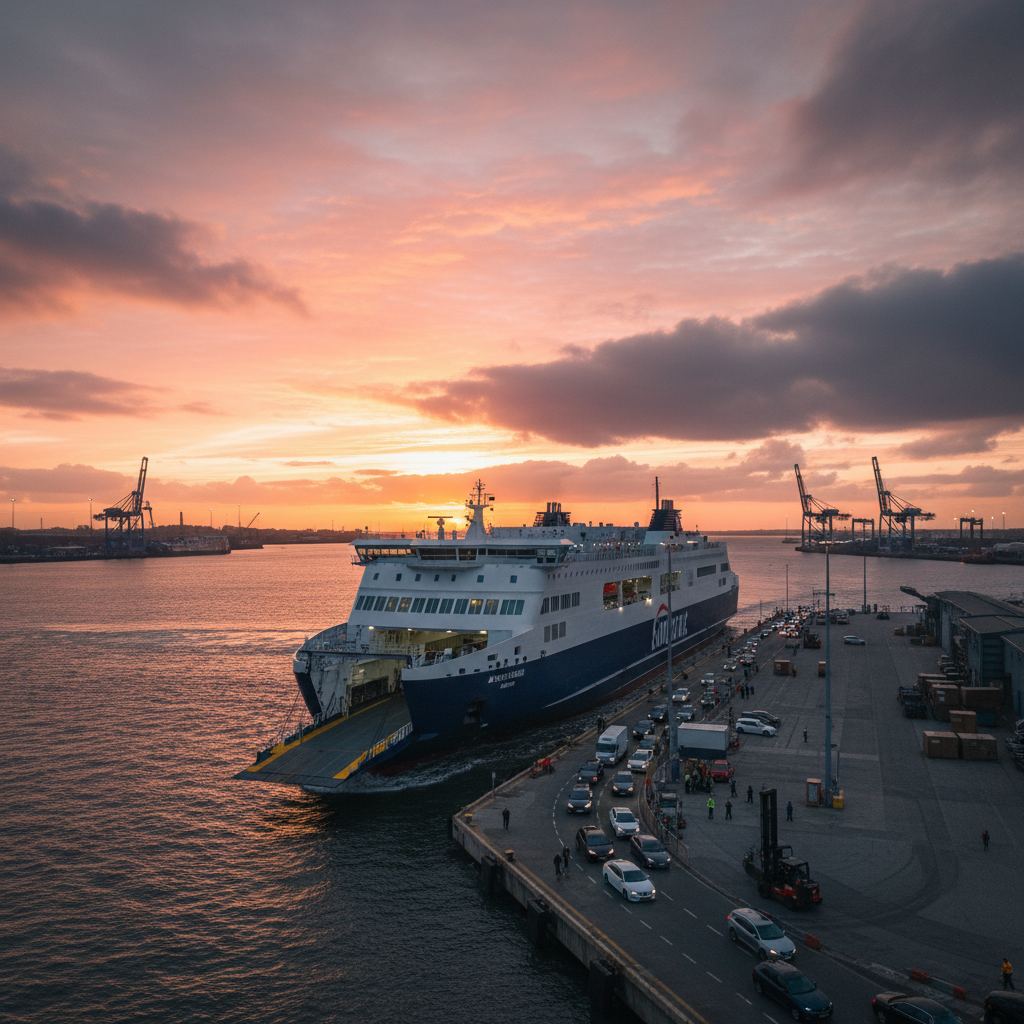
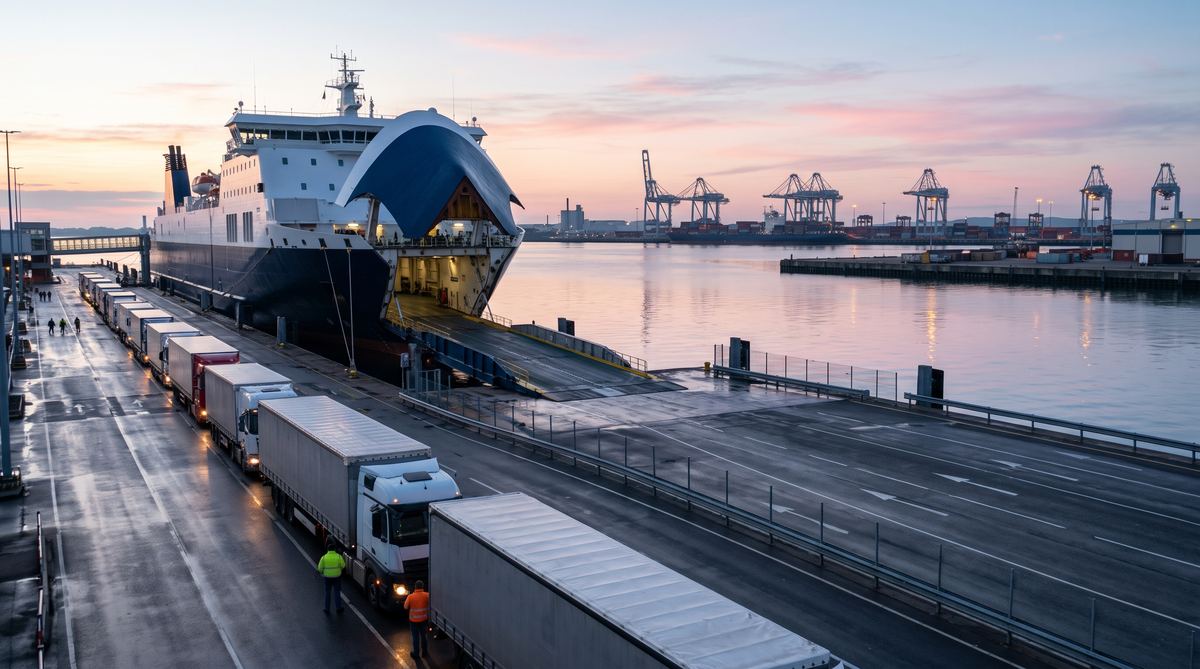
A truck drives up the ramp, stops in its assigned lane, is lashed down, and twenty minutes later the ship is already manoeuvring. This is the daily work of a Ro-Ro ferry: a ship on which vehicles drive on and off under their own power, with no cranes and no specially equipped quay.
Behind that apparent simplicity lies a complex machine. It needs a stowage plan, controlled stability, fire protection designed for decks full of vehicles and a port call that must keep to time even with passengers, trucks and dangerous goods on board at once.
This guide explains what Ro-Ro and Ro-Pax mean, which ship types exist, how a car deck is loaded, which risks have shaped the safety rules, how the port call works and how to think about the commercial model. It is meant for operators, technicians, shore staff and anyone entering the sector.
The key point: on a Ro-Ro, profitability and safety come from the same place, the car deck. Every metre of lane used well earns revenue, every badly positioned or badly lashed vehicle is a risk, and the difference is made by discipline during the port call.
What Ro-Ro and Ro-Pax mean
Ro-Ro stands for roll-on/roll-off: the cargo rolls on and rolls off. It contrasts with Lo-Lo, lift-on/lift-off, where cargo is lifted by crane, as happens with containers on a traditional container ship.
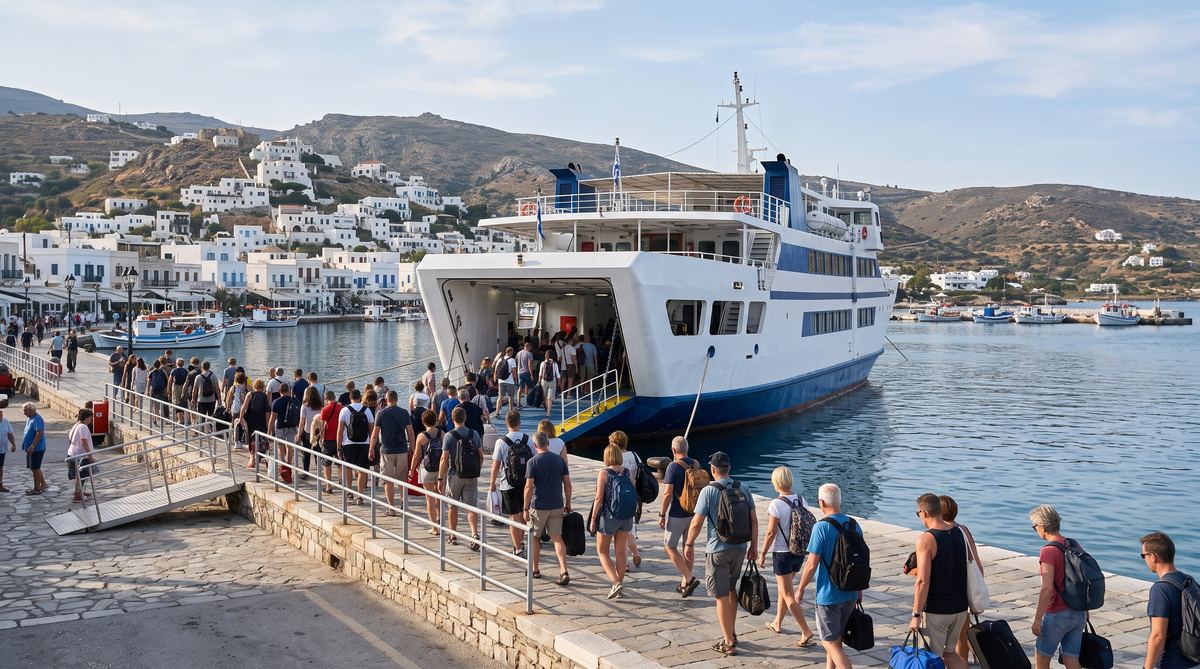
Ro-Pax is the contraction of Ro-Ro passenger: a ship carrying wheeled vehicles and passengers on the same hull. These are the ferries we know best, with trucks and cars on the lower decks and cabins, restaurants and lounges above.
In everyday language "ferry" and "Ro-Pax" overlap, but the distinction matters. A pure Ro-Ro, with no passengers beyond the drivers of the vehicles, has different rules, equipment and economics from a Ro-Pax carrying thousands of people.
The advantage is port call speed and logistical simplicity. The vehicle goes from point A to point B without being unloaded from the truck, and the road haulier avoids breaks in the cargo chain, with less risk of damage and less handling.
This explains the strength of Ro-Ro on short and medium routes, on island links and wherever sea transport is one leg of a road journey. The price to pay is that much of the ship's volume is used to carry air between one vehicle and the next.
Types of Ro-Ro ship: Ro-Pax, Ro-Ro cargo, Con-Ro and PCTC
Very different ships coexist under the Ro-Ro label. The table summarises the main families, bearing in mind that commercial categories do not always coincide with the definitions of international rules.
| Type | What it carries | Typical features |
|---|---|---|
| Ro-Pax | Passengers, cars, trucks, trailers | Car decks plus passenger accommodation and services, fixed timetables, frequent port calls |
| Ro-Ro cargo | Trucks, trailers, heavy vehicles, sometimes a few drivers | Few or no passengers, plenty of space for cargo, regular routes |
| Con-Ro | Containers and rolling cargo | Decks for wheeled vehicles and holds or open deck for containers |
| PCTC | New cars and trucks, construction machinery | Many decks, often height-adjustable, stern or side ramp, long routes |
| Train ferry | Railway wagons, sometimes road vehicles too | Tracks on deck, rare but present on some specific routes |
How a ferry is loaded: ramps, decks and lane metres
The heart of the operation is the car deck. Vehicles gain access through one or more ramps, at the bow, stern or side, which rest on a movable or fixed linkspan on the quay. The connection between quay and ship depends on the port and the tides.
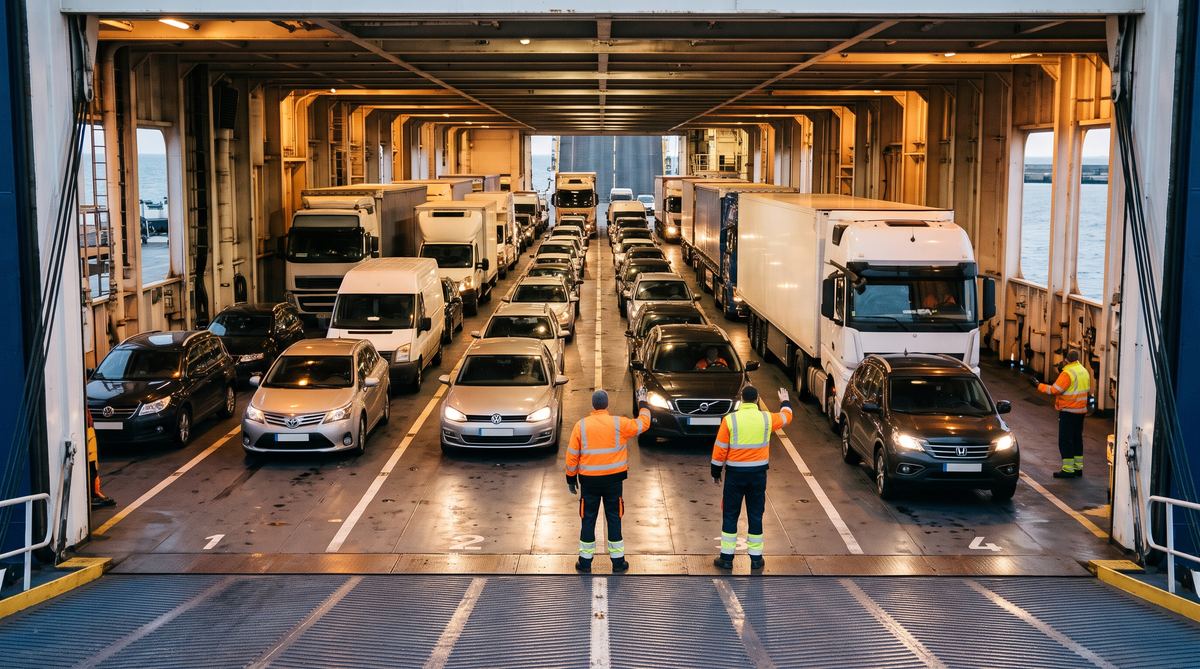
The deck is divided into lanes, parallel strips along which vehicles are lined up. Loading capacity is therefore measured not only in number of vehicles but in lane metres: a truck with trailer can occupy many metres, a car very few.
The stowage plan
Before boarding, the responsible officer, usually the chief officer, works with a stowage plan. The plan decides where each vehicle goes, taking account of many requirements that often conflict with each other:
- Order of discharge. Vehicles leaving at the first port must be accessible, without blocking those bound for later calls.
- Weight and centre of gravity. The heaviest loads must be positioned so as to keep trim and stability within approved limits.
- Height and profile. Tall vehicles must clear the deck beams and any movable decks.
- Dangerous goods. Some vehicles require specific positions, segregation and checks, as our guide to the IMDG Code explains.
- Refrigerated vehicles. They need electrical sockets and accessible positions for checking the refrigeration unit.
The plan is not a static document. It changes up to the last moment, when a truck does not show up, another arrives out of hours or the actual weight differs from the declared one. That is why the port call works well only if information ashore and on board stays aligned.
Lashing and securing vehicles
An unlashed vehicle in a rough sea becomes a projectile weighing many tonnes. Lashing secures trucks, trailers and cars to the deck with chains, straps and suitable devices, in accordance with the ship's cargo securing manual, which must be approved by the flag.
The basic rules are easy to state and hard to enforce when in a hurry: handbrake on, gear engaged, securing points used correctly, no vehicle left loose. The discipline of the deck crew and the time allowed for the port call are the real safety factor.
Safety on Ro-Ro ferries: stability, car deck and fire
Ro-Ro ferries have structural characteristics that make them special from a safety standpoint. The car deck is one large open space, with no internal transverse bulkheads, and its position, close to the waterline, weighs on stability in the event of damage or flooding.
The international rules, collected in the SOLAS Convention, have been strengthened several times after serious accidents involving ferries of this type. Two very well-known cases, the Herald of Free Enterprise in 1987 and the Estonia in 1994, showed how fatal a hull opening left open or failing can be for this family of ships.
Water on deck and stability
The most studied risk is water on the car deck. When water enters a large, uncompartmented space, it moves from side to side as the ship rolls, and this free surface effect can quickly reduce stability.
That is why hull openings matter: doors, ramps and visors must be closed and secured before departure, with checks and closure indicators on the bridge. The rules on damage stability have been revised over time with this family of ships in mind too.
If you are an operator, the precise requirements depend on the date of construction, the area of operation and the flag. A serious analysis starts from the ship's certificates and consultation with the classification society, not from a general summary.
Fire on the car deck
A deck full of vehicles has a significant fire load: fuel in tanks, batteries, tyres, cargo. The rules provide for these spaces detection, controlled ventilation, compartmentation and fixed extinguishing systems, with requirements that vary with the type of space and the date of construction.
Operating practices count as much as the installations. A regular patrol of the deck during the crossing, checks on refrigerated vehicles and sockets, inspection of vehicles showing signs of leaks or damaged batteries and fire drills are part of the routine of a well-run Ro-Ro, and must be written into the safety management system: the guide to the ISM Code in practice explains this.
A development that operators follow closely is vehicles with high-capacity batteries. How to handle them on deck, in which spaces and with what emergency procedures is an evolving subject: follow the circulars of the flag, the class society and the IMO.
The port call: timing, mooring and order of operations
A Ro-Ro earns its keep in the time spent at sea, not at the quay. That is why every minute of the port call is measured. On short routes a turnaround time of, indicatively, a few tens of minutes may be the parameter that decides whether a timetable is sustainable.
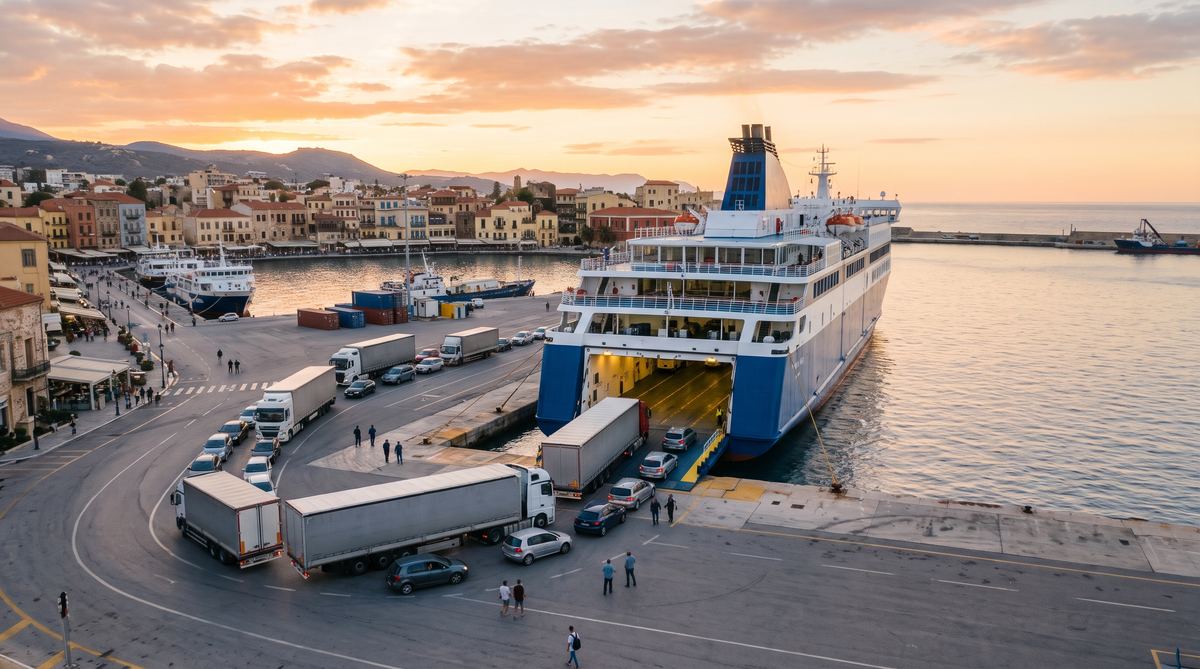
The typical sequence is simple. The ship moors, the ramp is lowered, outgoing vehicles disembark, departing ones embark in the order of the stowage plan, lashing is done, the openings are closed, and the ship sails after the final checks.
Each step depends on a different actor: mooring crews, quay staff, the terminal, border police and customs, shipboard staff. Every delay adds up and is rarely recovered, unless by sailing faster, at a fuel cost that is far from negligible.
Passengers, cars and trucks: how they coexist on the same ship
On Ro-Pax ships passengers and freight share the hull, the port and sometimes the ramp. The organisation must prevent the two flows from obstructing each other: separate access for vehicles and pedestrians, distinct waiting areas, a boarding order that favours those with tight schedules.
Truck drivers are a category of their own. Some travel with the vehicle and are entitled to dedicated areas on board, others hand over the trailer and do not board. Ticket type, timetables and layover rules change accordingly.
Unaccompanied trailers
An unaccompanied trailer travels without a tractor unit and without a driver. It is taken onto the deck by a terminal tractor, lashed by the crew and picked up by another tractor unit at the port of arrival. The advantage is that the costs and working hours of a driver standing idle at sea are avoided.
In exchange, more coordination is needed. An unaccompanied trailer requires proper transport documents, a clear delivery point, tractors and staff in port and secure identification. A mistake on a plate or a booking reference turns into concrete delays.
The number of people on board
On a Ro-Pax it is not only what is carried that counts, but also who is on board. The number of persons cannot exceed the figure stated on the ship's safety certificate, and they must be counted and, in certain cases, registered. We discuss this in the article on passenger registration on ferries.
How ticketing and passage booking work
The revenue of a Ro-Pax comes from several channels. Foot passengers buy a travel ticket, travellers with cars book a vehicle space, road haulage companies book lane metres, often through framework contracts and commercial agents.
The two logics are different. The passenger buys a seat or a cabin, while the haulier buys deck space. The booking system must therefore manage two inventories that coexist on the same sailing and influence each other.
Tickets for island routes
On island links with several calls per voyage, capacity must be counted leg by leg: a seat free between the first and second call may be taken further on. A system designed for point-to-point routes struggles to represent this situation well.
The commercial model: lane metres, tariffs and freight
For wheeled freight the tariff is normally based on the space occupied: lane metres, or another equivalent unit, and sometimes weight. The tariff usually distinguishes by vehicle type, route, season and customer, with different conditions for large contracts.
The revenue of a sailing is made up of four main components, each with different logic and margins:
- Passengers. Foot tickets, cabins and seats, with often marked seasonality.
- Accompanying vehicles. Cars, motorbikes, motorhomes, with tariffs tied to length and height.
- Wheeled freight. Trucks and trailers, with contracts, volumes and prices that are more stable over the year.
- Onboard services. Catering, shops, supplements and cabins, which depend on the length of the crossing.
The operating indicators that matter
A Ro-Ro is managed with a few numbers, read often and per sailing. There is no universal list, but these are among the indicators most used by operators, to be calculated with consistent definitions for each route.
- Lane metre fill rate. How much lane has been sold and how much actually occupied, per sailing and per direction.
- Departure and arrival punctuality. Measured against the published timetable, with a declared tolerance threshold.
- Turnaround time. From mooring to departure, with detail of the discharge, loading and closing phases.
- Fuel consumption per leg. Compared with speed and load, because punctuality recovered at sea has a cost.
- Ship availability. Days in service compared with maintenance and unplanned stoppages.
- Complaints and incidents on deck. Damage to vehicles, missed deliveries, reported near misses.
The weak point of many operators is not a lack of data but its dispersion: bookings in one system, maintenance in another, crew in a third. Our guide to ferry software with dynamic scheduling explains how to rebuild the picture.
How Software Simplifies Ferry Management
The technical and regulatory side of a Ro-Pax ship is made up of many deadlines: certificates, inspections, maintenance, crew rest hours, drills. Missing one means risking a detention or a non-conformity during an inspection.
The SupaMaritime Ferry module covers maintenance, crew, rest hours and ISM, ISPS and SOLAS compliance for passenger and ro-ro ferries. It gathers safety equipment with expiry dates, certificates with alerts, rosters, drills and shipboard documents in a single environment. Ticketing, bookings and car deck loading are not part of it.
For selling passages on island routes there is a separate module, SupaMaritime Ferry Booking. It manages voyages with several calls and seats counted leg by leg, tariffs from your own tariff table, online and counter sales and manifests per port call with QR scan boarding.
Discover the Ferry module and Ferry Booking, or the pages dedicated to Ro-Pax operators and multi-route networks.
Frequently Asked Questions
What is the difference between a Ro-Ro and a Ro-Pax ship?
A Ro-Ro ship carries wheeled vehicles that drive on and off under their own power. A Ro-Pax is a Ro-Ro that also carries passengers, with cabins, services and safety equipment for people. A pure Ro-Ro normally has few passengers, often only the drivers.
What do lane metres mean on a ferry?
They are the linear metres of lane available on the car deck. They are used to measure loading capacity and to build tariffs for vehicles, because a vehicle occupies a length of lane more than a volume. The term is used in the industry as "lane metres".
Why are Ro-Ros considered more delicate from a safety standpoint?
Because of the large car deck without transverse bulkheads, where water can accumulate and shift, and because of the fire load of the vehicles. For this reason the SOLAS rules have been strengthened over time. The requirements applicable to a ship depend on flag, date of construction and area of operation.
What is an unaccompanied trailer?
It is a trailer shipped without a tractor unit and without a driver, taken on board by a terminal tractor and collected at the port of arrival by another tractor unit. It reduces transport costs but requires careful documents, identification and coordination.
How long does a Ro-Pax port call last?
It depends on the route, the ship and the port. On short links turnarounds of a few tens of minutes are common; on long routes or with heavy loads they are longer. The important thing is to define a target time per port call and measure it consistently.
Do passengers have to be registered on board a ferry?
The number of persons on board must always be counted, and for some crossings registration of passenger details is also required, under European legislation and national rules. The details are in our guide to passenger registration on ferries.
Final Thoughts
A Ro-Ro ferry works well when three things line up: a car deck filled methodically, a crew that applies closures, lashing and patrols with discipline, and a port call in which information arrives before the vehicles. The rest, from tariffs to indicators, follows from that.
If you manage one or more Ro-Pax ships and want to keep certificates, maintenance, crew and compliance under control, discover the SupaMaritime Ferry module.