
Passenger Registration on Ferries: EU Requirements, Passenger Lists and the Data to Collect
If a ferry has an emergency, the first question from the rescue services is always the same: how many people are on board, and who are they? Passenger registration exists so that this can be answered within minutes, not after hours spent reconstructing tickets and lists.
For an operator the matter is also very practical. The count must be done at every departure, the data must be collected without slowing down boarding, it must be handled in compliance with the GDPR and, where required, sent to the competent authority. Anyone doing this with spreadsheets and phone calls soon finds out where time and accuracy are lost.
This guide explains the principles of the European framework, starting with Directive 98/41/EC, which data is collected, how to organise the collection, how to handle special cases and where mistakes tend to creep in. Precise thresholds and deadlines depend on the legislation in force and on national transposition: always check them.
The key point: everyone on board must be counted before departure, and for longer crossings they must also be registered with a few essential details, made available to the rescue services. The collection method is the operator's choice; the result must always be reliable.
Why ferry passengers are registered
The reason is the safety of people, not commercial control. After shipwrecks and accidents in which it was hard to establish how many people were on board and who was unaccounted for, European legislation made a counting and registration system mandatory.
In a search and rescue operation, the list of names makes it possible to know who to look for, to estimate the resources to send and to inform families. Information on who needs special assistance helps to organise the evacuation and assistance ashore.
There is also a second, more everyday use: the count respects the maximum number of persons shown on the ship's safety certificate. A ferry cannot sail with more people than she is authorised to carry, and only a correct count proves it.
The European framework: Directive 98/41/EC and its amendments
The reference is Directive 98/41/EC, on the registration of persons sailing on board passenger ships operating to or from ports of the Member States. It has been amended several times, and the most recent amendment linked the transmission of data to the national maritime single window systems.
Some principles are stable and can be taken as given:
- Counting of all persons on board. Before departure, everyone boarding is counted, crew included, and the figure is communicated to the master.
- Registration of data for longer crossings. Beyond a certain distance or duration the directive also requires names and some essential information.
- Availability for the rescue services. The data must be made quickly accessible to those coordinating search and rescue operations.
- Limited use. The information collected serves the safety purposes provided for and must not be reused for anything else.
On thresholds and deadlines it is prudent not to rely on memory. The directive provides criteria linked to the length of the crossing and the type of voyage, with special rules for certain cases, and the Member States have transposed it through their own acts. Check the consolidated version and the national rule for your route.
Which ships it applies to
The directive concerns passenger ships, that is those certified to carry more than twelve passengers, operating to or from ports in the Union. Some categories and some sea areas may be treated differently, also depending on what the Member State has laid down.
If your ship sails between the Union and a third country, or between two national ports, check case by case which regime applies and who the reference authority is. The flag and the State of arrival may have different expectations.
The relationship with the maritime single window
For passenger ships, registration information now fits into a broader framework of digital formalities. Port call declarations flow into a national and European single window, which we discuss in the guide to the maritime single window.
The dates on which the new systems take effect and the technical means of transmission vary from country to country and over time. Ask the port authority and your agent which channel to use and in which formats.
Which passenger data is collected
The principle is minimisation: you collect what is needed to identify a person and provide adequate assistance, and no more. The typical list includes the following information, to be confirmed against the rule applicable to your route.
- Surname and first name. As shown on the identity document or the named ticket.
- Sex. Useful for distinguishing names and organising assistance.
- Age or age category. Adult, child, infant, or the year of birth, according to the applicable rules.
- Need for special assistance or care. Indicated by the passenger on an optional basis, in case of emergency.
- An emergency contact. Where required or useful, always on an optional basis.
Data on assistance needs deserves particular attention. It may concern health, so it requires caution, a clear privacy notice and optional collection: the passenger must be able to choose whether to provide it, without the journey being affected.
What you do not need to collect
For safety registration you do not, in general, need a home address, payment details or personal phone numbers, apart from emergency contacts chosen by the passenger. Asking for more increases risk and workload, and makes the legal basis harder to justify.
How to collect the data: booking, check-in and counting at the gate
There is no single correct method. The directive sets the purpose and the result, not the organisation. Operators usually combine several channels, because none is enough on its own for every type of passenger.
- Collection at booking. The name is entered when the ticket is bought, online or at the counter. It is the cleanest method, because the data is already in the system before boarding.
- Online or terminal check-in. The passenger completes or confirms the data before departure, through a link or a kiosk. It reduces queues but requires people to actually use it.
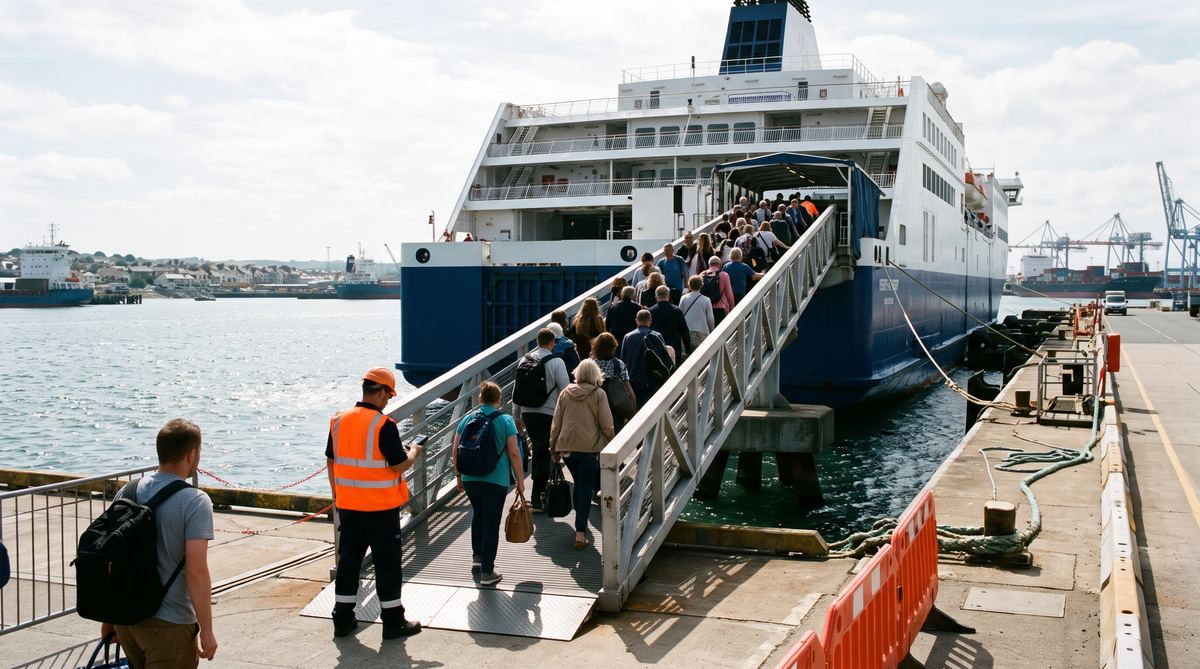
- Check at the gate. Staff scan the ticket or count people as they board, to align who is actually on board with who was expected.
- Manual collection. Paper forms or forms completed on board, useful as a fallback but slow and prone to transcription errors.
Counting at the gate is important even when the name is already known. Someone who has bought a ticket will not necessarily board, and someone who boards may not be on the list. Only the actual count shows how many people are really on board.
The typical flow, from sale to departure
An orderly flow has four stages: collection of data at sale, confirmation at check-in, counting at the gate, and closing the list before departure with a comparison between persons on board and certified capacity. The master receives the final total and the list is made available to those entitled to it.
If the number of people exceeds the limit, a clear procedure is needed: who decides, who disembarks, how it is communicated. Better to have it written down before finding yourself with a hundred people on the quay and a delayed departure.
Special cases: drivers, crew, minors and people with special needs
Every operator soon meets situations the basic model does not cover. It is useful to define in advance how to handle them, to avoid improvised decisions at the gate.
Vehicle and truck drivers
People travelling with a vehicle must be counted like everyone else. A truck driver who goes up onto the vehicle deck is a person on board, even if he or she does not pass through the passenger terminal. Processes that separate vehicle and pedestrian flows must therefore still report a single figure.
A different case is unaccompanied trailers: they carry no people, but must be recognised so they are not confused with a unit with a driver. We cover this in the guide to Ro-Ro and Ro-Pax ferries.
Crew and service staff
The crew are among the persons on board and fall within the total count. The muster list and crew lists have their own rules, but the overall number must include everyone. The same applies to service staff, suppliers and guests who board for work and leave before departure: clear rules are needed on who is registered and when they come off the list.
Children and infants
Minors often travel with an adult, and the rules treat them by age category. Small children and infants must be counted even when they have no assigned seat or paid ticket. The sales system must therefore keep track of them, otherwise the real number will always be higher than the number sold.
For minors travelling without their parents, specific procedures are needed, defined by the operator and, where required, by national rules. A named and documented escort is useful both for safety and for handling an emergency.
People who require assistance
Anyone with reduced mobility or other needs must be able to say so when booking. The information is used to prepare boarding, assign a suitable place and, in an emergency, know who needs help to evacuate. The European rules on the rights of disabled passengers sit alongside the registration rules.
GDPR and retention of passenger data
Passenger data is personal data and the GDPR applies. The legal basis for safety registration is normally a legal obligation, so consent is not needed for the name, but a clear privacy notice is needed explaining what is collected and why.
Some practical principles almost always apply:
- Limited purpose. Data collected for safety is not used for marketing without a separate legal basis.
- Short retention. The rules provide that data must not be kept longer than necessary: set a period and make sure it is really applied, automatically.
- Controlled access. Only those who need it for safety should be able to view the list, with a record of who opens it.
- Careful handling of health data. Assistance needs are optional and must be protected with more care than other fields.
The exact retention period and the recipients depend on national law and on your organisation, and must be agreed with the data protection officer. For a broader view of the subject, read the guide to maritime data privacy.
Common mistakes and penalties
Most problems do not stem from bad faith but from fragmented processes. The weak points recur in the same places.
- Different lists for different channels. Online ticketing, the counter and agencies sell on the same sailing without a single list.
- Wrong or missing names. Resold tickets, misspelt surnames, passengers boarding with someone else's ticket.
- Infants and escorts not counted. The total sold is lower than the real one.
- Counting done only once. The figure is taken at the terminal and not updated when late arrivals board.
- Data kept without limit. Old archives with names and sensitive data that nobody has any reason to keep.
Consequences depend on the country. In general, breaching the registration obligations may lead to administrative penalties, findings during inspections and, in the event of an accident, a serious impact on the operator's liability. Amounts and procedures are set at national level: ask your maritime authority.
Digital check-in and integration with booking
The most reliable system is one in which the name is created once, at sale, and travels without re-keying all the way to the boarding list. Every manual step is an opportunity for error and a slowdown in the minutes before departure.
A good digital flow combines a ticket with a QR code, verification at the gate with a handheld device and a count that updates in real time. The passenger feels guided, the crew see how many are still to board and the master receives a reliable total.
One aspect that is underestimated is connectivity. In many ports, particularly on islands, the signal is uncertain on the quay or at anchorage, and a tool that stops working when the network drops becomes a problem. You need a boarding tool that keeps working offline and synchronises as soon as possible.

How Software Simplifies Passenger Registration
The work becomes simpler when sales, boarding and the passenger list are one system. The SupaMaritime Ferry Booking (Supaferry) is designed for inter-island transport: it handles voyages with several calls and seats counted per leg, with online and counter bookings drawing on the same seats.
The module produces manifests per port call and boarding with QR scanning. The manifest shows the passengers for each call against certified capacity, with special needs and minors with their escorts, and boarding keeps working without signal and synchronises when the connection returns.
What the software does not do for you: decide which data your route requires, choose the channel by which you report it to the authority and set the retention periods. These are decisions to be made with the maritime authority and the data protection officer.
The SupaMaritime Ferry module, by contrast, covers maintenance, crew, rest hours and ship compliance, but not ticketing or bookings. Discover Ferry Booking and the Ferry module, or the pages for inter-island ferry companies and for high-speed ferries.
Frequently Asked Questions
What is Directive 98/41/EC?
It is the European directive on the registration of persons sailing on board passenger ships to and from ports of the Member States. It requires counting who is on board and, for longer crossings, registering some of their data, so that it is available in the event of search and rescue. It has been amended several times.
Is a passenger list mandatory on every crossing?
Counting the persons on board is always required. The obligation to also register names depends on the length and nature of the crossing and on national rules. Do not assume that a short route is exempt: check the rule that applies to your route.
Which passenger data must be registered?
Generally surname, first name, sex and age or age category. Information on special assistance or care is optional and is provided by the passenger. For each field, check the exact list provided for by the legislation in force and stick to it.
Do children and infants have to be counted too?
Yes. Everyone on board falls within the count, including children without an assigned seat or with a free ticket. The sales system must therefore record these passengers too, otherwise the actual number exceeds the number sold.
How long can passenger data be kept?
Only for as long as needed for the safety purpose. The precise period depends on national law and on the guidance of the data protection authority. Agree a short period with your data protection officer and delete the data automatically.
Is an electronic ticket with a QR code enough for registration?
A ticket with a QR code is a collection and control tool, it does not replace the obligation. It must contain, or be linked to, the required data, and the actual count at boarding must be reconciled with the list. Quality depends on the overall process.
In Conclusion
Registering passengers means being able to say, at any moment, how many people are on board and who they are. The European framework sets the principles, national transposition defines thresholds and arrangements, and it is up to the operator to organise a process that is simple, consistent and respectful of privacy.
If you run inter-island services and want a single flow from sale to boarding manifest, discover SupaMaritime Ferry Booking.