Classification Societies and Class Surveys: How They Work, IACS and the Survey Cycle
When an owner buys a ship, an underwriter quotes it or a charterer accepts it, one of the first questions is always the same: what class is she? A classification society sets the technical rules for building and maintaining a ship and checks, through periodic surveys, that those rules are being met.
For anyone running a fleet, class is not an administrative formality but a calendar of deadlines that shapes how the ship is employed, when she goes off-hire for technical stops and how the maintenance budget is spent. An overdue survey can lead to suspension of class, and without class almost no ship can be insured or chartered.
This guide explains what classification is and how it differs from statutory certification, who the IACS members are, how the survey cycle is structured, what conditions of class and class notations are, and how to organise preparation and the survey calendar in practice.
The key point: class is the common technical language between owner, underwriter, charterer and authorities. Keeping it in order means knowing in advance every survey, every open condition and every window available for dry-docking.
What a classification society is and what it does
A classification society, or simply class, is a technical organisation that publishes rules for the design, construction and maintenance of the hull, the machinery and the onboard systems. It reviews the drawings, supervises construction and then follows the ship throughout her operating life.
The outcome is the certificate of class: it states that the ship, as at the date of her last survey, complies with the society's rules and may retain her class. It is a private document in the legal sense, issued at the owner's request, but it carries enormous commercial weight.
The first societies appeared in the eighteenth and nineteenth centuries to help underwriters assess the risks of ships. Today the role is far broader, but the underlying function has not changed: to give those who finance, insure and charter a ship an independent technical opinion on her condition.
Class versus statutory certificates: what is the difference
This is the most common source of confusion. Class is a contractual relationship between the owner and the society; statutory certificates, on the other hand, are required by international conventions such as SOLAS and MARPOL and are issued, or caused to be issued, by the flag State.
Flag States may, however, delegate statutory surveys to recognised organisations (ROs). Many classification societies perform this role, under rules set at IMO level and in the relevant codes. This is why a single survey on board can serve both for class and for flag certificates.
| Aspect | Class | Statutory certification |
|---|---|---|
| Basis | The society's technical rules, requested by the owner | International conventions and the law of the flag State |
| Who decides | The classification society | The flag State, directly or through an RO |
| What it covers | Structure, machinery and essential systems, according to the society's rules | Safety, pollution prevention, load lines and other convention requirements |
| Who requires it | Underwriters, financiers, charterers | Flag authorities and port State control |
In practice, when a ship loses class, the validity of the statutory certificates issued by the same society on behalf of the flag may also be at risk. It is therefore sensible to treat the two spheres as a single calendar, bearing in mind that each flag has its own rules on who may certify and how.
What IACS is and who the main classification societies are
IACS (the International Association of Classification Societies) is the association that brings together the main classification societies and harmonises their rules and practices. It publishes unified requirements and resolutions that its members apply, including the Common Structural Rules for oil tankers and bulk carriers.
The members include, to name the best known:
- ABS (American Bureau of Shipping), based in the United States.
- Bureau Veritas, French.
- DNV, Norwegian.
- Lloyd's Register, British.
- ClassNK (Nippon Kaiji Kyokai), Japanese.
- RINA, Italian, the successor to the Registro Italiano Navale.
- Korean Register, China Classification Society, Indian Register of Shipping, Polish Register of Shipping and others.
The exact list of members can change over time: to find out who belongs to IACS today, check the association's website. There are also non-member societies on the market, which may have a role of their own but which underwriters and charterers assess case by case.
The Registro Italiano Navale is now part of the RINA group, which carries out both classification and other certification and consultancy activities. In everyday language in Italy, many people still use the old name to refer to the Italian classification society.
The class survey cycle: annual, intermediate and special
Class is maintained through a cycle of surveys that normally repeats every five years. The pivot of the cycle is the renewal survey, known as the special survey, around which the others are arranged. The exact dates are shown on the certificate of class and in the documents the society sends to the owner.
The main surveys are listed below. The detailed rules, the length of the periods and the tolerances vary from society to society and by ship type, so the reference is always the rules of your own class.
| Survey | Indicative frequency | What is generally checked |
|---|---|---|
| Annual (annual survey) | Every year, within a window around the anniversary date, normally three months either side | General condition of hull, machinery and systems, with the ship in service |
| Intermediate (intermediate survey) | Between the second and third anniversary of the cycle | More extensive checks than the annual survey, with tests and inspection of selected areas |
| Special or renewal (special/renewal survey) | About every five years | Complete examination of hull and machinery, with thickness measurements and openings |
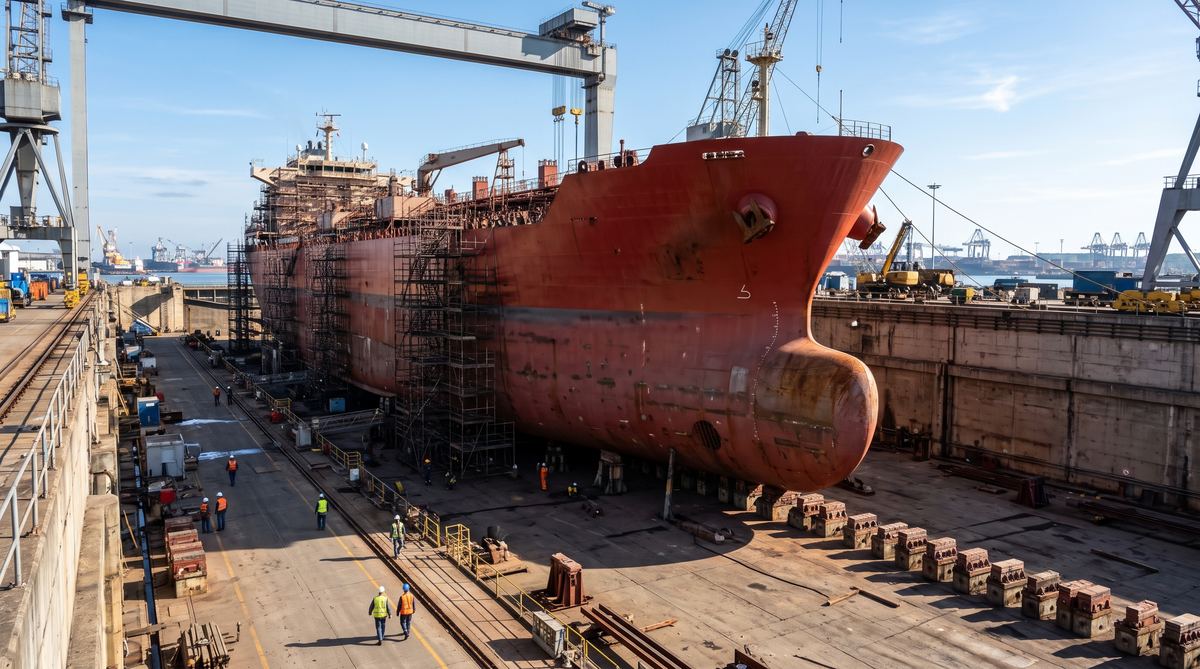
| Out of water (docking, bottom survey) | Twice in five years, with the maximum interval between surveys set by the society | Hull, rudder, sea chests, propeller, anodes |
| Propeller shaft (tailshaft survey) | Depending on the type of shaft and the lubrication and sealing arrangements | Propeller shaft, bearings, seals |
| Boilers (boiler survey) | According to the society's rules and the type of boiler | Internal and external condition, safety valves, control equipment |
Tankers and bulk carriers are also subject to enhanced hull inspection programmes, known as the Enhanced Survey Programme (ESP), with thickness measurements and structural checks that increase with the age of the ship. The additional checks lengthen the time spent in the yard accordingly.
Continuous and planned surveys: how the workload is spread
Opening up and inspecting everything in one go would be unthinkable for a ship in service. For this reason societies offer continuous survey schemes, in which the work of the five-year cycle is spread across several interventions, each with its own due date.
Schemes of this kind exist for the hull and for the machinery, along with a variant in which the owner's maintenance plan is recognised by the society, as with planned maintenance schemes for machinery. The details depend on the society and on the approval of the ship, so they must be agreed and documented.
The advantages are concrete:
- Less concentration of work. Items are spread across the cycle instead of all landing in the same yard period.
- Less downtime. Many activities are carried out in port during operations, with a surveyor attending the openings.
- Greater discipline. Every due date is a fixed date, so an overdue item shows up immediately.
The downside is that deadlines multiply. Anyone using a continuous plan without a shared calendar risks forgetting a single item and ending up with an overdue entry, with the consequences described below.
Conditions of class, recommendations and memoranda
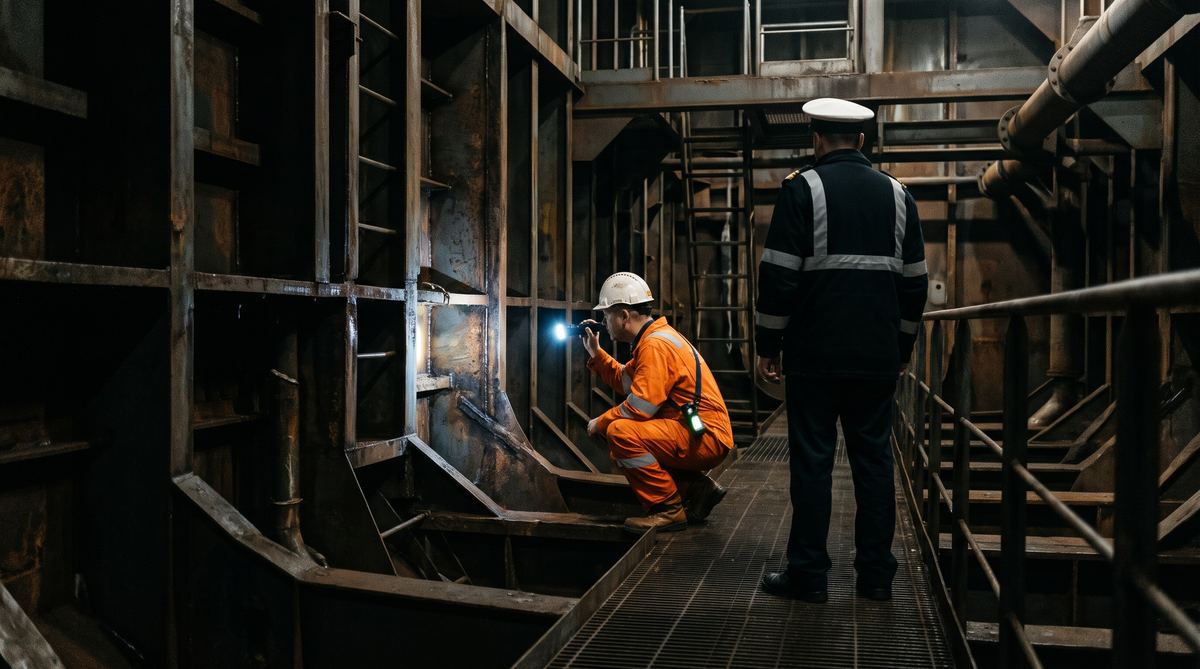
During a survey the surveyor may find a defect or wastage that does not prevent the ship from sailing but requires action within a certain time. The finding is formalised as a condition of class, which some societies also call a recommendation.
A condition of class is an obligation with a deadline: if it is not met by the due date, class may be suspended. The deadline depends on the seriousness of the finding and may be set for the next port, for a specific date or for the next survey.
Memoranda, by contrast, are informational notes: they flag a situation to keep under observation, for example an operating limitation or something to look at during the next survey, without constituting an obligation with a deadline. They should still be read, though: anyone buying a ship will find them in her class history.
For day-to-day management it is best to keep a single list, updated after every survey, with three fields for each item: what is required, by when and who is responsible. Lists scattered across several folders are the typical cause of forgotten conditions.
Class notations: what the codes on the certificate mean
In addition to the basic class, the certificate shows the notations (class notations): codes that describe the type of ship, the intended service or additional requirements met. The exact meaning is defined by each society's rules and is not identical from one society to another.
In general terms, notations fall into these groups:
- Ship type. Bulk carrier, oil tanker, container ship, offshore vessel and so on, which determines the applicable rules.
- Service or navigation area. Restrictions or extensions, for example navigation in ice.
- Additional requirements. For example equipment or systems that go beyond the minimum, or compliance with a particular inspection programme.
- Systems and automation. Some notations concern the machinery, unattended machinery space operation or other systems.
Notations have commercial consequences: a charterer may require a specific one, and a change of trade may call for a new notation or an upgrade. Before changing service, check with the society.
Why class matters: insurance, chartering and Port State Control
Class is the gateway to many commercial activities. Anyone who loses it, even temporarily, loses more than a certificate.
- Insurance. Hull and machinery cover and liability cover generally assume that the ship is classed with a recognised society. Check the clauses of your own policy.
- Chartering. Charter parties usually require the ship to maintain class and be free of overdue conditions. Loss of class can be grounds for breach or off-hire, depending on the contract.
- Finance and sale. Banks and buyers check the status of class and of surveys falling due. An imminent renewal survey affects the price.
- Port State control. PSC inspectors check that certificates and surveys are current. Suspended class or overdue items are among the findings that quickly make an inspection worse. The subject is covered in the guide to Port State Control and inspections.
Change of class and suspension: what happens and how to avoid it
A ship can change classification society, for example after a sale or for commercial reasons. The transfer of class follows rules laid down by IACS: the incoming society normally requires the documentation and may carry out surveys before accepting the ship.
Class may be suspended or withdrawn if a survey is not completed within the time limits, if a condition of class remains open beyond its due date, or if the ship suffers damage or an unapproved modification. In many cases the society can grant an extension, but only for justified reasons and with its written authorisation, never automatically.
To avoid problems:
- Report every damage. Groundings, collisions and damage to machinery or hull must be reported to the society, which decides whether a survey is needed.
- Do not modify without approval. Major conversions and repairs require approval of the drawings.
- Request extensions in good time. A request submitted before the due date, with the reasons, carries very different weight from one submitted afterwards.
How to prepare for a class survey
A well-prepared survey takes less time and holds fewer surprises. Preparation starts months in advance, especially for renewal surveys and dry-dockings. The planning of yard work is covered in the guide to dry-docking for commercial ships.
- Agree the date and place with the society. If the survey takes place in a port other than the usual one, the surveyor must be booked well ahead.
- Prepare the documents. Reports from previous surveys, the list of open conditions, maintenance records, past thickness measurements and approvals of modifications.
- Make the spaces safe. Tanks ventilated and tested for entry, scaffolding and lighting ready, work permits in order.
- Carry out an internal inspection first. Report in advance what you already know: a declared defect with a repair plan is handled better than one discovered during the survey.
- Plan for spares and crews. If an item requires repairs, having materials and technicians ready avoids prolonging the stay.
A special case is condition-based maintenance, which, with the society's confirmation, can in some cases replace part of the scheduled openings. The subject is addressed in the article on the ROI of predictive maintenance in shipping.

How Software Simplifies Managing the Class Calendar
A fleet's class calendar interweaves annual, intermediate and special surveys, open conditions, statutory deadlines and dry-dockings. Keeping it in separate spreadsheets works as long as the ships are few and the people do not change.
The SupaMaritime Merchant module brings together, in a single environment, planned maintenance by calendar or running hours, work orders, breakdowns, ship certificates and ISM and ISPS items, along with MARPOL and ballast water records. In practice it helps you to:
- See certificate expiry dates. With alerts before a survey or certificate falls due.
- Link maintenance and surveys. Scheduled jobs and work orders stay tied to the ship and her history.
- Document breakdowns. A tidy record of events helps you decide what to report to the society.
- Share status between office and ship. Whoever plans a dry-docking sees the same information as whoever answers for it on board.
Software does not replace the classification society or the surveyor's judgement: it is there so that you never arrive at a survey without knowing what is falling due. You will find the detail in the features of the Merchant module and in the pages for operators of offshore vessels and bulk carriers.
Frequently Asked Questions
What is the difference between a classification society and the flag State?
The flag State is the State in which the ship is registered and which answers for her at international level. A classification society is a private technical body that sets and verifies the rules for hull and machinery. Often the flag delegates statutory surveys to the society as a recognised organisation.
What is IACS?
It is the international association of the main classification societies. It harmonises technical rules, publishes unified requirements and defines common procedures, such as those for the transfer of class. The up-to-date list of members is on the association's website.
How often is a class survey carried out?
The cycle is normally five years, with annual surveys, one intermediate and one special renewal survey, in addition to the dry-dockings. Tolerances and detailed frequencies depend on the society and the ship type: the certificate and the rules of your own class are what count.
What happens if a ship loses class?
As a rule she loses her insurance cover and the ability to be chartered, and risks problems with the flag and with port State control. To regain class, the missing surveys must be carried out and the open conditions satisfied, with the time and cost that this involves.
Does the Registro Italiano Navale still exist?
The society now operates as RINA, which is the Italian IACS member and has taken the place of the Registro Italiano Navale. Many people in Italy still use the old name to refer to Italian class.
Can you change classification society?
Yes, through a transfer of class. The incoming society asks for the documentation and surveys before accepting the ship, often in coordination with the outgoing one. It is best to plan it around a survey that is already falling due, to avoid duplicating the work.
Final Thoughts
Class is the thread that ties together hull, machinery, insurance and chartering. Those who treat it as a shared calendar rather than a series of surprises reduce unplanned downtime and arrive at surveys with a clear picture.
Detailed rules, tolerances and extensions must always be checked with your own classification society and with the flag. If you want to keep deadlines, certificates and maintenance together, discover the SupaMaritime Merchant module.