Ship IMO Number: What It Is, How to Find It and How It Differs from MMSI and Call Sign
A ship changes name, flag, owner and even the colour of its hull. The IMO number does not: it stays the same for the whole life of the hull, which is why it has become the key by which the industry recognises a ship unambiguously.
Yet confusion is frequent in the office. The IMO number is mistaken for the MMSI transmitted by AIS, for the international radio call sign or for the official registration number. They are four different identifiers, assigned by different bodies and with different rules for changing. Confusing them means getting wrong an agency appointment, a pre-arrival declaration or a sanctions check.
This guide explains what the IMO number is, which ships must have one, where it is marked, how to verify it and how to find it. We then look at the difference from the MMSI, call sign and official number, its uses in compliance and chartering, and why company systems should identify ships by IMO and not by name.
The ship's name is a label that changes; the IMO number is the identity of the hull. Anyone managing fleets, port calls or charters should use the IMO as the unique key and treat name, flag and MMSI as attributes that can vary over time.
What the IMO number is and why it exists
The IMO ship identification number is a seven-digit code preceded by the letters "IMO", for example "IMO 9074729". It is assigned to the hull and stays with it for its whole life, regardless of name, flag, ownership, managing company and classification society.
The scheme grew out of the numbering that for decades was used by the major commercial ship registers, in particular Lloyd's Register. The International Maritime Organization (IMO) adopted it as an international system and later made it mandatory for ships within the scope of the SOLAS Convention.
The reason is practical. There are many ships with similar names, transliterations differ from country to country and a renamed ship can slip past a controller. A permanent identifier makes it harder to hide the history of a hull and makes the following easier:
- Fraud prevention. It is easier to trace the history of a ship that has changed name or flag several times.
- Safety and controls. Port and flag authorities link inspections, deficiencies and accidents to the same unit over time.
- Ownership traceability. Hull, registered owner and managing company are linked without relying on the name alone.
- Data exchange. Ports, terminals, insurers and classification societies use the same reference.
Which ships must have an IMO number
The obligation derives from chapter XI-1 of the SOLAS Convention, devoted to special measures to enhance maritime safety. In general terms, the requirement covers passenger ships of 100 gross tonnage and above and cargo ships of 300 gross tonnage and above engaged on international voyages.
The IMO scheme allows the number to be assigned to other units as well, for example medium-to-large fishing vessels, and in practice registers, insurers and authorities use it outside the mandatory scope too. For borderline cases, such as tugs, offshore units or small-tonnage ships, check with the flag administration or the classification society.
A useful detail: the number is normally assigned during construction, at the request of the shipyard or the classification society to the body appointed by the IMO to manage the numbering. Whoever buys a second-hand ship therefore inherits an existing number, which must not be requested again.
How the IMO number is made up: seven digits and a check digit
The first six digits are a sequence assigned in order; the seventh is a check digit calculated from the others. It serves to catch the most common typing errors, before consulting any database.
The calculation is simple. Multiply the first six digits by the weights 7, 6, 5, 4, 3 and 2, in that order, add up the products and the last digit of the result must match the seventh digit of the number.
With the example number 9074729 the calculation is: 9×7 = 63, 0×6 = 0, 7×5 = 35, 4×4 = 16, 7×3 = 21, 2×2 = 4. The sum is 139, the last digit is 9 and it matches the final digit. A number that fails this test is most likely written wrongly.
The check digit does not guarantee that the number really exists, but it catches many transcription errors, such as a wrong digit or two swapped: it is best applied as soon as the data is entered.
Where the IMO number is marked on the ship
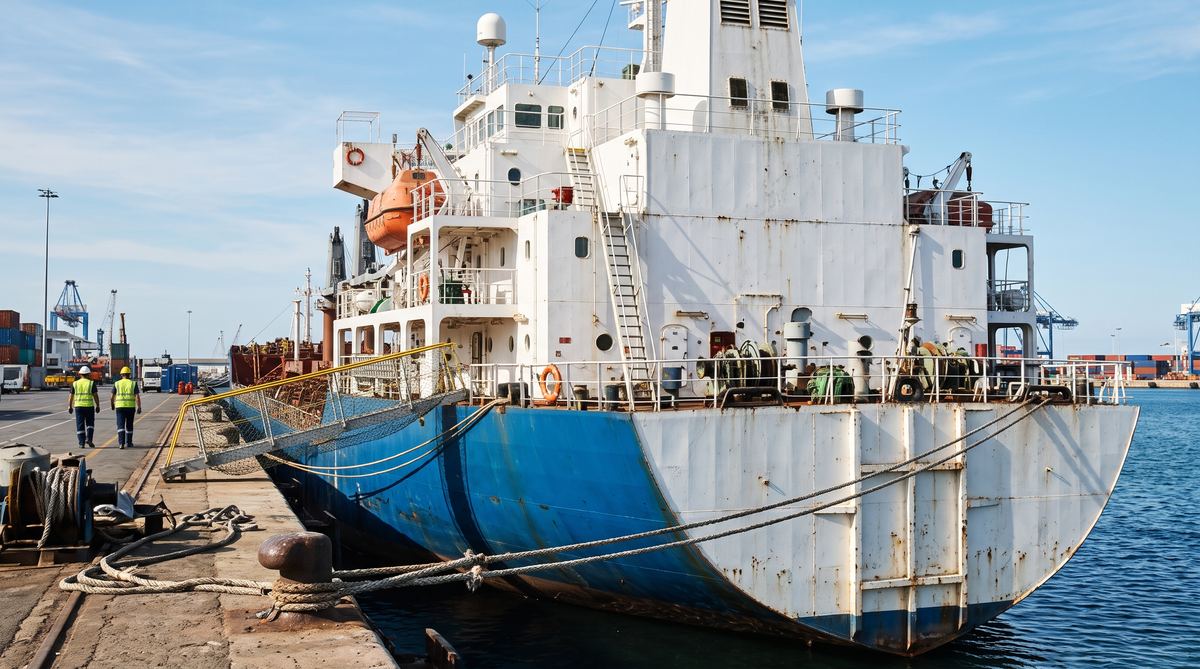
SOLAS requires the number to be permanently marked, in clearly visible characters of a colour contrasting with the background, in two distinct places. The exact arrangement should be checked in the current text, but in summary the following are provided for:
- External marking. In a clearly visible place, for example at the stern, on both sides of the hull amidships above the highest assigned load line, or on the sides or front of the superstructure. On passenger ships a horizontal surface visible from the air is also provided for.
- Internal marking. In an easily accessible place, for example on an end transverse bulkhead of the machinery spaces, on a hatchway or, on tankers, in the pump room. On ships with ro-ro spaces it is provided on an end bulkhead of those spaces.
The internal marking has a precise purpose: the number stays legible even if a ship is repainted or the exterior is altered. For the inspector or surveyor who has to verify the identity of a hull, it is the most reliable confirmation.
The number also appears on all statutory and class certificates, on the Continuous Synopsis Record and on the hull's archive documents. In the Continuous Synopsis Record, the record that summarises the ship's history by flag, ownership and company, the IMO number provides the common thread even when everything else changes.
The IMO number of the owner and of the managing company
Besides the ship, the international scheme also identifies with a seven-digit number the company managing the ship (the company, in the sense of the ISM Code) and the registered owner. These numbers differ from that of the hull and from each other.
The distinction matters because in shipping ownership chains are often long. The registered owner may be a special-purpose company that owns a single ship, while commercial and technical management lie with different companies, sometimes in different jurisdictions.
Whoever carries out a counterparty check, for example before accepting a new charterer or releasing a payment, should therefore know three items:
- The ship's IMO number. Identifies the hull.
- The company's IMO number. Identifies who assumes management responsibility for the purposes of the ISM Code, and normally also appears on the Document of Compliance and the safety management certificate.
- The registered owner's IMO number. Identifies the formal holder of the ship.
If you want to look further into the role of the managing company and the safety system, we have explained the ISM Code in practice with DPA and audits.
IMO number, MMSI, call sign and official number: what is the difference?
The IMO number identifies the hull; the other three codes identify the ship as a unit entered in a register or as a radio station. That is why they change when the flag changes, while the IMO does not.
| Identifier | What it identifies | Who assigns it | Does it change with the flag? | Where it is used |
|---|---|---|---|---|
| IMO number | The hull, for its whole life | Body appointed by the IMO, normally at construction | No | Certificates, inspections, charters, compliance, sanctions |
| MMSI | The ship's radio and AIS station (nine digits) | The flag administration | Yes, it is generally reassigned | AIS, digital selective calling (DSC), distress |
| Call sign | The ship's radio station | The flag administration | Yes | Radio communications, port call documents |
| Official number | Entry in the flag register | The register of registry | Yes | Title deeds, mortgages, national documents |
MMSI: the radio and AIS identity
The MMSI (Maritime Mobile Service Identity) is a nine-digit code. The first three, known as the MID (Maritime Identification Digits), indicate the country of assignment. It is programmed into the shipboard equipment and transmitted by AIS and by digital selective calling.
If a ship changes flag, the MMSI normally changes with it. For this reason, in a tracking system, a change of MMSI without a change of IMO does not indicate a new ship, but the same ship in a new guise.
Call sign and official number
The international call sign is the ship's radio identifier, with a prefix indicating nationality. The official number, by contrast, is the one under which the ship is entered in the flag register and is the reference for title deeds, mortgages and national documents.
How to find a ship's IMO number
When a ship is known only by name, the safest way to trace its IMO is to start from a document of the ship itself. The sources, in order of reliability, are usually these:
- Shipboard certificates. The statutory and class certificates, the Continuous Synopsis Record and the certificate of registry show the IMO number.
- Port call and charter documents. The pre-arrival request, the crew list, FAL declarations and charter recaps normally state it next to the name.
- AIS signal. Among the static data periodically transmitted by the ship are name, call sign, ship type and IMO number. A tracking application shows it together with the position.
- Public and commercial databases. There are ship registers, databases of port authorities and flag registers, and professional databases that allow searching by name, call sign or MMSI.
- Marking on the hull. On site, the side or stern shows the number, and it can be compared with the one declared in the documents.
Do not trust a single source. If the number in a document and the one in a database do not match, or if the check digit does not add up, ask the master or the managing company for confirmation before proceeding.
What the IMO number is used for in compliance, chartering and port calls
The IMO number runs through almost every process in a company. If it is missing or wrong, the problem emerges at the least convenient moment: at the quay, in a counterparty check or in an inspection.
Sanctions and due diligence
Sanctions lists, which name ships subject to restrictions, normally show the IMO next to the name. For whoever checks a ship before a charter or a payment, the IMO is the only truly reliable data point, because name and flag can be changed.
The risk is real: identity falsification practices exist, including the use of another ship's name or details and the manipulation of AIS signals. A serious check compares IMO, history of names and flags, registered ownership and consistency of position data. For decisions involving legal risk, consult a professional and your compliance advisors.
Charters, insurance and class
A charter recap, a policy or a class certificate must identify the ship precisely. The name alone seems enough until a ship is renamed in the middle of a contract: the IMO makes it possible to show that it is always the same hull being discussed.
Classification societies and insurers record surveys, class conditions and claims on the basis of the same number.
Port calls, formalities and port controls
Pre-arrival notifications, FAL declarations and communications to single windows give the IMO to identify unambiguously the ship about to enter port. In our article on the maritime single window we explain how these declarations are submitted.
Port state controls are also based on the identity of the ship: inspections, deficiencies and detentions are recorded against the IMO. To understand what happens in an inspection, see the guide to Port State Control.
Data errors: why systems must use the IMO as the key
Data quality problems on ships are almost always of the same kind. The name is recorded, and the name is the least stable attribute of all.
- Name changes. A renamed ship appears as a second ship in spreadsheets and archives, with history, certificates and costs split in two.
- Similar names and transliterations. Ships with the same name, prefixes such as "MV" or "MT" entered or omitted, different spaces and hyphens create duplicates and wrong cross-matches.
- Typing errors. A single wrong digit can point to another ship that really exists, and the error goes unnoticed.
- MMSI and call sign used as the key. When the flag changes, the link between historical and new data is lost.
- Numbers pasted without checking. Data copied from emails or PDFs with extra spaces, letters or leading zeros.
The design rule is simple: in databases, port call sheets and integrations, the ship is identified by IMO number and the check digit is verified on entry. Name, flag, MMSI and call sign become attributes with a validity date, of which history is kept.
For units without an IMO number because they fall outside the scope, an internal identifier is defined and the reason is noted, rather than forcing an invented number.
How Software Simplifies Ship Identity Management
A stable identifier is useful only if every process uses it. The SupaMaritime Merchant module gathers in a single app, for each ship, maintenance, crew, certificates with expiry alerts and compliance records such as ISM, ISPS, MARPOL and ballast water. Having a single record per ship prevents the same data from living in spreadsheets under different names.
For those working on port calls, the SupaMaritime Agent module with the Pro Plan offers ship data starting from the IMO number, AIS positions on every port call and the port radar of approaching ships. This way the agent starts from the IMO and not from the name when updating the principal.
If you are interested in tracking, you will find the overall picture on the page dedicated to vessel tracking software and, for performance monitoring, in the article on performance monitoring software.
Frequently Asked Questions
Does the IMO number change if the ship changes name or flag?
No. The IMO number is tied to the hull and does not change with name, flag, ownership or managing company. The MMSI, call sign and official number do change, since they depend on the flag and the register of registry.
What is the difference between the IMO number and the MMSI?
The IMO number identifies the hull and is permanent. The MMSI is the nine-digit code of the ship's radio and AIS station, assigned by the flag administration and normally changed when the ship changes flag.
For a company database the right key is the IMO, while the MMSI is a useful attribute for correlating AIS data.
Do all ships have an IMO number?
No. For passenger and cargo ships on international voyages above certain gross tonnage thresholds the number is mandatory under SOLAS. Many smaller units, pleasure craft or small fishing vessels may not have one. If in doubt, ask the flag administration or the classification society.
How do you check that an IMO number is correct?
The first check is the check digit: multiply the first six digits by 7, 6, 5, 4, 3 and 2, add up the products and verify that the last digit of the total matches the seventh digit.
Then confirm that name, flag and ship type match those on the certificates or in a reliable database.
Can the IMO number be used to search for a ship?
Yes, and it is the most reliable way. Ship registers, port authority databases and AIS tracking applications allow searching by IMO. A search by name may return ships with the same name or confused histories, whereas the IMO leads to a single hull.
What is the owner's IMO number?
It is a seven-digit number, distinct from the ship's, that identifies the company managing the ship for the purposes of the ISM Code and the registered owner. It helps to reconstruct ownership chains and carry out counterparty checks.
In Conclusion
The IMO number is the only identifier that follows the hull for its whole life. MMSI, call sign and official number serve specific purposes and change with the flag, and the name changes whenever the owner decides. Whoever bases processes and archives on these unstable attributes sooner or later ends up with duplicates, orphaned certificates and incomplete checks.
The solution is methodical, not complicated: a single key by IMO, check digit verification on entry, history of the other attributes. To bring this order to the daily management of maintenance, crew and compliance, discover the SupaMaritime Merchant module.